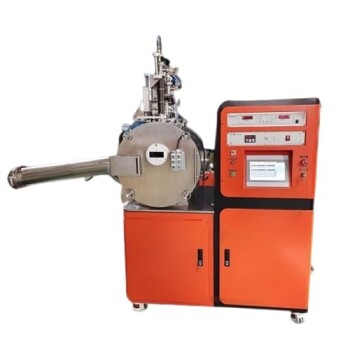
Choosing the right furnace technology is the deciding factor in the manufacturability of large-scale ceramic components. When producing large-sized boron carbide parts, utilizing a vacuum furnace for reaction sintering offers superior dimensional control and significantly lower thermal requirements compared to pressure sintering methods.
Core Takeaway Reaction sintering in a vacuum furnace enables near-net-shape manufacturing with dimensional changes of less than 1%. By operating at temperatures 350–550 degrees Celsius lower than pressure sintering, it reduces equipment strain and drastically improves the yield of large, complex precision components.
Achieving Precision at Scale
Superior Dimensional Stability
For large-sized components, even minor shrinkage rates can result in significant absolute dimensional errors.
A vacuum furnace utilized for reaction sintering mitigates this risk by ensuring dimensional changes remain extremely small, typically less than 1 percent.
Near-Net-Shape Capabilities
This high degree of stability supports "near-net-shape" forming technology.
Manufacturers can produce complex geometries that require minimal post-process machining, which is often difficult and costly with hard ceramic materials like boron carbide.
Thermal Efficiency and Equipment Demands
Significantly Lower Operating Temperatures
Reaction sintering in a vacuum furnace requires temperatures ranging from 1450 to 1650 degrees Celsius.
This is a substantial reduction compared to pressureless or hot-press sintering, which often demands temperatures exceeding 2000 degrees Celsius.
Reduced Equipment Strain
lowering the peak temperature requirement relaxes the stringent thermal resistance specifications for the manufacturing equipment.
This reduction in thermal stress extends the lifespan of the furnace components and lowers the capital investment required for high-temperature insulation and heating elements.
Improving Component Yield
High-pressure and extreme-temperature environments often lead to higher rejection rates for large parts due to thermal shock or deformation.
The moderate conditions of vacuum reaction sintering significantly improve the yield of large-sized precision ceramic components.
Understanding the Trade-offs
While vacuum reaction sintering excels in precision and forming, it is important to recognize where pressure sintering (Hot Press) holds advantages.
Density and Mechanical Strength
Pressure sintering furnaces are designed to apply physical force during the heating process.
This promotes the densification of ceramic materials, potentially resulting in higher product strength and superior mechanical performance compared to reaction sintering.
Production Speed
Hot press sintering typically offers a shorter sintering time.
If the primary goal is rapid cycle times and maximum theoretical density rather than geometric complexity or size, pressure sintering provides high production efficiency.
Making the Right Choice for Your Project
Selecting the correct furnace depends entirely on whether your priority is the geometry of the part or the density of the material.
- If your primary focus is Precision and Size: Choose vacuum reaction sintering to produce large, complex-shaped components with minimal distortion and high yield.
- If your primary focus is Material Strength: Choose pressure sintering to achieve maximum material densification and superior mechanical properties.
Ultimately, for large-scale precision ceramics, vacuum reaction sintering provides the balance of control and efficiency needed to make production viable.
Summary Table:
| Feature | Vacuum Reaction Sintering | Pressure Sintering (Hot Press) |
|---|---|---|
| Sintering Temp | 1450°C – 1650°C (Lower) | > 2000°C (Higher) |
| Dimensional Change | < 1% (Minimal shrinkage) | Significant shrinkage |
| Geometry Support | Complex, Near-net-shape | Simpler shapes |
| Primary Strength | Dimensional Precision & Yield | Density & Mechanical Strength |
| Equipment Strain | Low thermal stress | High thermal/mechanical stress |
Optimize Your Advanced Ceramic Production with KINTEK
Are you manufacturing large-scale precision components? At KINTEK, we understand that the right furnace technology is critical to your project's success. Whether you need the extreme dimensional control of a vacuum furnace for reaction sintering or the high-density results of hot-press systems, our team provides the high-performance laboratory equipment and consumables you need.
From high-temperature vacuum, muffle, and tube furnaces to hydraulic presses (hot, isostatic, and pellet) and high-quality crucibles, KINTEK specializes in comprehensive solutions for material science. Our portfolio also extends to crushing and milling systems, cooling solutions, and specialized battery research tools.
Maximize your yield and achieve superior material performance. Contact us today to discuss your specific requirements!
References
- Wenhao Sha, Qing Huang. Effect of Carbon Content on Mechanical Properties of Boron Carbide Ceramics Composites Prepared by Reaction Sintering. DOI: 10.3390/ma15176028
This article is also based on technical information from Kintek Solution Knowledge Base .
Related Products
- 600T Vacuum Induction Hot Press Furnace for Heat Treat and Sintering
- Vacuum Heat Treat and Molybdenum Wire Sintering Furnace for Vacuum Sintering
- Small Vacuum Heat Treat and Tungsten Wire Sintering Furnace
- Vacuum Heat Treat Sintering Brazing Furnace
- Vacuum Heat Treat and Sintering Furnace with 9MPa Air Pressure
People Also Ask
- What role does an induction vacuum hot pressing furnace play in sintering? Achieve 98% Density in Carbide Blocks
- What advantages does a vacuum hot press furnace provide for LSLBO ceramic electrolytes? Achieve 94% Relative Density
- What role does a Vacuum Hot Press (VHP) furnace play in the densification of austenitic stainless steel 316 composites?
- What role does mechanical pressure play during the vacuum diffusion bonding of tungsten and copper? Keys to Solid Bonding
- What are the advantages of a vacuum hot press furnace for W-50%Cu? Achieve 99.6% Density at Lower Temperatures