Knowledge What are the advantages of using an agate mortar for manual mixing? Protect Particle Integrity in Solid-State Batteries
Author avatar

Tech Team · Kintek Solution

Updated 1 day ago

What are the advantages of using an agate mortar for manual mixing? Protect Particle Integrity in Solid-State Batteries


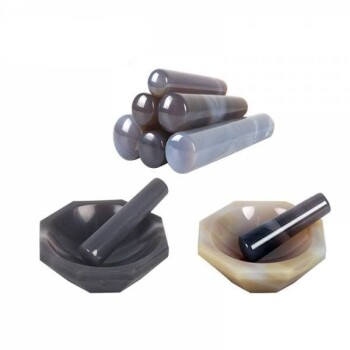
The primary advantage of using an agate mortar is its ability to facilitate uniform dispersion without applying destructive mechanical stress. Unlike mechanical mixing, which often utilizes high shear forces, manual mixing with an agate mortar preserves the structural integrity of fragile active materials (like NCM-811) while ensuring solid electrolytes (such as LPS or LATP) are not excessively deformed.

Core Insight: The success of a solid-state battery relies heavily on the quality of the solid-solid interfaces. Manual mixing with an agate mortar allows you to establish the necessary ion channels through sufficient contact, without shattering the active particles or introducing metallic contaminants that degrade high-voltage performance.

Preserving Microstructural Integrity

Avoiding Excessive Shear Forces

Mechanical mixing methods often rely on high-energy impact or shear to blend components. Manual mixing significantly reduces this physical stress.

By controlling the pressure applied via the pestle, you avoid the excessive mechanical shear forces that are inherent to automated milling processes.

Protecting Active Material Particles

High-nickel materials, such as NCM-811, are particularly sensitive to physical processing.

Using an agate mortar ensures these active material particles remain intact during the mixing phase. This prevents particle fracture, which can lead to capacity loss and poor cycle life.

Preventing Electrolyte Deformation

Solid electrolytes like LPS or LATP require careful handling to function correctly.

Gentle manual mixing ensures these electrolytes are distributed evenly to form ion channels, rather than being crushed or excessively deformed, which can impede ionic conductivity.

Achieving Purity and Uniformity

Facilitating Uniform Dispersion

Despite being a manual process, the use of an agate mortar is highly effective for dispersing components.

The smooth surface of the mortar, combined with the motion of the pestle, facilitates the uniform dispersion of active materials within the solid electrolyte matrix. This is critical for establishing consistent ionic and electronic conductive networks throughout the composite electrode.

Ensuring Chemical Inertness

A distinct advantage of agate is its material properties: high hardness and chemical inertness.

Mechanical mixers, particularly those using steel components, can introduce metallic contaminants into the mixture. Agate eliminates this risk, preventing the introduction of impurities that are harmful to high-voltage cathode materials.

Understanding the Trade-offs

The Consistency Challenge

While manual mixing offers superior protection for particle integrity, it introduces the variable of human technique.

Achieving perfectly reproducible results between different batches can be difficult, as the mixing energy depends on the operator rather than a calibrated machine setting.

Scalability Limitations

The agate mortar approach is inherently limited to small-scale preparation.

For large-scale manufacturing, the time and effort required for manual mixing become prohibitive, necessitating a transition to mechanical methods that—while faster—must be carefully tuned to mimic the gentle nature of manual mixing.

Making the Right Choice for Your Goal

To determine whether manual mixing with an agate mortar is the correct approach for your specific application, consider your current development stage:

  • If your primary focus is fundamental research or prototyping: Prioritize the agate mortar to eliminate contamination variables and ensure the intrinsic properties of your materials are being tested, not the artifacts of processing damage.
  • If your primary focus is preserving high-voltage stability: Use the agate mortar to guarantee zero metallic contamination, which is often the silent killer of high-voltage cathode performance.

Ultimately, the choice of mixing method defines the quality of the solid-solid interface, which is the single most critical factor in solid-state battery performance.

Summary Table:

Feature Manual Agate Mixing Mechanical Mixing
Material Stress Low / Controlled High Shear / Impact
Particle Integrity High (Prevents Fracturing) Risk of Crushing
Purity High (Chemically Inert) Potential Metallic Contamination
Interface Quality Excellent Solid-Solid Contacts Variable due to Deformation
Scalability Limited (Research Scale) High (Industrial Scale)
Primary Use R&D, Prototyping Large-Scale Manufacturing

Elevate Your Material Research with KINTEK Precision

Precise material preparation is the foundation of breakthrough battery technology. KINTEK specializes in providing high-quality laboratory equipment and consumables designed for the most demanding research environments. Whether you need high-purity agate mortars and crushing systems to preserve delicate microstructures like NCM-811, or advanced high-temperature furnaces, hydraulic presses, and battery research tools, we have the expertise to support your workflow.

Our value to you:

  • Purity Guaranteed: Eliminate contamination in your high-voltage cathode materials.
  • Structural Integrity: Tools designed to establish perfect ion channels without destructive stress.
  • Comprehensive Solutions: From solid-state electrolyte processing to ULT freezers and vacuum furnaces, we cover your entire lab footprint.

Ready to achieve superior solid-solid interfaces and enhance your battery performance? Contact KINTEK today for a customized consultation!

Related Products

People Also Ask

Related Products

Laboratory Single Horizontal Jar Mill

Laboratory Single Horizontal Jar Mill

KT-JM3000 is a mixing and grinding instrument for placing a ball milling tank with a volume of 3000ml or less. It adopts frequency conversion control to realize timing, constant speed, direction change, overload protection and other functions.

Laboratory Ten-Body Horizontal Jar Mill for Lab Use

Laboratory Ten-Body Horizontal Jar Mill for Lab Use

The Ten-body horizontal jar mill is for 10 ball mill pots (3000ml or less). It has frequency conversion control, rubber roller movement, and PE protective cover.

High Energy Planetary Ball Mill for Laboratory Horizontal Tank Type Milling Machine

High Energy Planetary Ball Mill for Laboratory Horizontal Tank Type Milling Machine

KT-P4000H uses the unique Y-axis planetary motion trajectory, and utilizes the collision, friction and gravity between the sample and the grinding ball to have a certain anti-sinking ability, which can obtain better grinding or mixing effects and further improve the sample output.

High Energy Planetary Ball Mill Milling Machine for Laboratory

High Energy Planetary Ball Mill Milling Machine for Laboratory

The biggest feature is that the high energy planetary ball mill can not only perform fast and effective grinding, but also has good crushing ability

High Energy Planetary Ball Mill Milling Machine for Laboratory

High Energy Planetary Ball Mill Milling Machine for Laboratory

Experience fast and effective sample processing with the F-P2000 high-energy planetary ball mill. This versatile equipment offers precise control and excellent grinding capabilities. Perfect for laboratories, it features multiple grinding bowls for simultaneous testing and high output. Achieve optimal results with its ergonomic design, compact structure, and advanced features. Ideal for a wide range of materials, it ensures consistent particle size reduction and low maintenance.

Manual High Temperature Heated Hydraulic Press Machine with Heated Plates for Lab

Manual High Temperature Heated Hydraulic Press Machine with Heated Plates for Lab

The High Temperature Hot Press is a machine specifically designed for pressing, sintering and processing materials in a high temperature environment. It is capable of operating in the range of hundreds of degrees Celsius to thousands of degrees Celsius for a variety of high temperature process requirements.

Small Injection Molding Machine for Lab Use

Small Injection Molding Machine for Lab Use

The small injection molding machinehas fast and stable movements; good controllability and repeatability, super energy saving; the product can be automatically dropped and formed; the machine body is low, convenient for feeding, easy to maintain, and no height restrictions on the installation site.

Custom PTFE Teflon Parts Manufacturer Corrosion Resistant Cleaning Rack Flower Basket

Custom PTFE Teflon Parts Manufacturer Corrosion Resistant Cleaning Rack Flower Basket

The PTFE cleaning rack, also known as the PTFE flower basket cleaning flower basket, is a specialized laboratory tool designed for the efficient cleaning of PTFE materials. This cleaning rack ensures thorough and safe cleaning of PTFE items, maintaining their integrity and performance in laboratory settings.

VHP Sterilization Equipment Hydrogen Peroxide H2O2 Space Sterilizer

VHP Sterilization Equipment Hydrogen Peroxide H2O2 Space Sterilizer

A hydrogen peroxide space sterilizer is a device that uses vaporized hydrogen peroxide to decontaminate enclosed spaces. It kills microorganisms by damaging their cellular components and genetic material.

Custom PTFE Teflon Parts Manufacturer for Conductive Glass Substrate Cleaning Rack

Custom PTFE Teflon Parts Manufacturer for Conductive Glass Substrate Cleaning Rack

The PTFE conductive glass substrate cleaning rack is used as the carrier of the square solar cell silicon wafer to ensure efficient and pollution-free handling during the cleaning process.

CVD Diamond Cutting Tool Blanks for Precision Machining

CVD Diamond Cutting Tool Blanks for Precision Machining

CVD Diamond Cutting Tools: Superior Wear Resistance, Low Friction, High Thermal Conductivity for Non-Ferrous Materials, Ceramics, Composites Machining

High Pressure Laboratory Vacuum Tube Furnace Quartz Tubular Furnace

High Pressure Laboratory Vacuum Tube Furnace Quartz Tubular Furnace

KT-PTF High Pressure Tube Furnace: Compact split tube furnace with strong positive pressure resistance. Working temp up to 1100°C and pressure up to 15Mpa. Also works under controller atmosphere or high vacuum.

Small Vacuum Heat Treat and Tungsten Wire Sintering Furnace

Small Vacuum Heat Treat and Tungsten Wire Sintering Furnace

The small vacuum tungsten wire sintering furnace is a compact experimental vacuum furnace specially designed for universities and scientific research institutes. The furnace features a CNC welded shell and vacuum piping to ensure leak-free operation. Quick-connect electrical connections facilitate relocation and debugging, and the standard electrical control cabinet is safe and convenient to operate.

Electric button battery sealing machine

Electric button battery sealing machine

The electric button battery sealing machine is a high-performance packaging equipment designed for mass production of button batteries (such as CR series, LR series, SR series, etc.), suitable for electronic manufacturing, new energy research and development, and industrial automation production lines.

Graphite Vacuum Furnace IGBT Experimental Graphitization Furnace

Graphite Vacuum Furnace IGBT Experimental Graphitization Furnace

IGBT experimental graphitization furnace, a tailored solution for universities and research institutions, with high heating efficiency, user-friendliness, and precise temperature control.

Electric Rotary Kiln Continuous Working Small Rotary Furnace Heating Pyrolysis Plant

Electric Rotary Kiln Continuous Working Small Rotary Furnace Heating Pyrolysis Plant

Efficiently calcine and dry bulk powder and lump fluid materials with an electric heating rotary furnace. Ideal for processing lithium ion battery materials and more.

Precision Machined Zirconia Ceramic Ball for Engineering Advanced Fine Ceramics

Precision Machined Zirconia Ceramic Ball for Engineering Advanced Fine Ceramics

zirconia ceramic ball have the characteristics of high strength, high hardness, PPM wear level, high fracture toughness, good wear resistance, and high specific gravity.

Manual Lab Heat Press

Manual Lab Heat Press

Manual hydraulic presses are mainly used in laboratories for various applications such as forging, molding, stamping, riveting and other operations. It allows the creation of complex shapes while saving material.

Vacuum Hot Press Furnace Machine for Lamination and Heating

Vacuum Hot Press Furnace Machine for Lamination and Heating

Experience clean and precise lamination with Vacuum Lamination Press. Perfect for wafer bonding, thin-film transformations, and LCP lamination. Order now!

Benchtop Laboratory Freeze Dryer for Lab Use

Benchtop Laboratory Freeze Dryer for Lab Use

Premium benchtop laboratory freeze dryer for lyophilization, preserving samples with ≤ -60°C cooling. Ideal for pharmaceuticals & research.


Leave Your Message