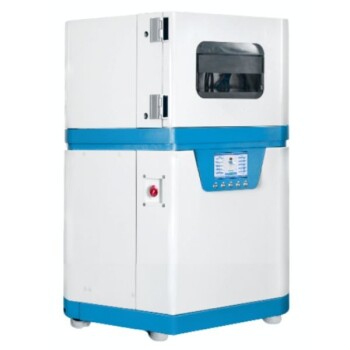
Vacuum Hot Pressing (VHP) outperforms pressureless sintering by applying simultaneous mechanical pressure and thermal energy to Mg3Sb2 powder. This dual-action process significantly lowers the activation energy required for sintering, enabling the material to reach high density at temperatures lower than those required for melting.
The core advantage of VHP lies in its ability to decouple densification from thermal exposure. By driving consolidation through mechanical force rather than just heat, you achieve superior material density and electrical properties while preserving the fine-grained microstructure essential for thermoelectric performance.
Mechanisms of Superior Densification
Overcoming Residual Porosity
Pressureless sintering often leaves residual porosity because it relies solely on thermal diffusion to close gaps between particles.
Plastic Deformation and Flow
VHP introduces uniaxial mechanical pressure (typically 30–70 MPa), which forces powder particles together through plastic deformation and diffusion creep.
Removal of Trapped Gases
Operating under a vacuum environment is critical for extracting gases trapped within pores. This allows the material to consolidate into a bulk form with relative densities typically exceeding 96% to 98% of the theoretical maximum.
Controlling Microstructure and Composition
Inhibiting Excessive Grain Growth
In thermoelectric materials, a fine grain structure is vital. Because VHP reduces the activation energy for sintering, fully dense materials can be fabricated at lower temperatures.
Preserving Nanocrystalline Features
This reduction in thermal load prevents the rapid grain boundary migration that occurs at higher temperatures. Consequently, VHP maintains fine-grained, uniform, or even nanocrystalline microstructures that pressureless sintering would destroy.
Stabilizing Chemical Composition
The vacuum environment does more than remove pores; it suppresses the volatilization of unstable elements at high temperatures. This ensures the chemical composition of the Mg3Sb2 remains stable throughout the fabrication process.
Impact on Material Performance
Enhanced Electrical Transport
The high density achieved via VHP creates a continuous path for electron flow. This directly translates to superior electrical transport properties compared to the porous structures often resulting from pressureless methods.
Superior Mechanical Strength
The simultaneous application of heat and pressure facilitates diffusion bonding and plastic flow. The resulting material exhibits hardness and tensile strength comparable to forged materials, far exceeding the mechanical integrity of components made via traditional arc melting or pressureless sintering.
Understanding the Comparison Risks
The Limitations of Pressureless Sintering
It is important to recognize why VHP is preferred despite the equipment complexity. Pressureless sintering relies entirely on high temperatures to drive densification.
The Trade-off of Temperature vs. Density
To achieve comparable density without pressure, pressureless methods require significantly higher temperatures. This inevitably leads to excessive grain growth, which degrades the thermoelectric properties you are trying to engineer.
Making the Right Choice for Your Goal
While VHP adds process complexity, it is generally the superior route for high-performance thermoelectrics.
- If your primary focus is Electrical Performance: Choose VHP to maximize density (>96%) and ensure optimal electrical transport pathways.
- If your primary focus is Microstructural Control: Choose VHP to sinter at lower temperatures, effectively inhibiting grain growth and preserving nanostructures.
- If your primary focus is Mechanical Integrity: Choose VHP to leverage plastic deformation for a robust, void-free block with high tensile strength.
For Mg3Sb2 thermoelectric applications, VHP provides the necessary control to simultaneously maximize density and minimize grain size, a balance that pressureless sintering cannot achieve.
Summary Table:
| Feature | Vacuum Hot Pressing (VHP) | Pressureless Sintering |
|---|---|---|
| Densification Mechanism | Simultaneous Heat + Uniaxial Pressure | Thermal Diffusion Only |
| Relative Density | High (>96-98%) | Lower (Residual Porosity) |
| Microstructure | Fine-grained / Nanocrystalline | Excessive Grain Growth |
| Chemical Stability | Vacuum suppresses volatilization | Risk of element loss at high T |
| Mechanical Strength | Superior (Comparable to forged) | Lower (Brittle/Porous) |
Elevate Your Material Research with KINTEK Precision Solutions
Unlock the full potential of your Mg3Sb2 thermoelectric materials with KINTEK’s industry-leading Vacuum Hot Press (VHP) systems. Whether you are aiming for near-theoretical density, precise microstructural control, or enhanced electrical transport, our advanced thermal processing equipment is engineered to deliver repeatable, high-performance results.
Why partner with KINTEK?
- Comprehensive Range: From vacuum and atmosphere furnaces to high-pressure reactors and hydraulic pellet presses.
- Specialized Expertise: Supporting battery research, metallurgy, and advanced ceramics with tailored laboratory equipment.
- Total Solutions: We provide everything from crushing/milling systems to high-purity crucibles and cooling solutions.
Ready to optimize your fabrication process? Contact our technical experts today to find the perfect equipment solution for your laboratory's unique needs.
Related Products
- Vacuum Hot Press Furnace Machine Heated Vacuum Press
- Vacuum Hot Press Furnace Machine for Lamination and Heating
- Vacuum Hot Press Furnace Heated Vacuum Press Machine Tube Furnace
- 600T Vacuum Induction Hot Press Furnace for Heat Treat and Sintering
- Touchscreen Automatic Vacuum Heat Press
People Also Ask
- What advantages does a vacuum hot press furnace provide for LSLBO ceramic electrolytes? Achieve 94% Relative Density
- What role does a Vacuum Hot Press (VHP) furnace play in the densification of austenitic stainless steel 316 composites?
- What are the advantages of using a vacuum hot pressing furnace? Superior Densification for 2024Al/Gr/SiC Composites
- Why is it necessary to maintain a high-vacuum environment within a vacuum hot press furnace? Optimize Cu-SiC Sintering
- Why is the gradient heating function of a vacuum hot press furnace essential? Enhance Graphite-Aluminum Composites