Knowledge evaporation boat What are the disadvantages of thermal evaporation method? Key Limitations in Purity and Performance
Author avatar

Tech Team · Kintek Solution

Updated 2 months ago

What are the disadvantages of thermal evaporation method? Key Limitations in Purity and Performance


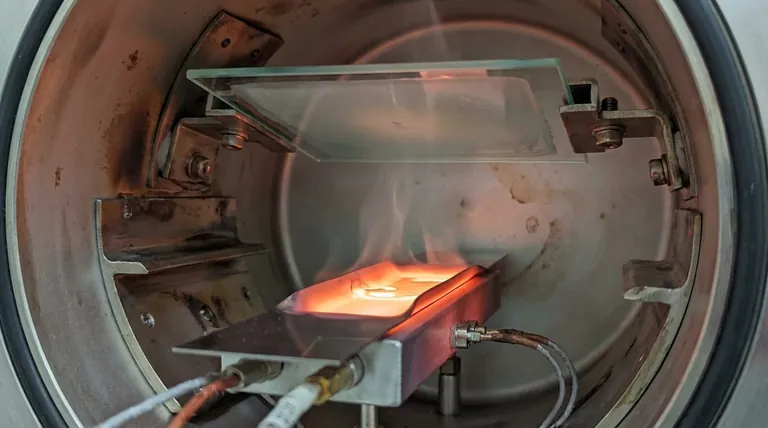
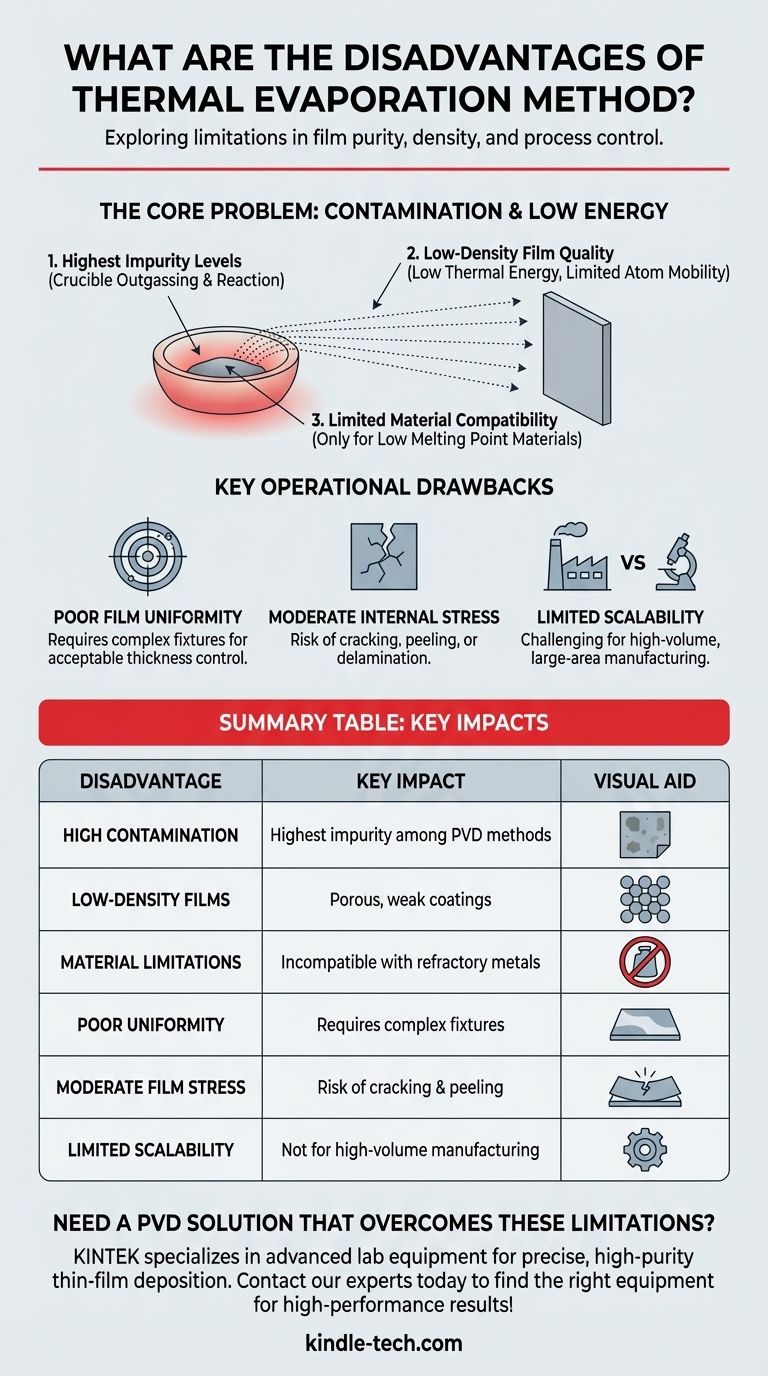
The primary disadvantages of thermal evaporation are its high levels of film contamination, the low density of the resulting film, and its incompatibility with high-melting-point materials. These issues stem from the method's inherent simplicity, which involves heating the entire source material and its container (a crucible or boat) to the point of vaporization.

While valued for its simplicity and low cost, thermal evaporation offers limited control over the deposition process. This lack of control is the direct cause of its main drawbacks: higher impurity levels and weaker film quality compared to more advanced techniques.
What are the disadvantages of thermal evaporation method? Key Limitations in Purity and Performance

The Core Problem: Contamination and Low Energy

The fundamental limitations of thermal evaporation are a direct result of how it generates vapor. By heating the entire source container, the process introduces variables that are difficult to control, impacting the final film's quality.

The Highest Impurity Levels

Thermal evaporation is known for having the highest impurity levels among all Physical Vapor Deposition (PVD) methods. Because the crucible or boat holding the source material is also heated to extreme temperatures, the container material itself can outgas or react with the evaporant, contaminating the vapor stream and embedding impurities into the deposited film.

Low-Density Film Quality

The atoms that evaporate from the source do so with relatively low thermal energy. When they land on the substrate, they have limited mobility to arrange themselves into a dense, tightly packed structure. This results in films that are more porous and have lower density, which can compromise their mechanical and optical properties. This can be partially improved with techniques like ion-assist, but the base quality remains lower than other methods.

Limited Material Compatibility

This method is only suitable for materials with relatively low melting points, such as aluminum or silver. Materials that require very high temperatures to evaporate, like refractory metals (e.g., tungsten, molybdenum), are not compatible. Attempting to heat these materials would often damage the heating element or crucible before significant evaporation occurs.

Key Operational Drawbacks

Beyond the quality of the film itself, the process has several practical limitations that affect its use in manufacturing environments.

Poor Film Uniformity

Without additional hardware, thermal evaporation produces films with poor thickness uniformity. The vapor naturally follows a line-of-sight path from the source to the substrate, creating a thicker deposit directly above the source and thinner deposits toward the edges. Achieving acceptable uniformity requires complex and costly additions like planetary substrate fixtures and uniformity masks.

Moderate Internal Stress

The films deposited via thermal evaporation often exhibit moderate internal stress. This built-in tension or compression can cause the film to crack, peel, or delaminate from the substrate over time, especially when subjected to thermal cycling.

Limited Scalability

While excellent for lab-scale research and small batch production, the method faces challenges with scalability. Maintaining uniform heating and deposition over very large areas is difficult, making it less suitable for high-volume manufacturing compared to other techniques.

Making the Right Choice for Your Goal

Understanding these disadvantages is critical for selecting the right deposition technique. The choice depends entirely on balancing the need for film quality against budget and material constraints.

  • If your primary focus is low-cost deposition of simple metals: Thermal evaporation is an excellent choice for applications like basic electrical contacts or decorative coatings where pristine purity is not the main concern.
  • If your primary focus is high-purity, dense films for advanced devices: The inherent contamination and low density make other PVD methods like sputtering or e-beam evaporation a much safer and more reliable option.
  • If your primary focus is depositing high-melting-point or refractory materials: This method is fundamentally unsuitable, and you must use a higher-energy process like e-beam evaporation or sputtering.

By aligning the method's capabilities with your project's specific performance requirements, you can avoid costly failures and ensure a successful outcome.

Summary Table:

Disadvantage Key Impact
High Contamination Highest impurity levels among PVD methods due to crucible outgassing.
Low-Density Films Porous, weak coatings due to low-energy atom deposition.
Material Limitations Incompatible with high-melting-point materials like refractory metals.
Poor Uniformity Requires complex fixtures for acceptable thickness control.
Moderate Film Stress Risk of cracking, peeling, or delamination over time.
Limited Scalability Challenging for high-volume, large-area manufacturing.

Need a PVD solution that overcomes the limitations of thermal evaporation?

KINTEK specializes in advanced lab equipment and consumables for precise, high-purity thin-film deposition. Whether you require higher-density coatings, compatibility with refractory materials, or scalable manufacturing solutions, our expertise in sputtering and e-beam evaporation systems can ensure your project's success.

Contact our experts today to discuss your specific application and find the right equipment for high-performance results!

Visual Guide
What are the disadvantages of thermal evaporation method? Key Limitations in Purity and Performance Visual Guide

Related Products

People Also Ask

Related Products

Molybdenum Tungsten Tantalum Evaporation Boat for High Temperature Applications

Molybdenum Tungsten Tantalum Evaporation Boat for High Temperature Applications

Evaporation boat sources are used in thermal evaporation systems and are suitable for depositing various metals, alloys and materials. Evaporation boat sources are available in different thicknesses of tungsten, tantalum and molybdenum to ensure compatibility with a variety of power sources. As a container, it is used for vacuum evaporation of materials. They can be used for thin film deposition of various materials, or designed to be compatible with techniques such as electron beam fabrication.

Aluminized Ceramic Evaporation Boat for Thin Film Deposition

Aluminized Ceramic Evaporation Boat for Thin Film Deposition

Vessel for depositing thin films; has an aluminum-coated ceramic body for improved thermal efficiency and chemical resistance. making it suitable for various applications.

Evaporation Boat for Organic Matter

Evaporation Boat for Organic Matter

The evaporation boat for organic matter is an important tool for precise and uniform heating during the deposition of organic materials.

Chemical Vapor Deposition CVD Equipment System Chamber Slide PECVD Tube Furnace with Liquid Gasifier PECVD Machine

Chemical Vapor Deposition CVD Equipment System Chamber Slide PECVD Tube Furnace with Liquid Gasifier PECVD Machine

KT-PE12 Slide PECVD System: Wide power range, programmable temp control, fast heating/cooling with sliding system, MFC mass flow control & vacuum pump.

Multi Heating Zones CVD Tube Furnace Machine Chemical Vapor Deposition Chamber System Equipment

Multi Heating Zones CVD Tube Furnace Machine Chemical Vapor Deposition Chamber System Equipment

KT-CTF14 Multi Heating Zones CVD Furnace - Precise Temperature Control and Gas Flow for Advanced Applications. Max temp up to 1200℃, 4 channels MFC mass flow meter, and 7" TFT touch screen controller.

Electron Beam Evaporation Coating Gold Plating Tungsten Molybdenum Crucible for Evaporation

Electron Beam Evaporation Coating Gold Plating Tungsten Molybdenum Crucible for Evaporation

These crucibles act as containers for the gold material evaporated by the electron evaporation beam while precisely directing the electron beam for precise deposition.

Electron Beam Evaporation Coating Oxygen-Free Copper Crucible and Evaporation Boat

Electron Beam Evaporation Coating Oxygen-Free Copper Crucible and Evaporation Boat

Electron Beam Evaporation Coating Oxygen-Free Copper Crucible enables precise co-deposition of various materials. Its controlled temperature and water-cooled design ensure pure and efficient thin film deposition.

Customer Made Versatile CVD Tube Furnace Chemical Vapor Deposition Chamber System Equipment

Customer Made Versatile CVD Tube Furnace Chemical Vapor Deposition Chamber System Equipment

Get your exclusive CVD furnace with KT-CTF16 Customer Made Versatile Furnace. Customizable sliding, rotating, and tilting functions for precise reactions. Order now!

High Purity Pure Graphite Crucible for Evaporation

High Purity Pure Graphite Crucible for Evaporation

Vessels for high temperature applications, where materials are kept at extremely high temperatures to evaporate, allowing thin films to be deposited on substrates.

Hemispherical Bottom Tungsten Molybdenum Evaporation Boat

Hemispherical Bottom Tungsten Molybdenum Evaporation Boat

Used for gold plating, silver plating, platinum, palladium, suitable for a small amount of thin film materials. Reduce the waste of film materials and reduce heat dissipation.

Evaporation Crucible for Organic Matter

Evaporation Crucible for Organic Matter

An evaporation crucible for organic matter, referred to as an evaporation crucible, is a container for evaporating organic solvents in a laboratory environment.

Electron Beam Evaporation Coating Conductive Boron Nitride Crucible BN Crucible

Electron Beam Evaporation Coating Conductive Boron Nitride Crucible BN Crucible

High-purity and smooth conductive boron nitride crucible for electron beam evaporation coating, with high temperature and thermal cycling performance.

Ceramic Evaporation Boat Set Alumina Crucible for Laboratory Use

Ceramic Evaporation Boat Set Alumina Crucible for Laboratory Use

It can be used for vapor deposition of various metals and alloys. Most metals can be evaporated completely without loss. Evaporation baskets are reusable.1

E Beam Crucibles Electron Gun Beam Crucible for Evaporation

E Beam Crucibles Electron Gun Beam Crucible for Evaporation

In the context of electron gun beam evaporation, a crucible is a container or source holder used to contain and evaporate the material to be deposited onto a substrate.

Tungsten Evaporation Boat for Thin Film Deposition

Tungsten Evaporation Boat for Thin Film Deposition

Learn about tungsten boats, also known as evaporated or coated tungsten boats. With a high tungsten content of 99.95%, these boats are ideal for high-temperature environments and widely used in various industries. Discover their properties and applications here.

Molybdenum Tungsten Tantalum Special Shape Evaporation Boat

Molybdenum Tungsten Tantalum Special Shape Evaporation Boat

Tungsten Evaporation Boat is ideal for vacuum coating industry and sintering furnace or vacuum annealing. we offers tungsten evaporation boats that are designed to be durable and robust, with long operating lifetimes and to ensure consistent smooth and even spreading of the molten metals.

Laboratory Rapid Thermal Processing (RTP) Quartz Tube Furnace

Laboratory Rapid Thermal Processing (RTP) Quartz Tube Furnace

Get lightning-fast heating with our RTP Rapid Heating Tube Furnace. Designed for precise, high-speed heating and cooling with convenient sliding rail and TFT touch screen controller. Order now for ideal thermal processing!

5L Heating Chilling Circulator Cooling Water Bath Circulator for High and Low Temperature Constant Temperature Reaction

5L Heating Chilling Circulator Cooling Water Bath Circulator for High and Low Temperature Constant Temperature Reaction

KinTek KCBH 5L Heating Chilling Circulator - Ideal for labs and industrial conditions with multi-functional design and reliable performance.

100L Heating Chilling Circulator Cooling Water Bath Circulator for High and Low Temperature Constant Temperature Reaction

100L Heating Chilling Circulator Cooling Water Bath Circulator for High and Low Temperature Constant Temperature Reaction

Get all-in-one heating, chilling, and circulating capabilities with our KinTek KCBH 80L Heating Chilling Circulator. High efficiency, reliable performance for labs and industrial applications.

20L Heating Chilling Circulator Cooling Water Bath Circulator for High and Low Temperature Constant Temperature Reaction

20L Heating Chilling Circulator Cooling Water Bath Circulator for High and Low Temperature Constant Temperature Reaction

Maximize lab productivity with KinTek KCBH 20L Heating Chilling Circulator. Its all-in-one design offers reliable heating, chilling, and circulating functions for industrial and lab use.


Leave Your Message