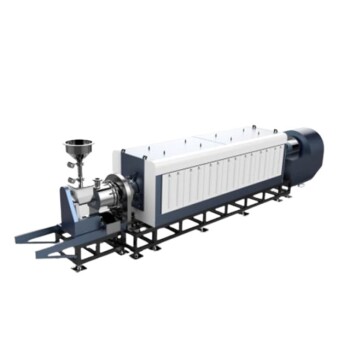
Direct resistance heating offers a fundamental shift in thermal processing by utilizing the Joule effect to generate heat within the reactor tubes themselves. Unlike traditional gas-fired furnaces that rely on external combustion, this equipment provides superior control over temperature profiles and significantly faster heating rates.
By applying electric current directly to conductive reaction tubes, these systems eliminate the inconsistencies of combustion, offering a pathway to both higher process precision and zero direct carbon emissions.
The Mechanics of Thermal Precision
Eliminating Flame Non-Uniformity
Traditional gas-fired furnaces face an inherent challenge: the physics of combustion. Flames create uneven heat zones, leading to hot spots and inconsistent thermal transfer across the reactor.
Direct resistance heating completely bypasses this limitation.
Because the heat is generated within the tube material itself via the Joule effect, the system avoids the chaotic geometry of a flame. This results in a highly uniform thermal environment that is difficult to replicate with gas.
Precise Control Over Distribution
The equipment design allows for granular management of heat distribution.
Operators can achieve exact temperature profiles along the length of the reactor. This precision is critical for sensitive chemical reactions where deviation can lead to unwanted byproducts or reduced yield.
Operational Speed and Efficiency
Achieving High Heating Rates
One of the most distinct equipment advantages is the speed at which the system can modulate temperature.
Direct resistance systems are capable of extremely high heating rates.
Without the thermal lag associated with heating a large furnace volume via combustion gases, the energy transfer is immediate. This allows for rapid startup times and quick adjustments to process variables.
Environmental Implications
Zero Direct Emissions
The equipment removes the smokestack from the equation.
During operation, the system produces zero direct carbon dioxide emissions. While gas furnaces are chemically bound to producing CO2 as a byproduct of heat generation, resistance heating decouples the thermal process from carbon output.
Understanding the Trade-offs
The Energy Source Dependency
While the equipment itself emits no carbon, the environmental benefit is conditional.
The system is only truly "zero emission" if the electricity is sourced from renewable energy.
If the local grid relies heavily on fossil fuels, the carbon footprint is merely shifted from the facility to the power plant. Therefore, the equipment advantage is maximized only when paired with a clean energy strategy.
Making the Right Choice for Your Goal
To determine if a direct resistance heating reactor is the right fit for your operation, consider your primary objectives:
- If your primary focus is process control and yield: Choose resistance heating for its ability to eliminate flame non-uniformity and deliver precise heat distribution.
- If your primary focus is rapid cycle times: Leverage the equipment's ability to achieve extremely high heating rates to reduce startup and transition times.
- If your primary focus is decarbonization: Implement this system to eliminate Scope 1 emissions, ensuring your electricity supply is backed by renewable sources.
Direct resistance heating transforms the reactor from a passive vessel into an active, high-precision thermal element.
Summary Table:
| Feature | Direct Resistance Heating | Traditional Gas-Fired Furnaces |
|---|---|---|
| Heat Source | Internal Joule Effect (Tube) | External Flame Combustion |
| Temperature Control | Highly Uniform & Granular | Inconsistent (Hot Spots) |
| Heating Rate | Extremely High/Rapid | Slow (Thermal Lag) |
| Direct CO2 Emissions | Zero | High (Combustion Byproduct) |
| Primary Advantage | Process Precision & Speed | Low Energy Cost (depending on grid) |
Elevate Your Laboratory Precision with KINTEK
Transitioning to advanced thermal processing requires more than just equipment—it requires a partner dedicated to technical excellence. KINTEK specializes in high-performance laboratory solutions, offering a comprehensive range of high-temperature furnaces, high-pressure reactors, and autoclaves designed to meet the most rigorous research standards.
Whether you are focusing on decarbonizing your workflow with zero-emission heating or need the rapid heating rates of our resistance systems, we provide the tools to ensure superior yield and process control. Our portfolio also includes cutting-edge battery research tools, electrolytic cells, and precision crushing systems to support every stage of your material science journey.
Ready to optimize your thermal processes? Contact us today to consult with our specialists and find the perfect equipment solution for your lab.
References
- Ismaël Amghizar, Kevin M. Van Geem. Sustainable innovations in steam cracking: CO<sub>2</sub> neutral olefin production. DOI: 10.1039/c9re00398c
This article is also based on technical information from Kintek Solution Knowledge Base .
Related Products
- Customizable Laboratory High Temperature High Pressure Reactors for Diverse Scientific Applications
- Visual High-Pressure Reactor for In-Situ Observation
- High Temperature Constant Temperature Heating Circulator Water Bath Chiller Circulator for Reaction Bath
- 10L Heating Chilling Circulator Cooling Water Bath Circulator for High and Low Temperature Constant Temperature Reaction
- Customizable High Pressure Reactors for Advanced Scientific and Industrial Applications
People Also Ask
- How do high-pressure and high-temperature reactors ensure the effective treatment of lignocellulosic wastewater in WAO?
- What equipment is required for high-pressure high-temperature reactions? Master Extreme Chemistry Safely
- How do you control high pressure in a reactor? A Guide to Safe & Stable Operation
- Why is argon better than nitrogen for inert atmosphere? Ensure Absolute Reactivity & Stability
- How does initial oxygen pressure affect the wet oxidation of pharmaceutical sludge? Master Your Oxidation Depth