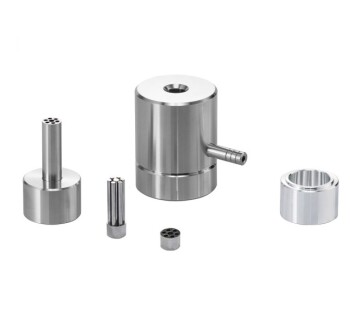
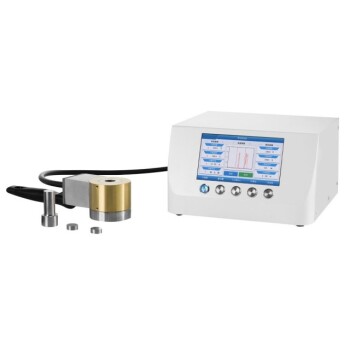
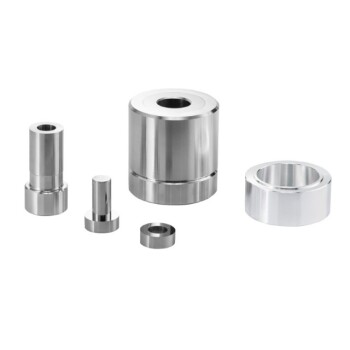
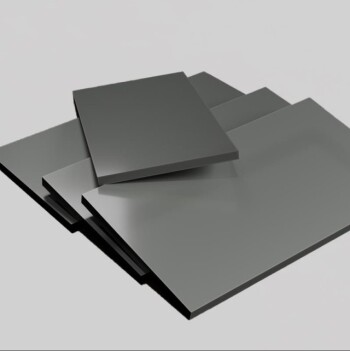
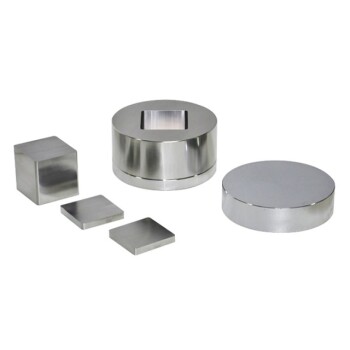
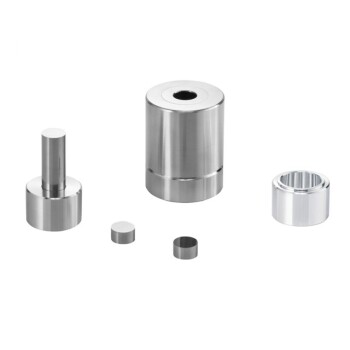
High-strength graphite molds serve a dual function in the Hot Pressing (HP) of High-Entropy Ceramics, acting simultaneously as the structural containment vessel and the active thermal engine of the process. They define the macroscopic shape of the ceramic by restricting lateral movement, while acting as a transmission medium to apply uniform mechanical pressure to the powder. Furthermore, due to their electrical conductivity, these molds function as heating elements or heat transfer components, ensuring the material is sintered under precise temperature conditions.
The critical value of a graphite mold lies in its ability to couple mechanical stability with thermal conductivity. It ensures that both the stress field (pressure) and the temperature field (heat) are distributed uniformly throughout the ceramic, which is the deciding factor in achieving high density and a defect-free microstructure.
Mechanical Containment and Pressure Transmission
Defining the Component Geometry
At the most fundamental level, the graphite mold serves as the container for the ceramic powder. It defines the macroscopic shape of the final component by strictly restricting lateral displacement of the powder particles. By preventing the powder from spreading outward, the mold forces the material to consolidate into a defined geometry.
Transmitting Uniaxial Pressure
The mold acts as the direct transmission medium for external mechanical force. In Hot Pressing, vertical pressure is applied to the assembly, and the high-strength graphite must transfer this force efficiently to the powder. This conversion of vertical pressure into compaction force is essential for reducing porosity.
Maintaining Structural Integrity at High Temperatures
High-Entropy Ceramics require sintering at elevated temperatures where many materials would fail. Graphite molds are essential because they maintain their high-strength properties even under extreme thermal stress. They must withstand significant axial pressures (often exceeding 30-40 MPa) without fracturing or deforming, ensuring the dimensional precision of the sample is preserved throughout the densification process.
Thermal Management and Heating
Acting as an Active Heating Element
Unlike passive molds used in other processes, graphite molds often play an active role in generating heat. Due to the electrical conductivity of graphite, the mold itself can function as a resistance heating element or an induction receptor. In these setups, the mold converts electrical or electromagnetic energy directly into heat.
Ensuring Uniform Heat Distribution
Achieving a uniform microstructure in High-Entropy Ceramics requires eliminating temperature gradients. Graphite possesses excellent thermal conductivity, which allows it to distribute heat evenly across the entire powder specimen. This prevents localized overheating or under-sintering, ensuring that the metallurgical bonding is consistent throughout the material.
Understanding the Operational Trade-offs
Oxidation Sensitivity
While graphite is thermally stable in vacuum or inert atmospheres, it is highly sensitive to oxidation in air at high temperatures. To prevent rapid degradation or "burn-off" of the mold, the Hot Pressing process must generally occur within a protective vacuum or inert gas environment.
Mechanical Pressure Limits
Although termed "high-strength," graphite is a brittle material with definite mechanical limits. While it can handle substantial compression, exceeding its specific pressure rating (e.g., beyond its designed MPa limit) will result in catastrophic fracture rather than plastic deformation. The process parameters must be strictly aligned with the specific grade of graphite used.
Making the Right Choice for Your Project
To maximize the quality of your High-Entropy Ceramics, align your mold selection with your specific sintering goals:
- If your primary focus is Dimensional Precision: Prioritize graphite grades with the highest available compressive strength to resist deformation under peak axial loads.
- If your primary focus is Microstructural Homogeneity: Select high-purity graphite with superior thermal conductivity to ensure the temperature field is perfectly uniform across the sample volume.
- If your primary focus is Process Efficiency: Utilize the mold's electrical properties to integrate it directly into the heating circuit (induction or resistance) for faster, more direct energy transfer.
Success in Hot Pressing relies not just on applying pressure, but on the precise control of the thermal-mechanical environment that only a high-quality graphite mold can provide.
Summary Table:
| Feature | Role in Hot Pressing (HP) | Impact on High-Entropy Ceramics |
|---|---|---|
| Mechanical Containment | Restricts lateral powder movement | Defines component geometry and precision |
| Pressure Transmission | Transfers vertical force (30-40+ MPa) | Eliminates porosity and ensures high density |
| Active Heating | Acts as resistance or induction element | Enables fast and direct energy transfer |
| Thermal Conductivity | Distributes heat uniformly | Prevents defects and ensures structural homogeneity |
| High-Temp Stability | Maintains strength at extreme temperatures | Preserves structural integrity during sintering |
Elevate Your Material Research with KINTEK Precision Solutions
Achieving the perfect balance of pressure and temperature in High-Entropy Ceramic sintering requires more than just high-quality molds; it requires a integrated laboratory ecosystem. KINTEK specializes in advanced laboratory equipment designed to meet the rigorous demands of material science.
Our comprehensive portfolio supports every stage of your workflow:
- High-Performance Systems: From vacuum and atmosphere high-temperature furnaces to precision hydraulic presses (pellet, hot, and isostatic).
- Sample Preparation: Advanced crushing, milling, and sieving equipment for optimal powder consistency.
- Specialized Research Tools: High-temperature high-pressure reactors, battery research consumables, and custom PTFE or ceramic crucibles.
Whether you are focusing on microstructural homogeneity or dimensional precision, KINTEK provides the high-strength tools and cooling solutions (ULT freezers, freeze dryers) necessary for success.
Ready to optimize your Hot Pressing process? Contact our technical experts today to find the perfect equipment and consumables for your lab.
References
- Huimin Xiang, Yanchun Zhou. High-entropy ceramics: Present status, challenges, and a look forward. DOI: 10.1007/s40145-021-0477-y
This article is also based on technical information from Kintek Solution Knowledge Base .
Related Products
- Anti-Cracking Press Mold for Lab Use
- Special Shape Press Mold for Lab
- Ball Press Mold for Lab
- Double Plate Heating Press Mold for Lab
- Lab Infrared Press Mold
People Also Ask
- What is the press mould method? A Guide to Consistent, Detailed Ceramic Forms
- How to use a press mold? Master the Art of Creating Consistent Ceramic Forms
- What is the function of press molds during the preparation of SiCf/Ti-43Al-9V composites? Achieve Structural Precision
- What is a press mold used for? Achieve Repeatable Precision and Efficiency
- What is the purpose of specialized pressure devices in sulfide solid-state batteries? Ensure Chemo-Mechanical Stability