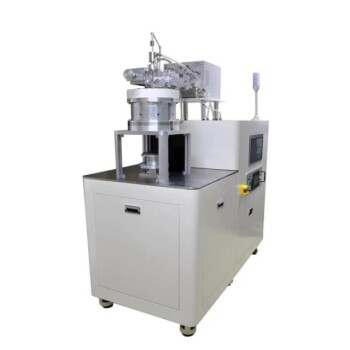
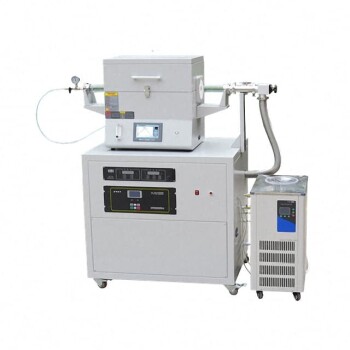
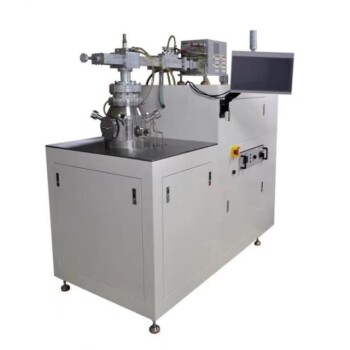
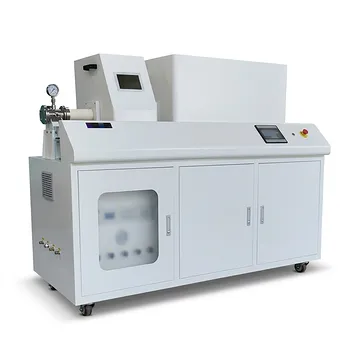
Atomic Layer Chemical Vapour Deposition (ALCVD) is a specialized thin-film deposition technique defined by its ability to control film growth with atomic-scale precision. It is characterized by the production of highly uniform, high-density, and pinhole-free films, even when applied to surfaces with complex geometries or high aspect ratios.
The defining feature of ALCVD is its self-limiting nature. Unlike continuous deposition methods, ALCVD builds material through sequential, self-terminating surface reactions, guaranteeing absolute control over film thickness and composition regardless of the substrate's shape.
The Mechanics of Atomic Precision
Self-Limiting Reactions
The core mechanism of ALCVD is the self-limiting reaction. Instead of flooding the surface with reactants simultaneously, precursors are introduced sequentially. Once the surface is fully saturated with a specific precursor, the reaction naturally stops, preventing excess material buildup.
Sequential Layer Formation
This process results in the continuous formation of atomic layers. By repeating these self-limiting cycles, engineers can determine the final thickness of the film simply by counting the number of reaction cycles performed.
Composition Control
Because the layers are built sequentially, the process offers excellent control over the film's chemical composition. This allows for the creation of precise, pure materials essential for sensitive applications like semiconductor transistor gates.
Superior Film Quality
Perfect Conformality
ALCVD excels at shape retention, also known as conformality. It provides excellent uniformity even on "high aspect ratio" surfaces, such as deep trenches or complex 3D nanostructures, where other deposition methods often fail to coat evenly.
Purity and Density
The films produced are pinhole-free and possess superior density. This lack of porosity is critical for applications requiring robust insulation or barrier properties, such as dielectric layers in nanotechnology.
High Uniformity
The self-limiting nature ensures that the film is uniform across the entire substrate. This reproducibility makes it highly reliable for batch processing in industrial manufacturing.
Operational Advantages and Trade-offs
Lower Growth Temperatures
A significant advantage of ALCVD is its ability to operate at lower growth temperatures compared to many conventional Chemical Vapour Deposition (CVD) processes. This allows for coating on temperature-sensitive substrates without damaging them.
Understanding the Speed Trade-off
While generic CVD is noted for high growth rates, the atomic-level precision of ALCVD inherently implies a different pace. Because the film is built one atomic layer at a time, the process prioritizes precision, density, and uniformity over raw deposition speed.
Making the Right Choice for Your Goal
To determine if ALCVD is the correct solution for your specific engineering challenge, consider your primary constraints:
- If your primary focus is Geometric Complexity: ALCVD is the ideal choice due to its ability to coat high aspect ratio structures with near-perfect conformality.
- If your primary focus is Film Integrity: Select ALCVD for applications requiring pinhole-free, high-density layers, such as transistor gate dielectrics.
- If your primary focus is Substrate Sensitivity: Leverage ALCVD for its lower process temperatures to protect delicate underlying materials.
ALCVD remains the premier choice when the requirement for atomic-level precision and uniformity outweighs the need for rapid bulk deposition.
Summary Table:
| Characteristic | Description | Benefit |
|---|---|---|
| Self-Limiting Growth | Sequential, self-terminating surface reactions | Absolute control over film thickness |
| Conformality | Even coating on high aspect ratio structures | Perfect uniformity on complex 3D shapes |
| Film Integrity | High-density, pinhole-free layer formation | Superior insulation and barrier properties |
| Temperature | Operates at lower growth temperatures | Safe for temperature-sensitive substrates |
| Precision | Layer-by-layer atomic construction | Excellent chemical composition control |
Elevate Your Thin-Film Research with KINTEK
Precision matters in advanced material science. At KINTEK, we understand that your breakthroughs depend on the integrity of your equipment and materials. Whether you are developing next-generation semiconductors or exploring nanotechnology, our specialized range of CVD and PECVD systems, high-temperature furnaces, and precision laboratory tools are designed to meet the most rigorous standards.
From high-purity ceramics and crucibles to advanced vacuum systems and battery research tools, KINTEK provides the comprehensive solutions needed for atomic-scale excellence. Our experts are ready to help you select the ideal configuration for your complex geometric challenges and substrate requirements.
Ready to achieve perfect film conformality? Contact KINTEK today to discuss your project needs!
Related Products
- Chemical Vapor Deposition CVD Equipment System Chamber Slide PECVD Tube Furnace with Liquid Gasifier PECVD Machine
- RF PECVD System Radio Frequency Plasma-Enhanced Chemical Vapor Deposition RF PECVD
- Customer Made Versatile CVD Tube Furnace Chemical Vapor Deposition Chamber System Equipment
- HFCVD Machine System Equipment for Drawing Die Nano-Diamond Coating
- Microwave Plasma Chemical Vapor Deposition MPCVD Machine System Reactor for Lab and Diamond Growth
People Also Ask
- What are the advantages of chemical vapor deposition? Achieve Superior Thin Films for Your Lab
- What types of substrates are used in CVD to facilitate graphene films? Optimize Graphene Growth with the Right Catalyst
- What is the chemical vapor deposition growth process? Build Superior Thin Films from the Atom Up
- How expensive is chemical vapor deposition? Understanding the True Cost of High-Performance Coating
- Why is Chemical Vapor Deposition (CVD) equipment uniquely suited for constructing hierarchical superhydrophobic structures?