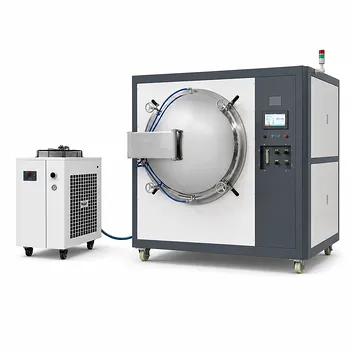
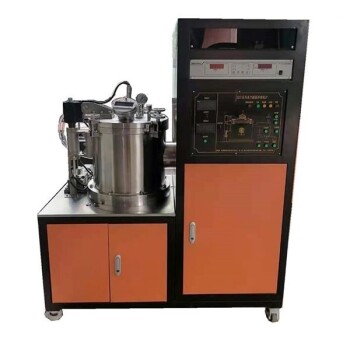
The primary advantage of using a vacuum hot pressing furnace for Lithium Niobate is the ability to achieve superior material density and piezoelectric performance through the simultaneous application of high temperature and axial pressure. This method produces ceramics with a density of up to 4.62 g/cm³ and significantly fewer pores than traditional pressureless sintering.
Core Takeaway Traditional sintering often struggles to eliminate internal porosity without excessive heat. Vacuum hot pressing solves this by mechanically forcing particle rearrangement, allowing for near-theoretical density and optimized electrical properties at lower processing temperatures.
The Mechanics of Densification
Simultaneous Pressure and Heat
Unlike traditional solid-state sintering, which relies solely on thermal diffusion, a vacuum hot pressing furnace applies axial mechanical pressure while heating the material.
This combination physically forces the ceramic powder particles together.
Accelerated Particle Rearrangement
The application of pressure significantly accelerates the rearrangement of powder particles and promotes diffusion creep.
This allows the material to reach high density much faster than thermal energy alone could achieve.
Elimination of Porosity
The primary reference indicates that Lithium Niobate ceramics produced via this method achieve a density of 4.62 g/cm³.
This high density corresponds to a drastic reduction in internal pores, which are detrimental to piezoelectric performance.
Enhancing Microstructure and Performance
Lowering Sintering Temperatures
Vacuum hot pressing effectively lowers the required sintering temperature for Lithium Niobate.
By adding mechanical energy (pressure), the system requires less thermal energy to achieve densification.
Controlling Grain Growth
Because the process occurs at lower temperatures and over shorter durations, it effectively inhibits excessive grain growth.
This results in a fine, nanocrystalline microstructure, which is essential for maintaining high mechanical strength and consistent piezoelectric properties.
Superior Piezoelectric Properties
The reduction in porosity and the dense arrangement of grains directly translate to better performance.
The resulting ceramics exhibit superior piezoelectric properties compared to those produced through traditional pressureless sintering.
Operational and Environmental Benefits
Short Sintering Times
The combination of pressure and heat promotes rapid densification, allowing for short holding times (potentially as low as 10 minutes).
This offers higher production efficiency compared to the prolonged heating cycles of traditional methods.
The Vacuum Advantage
Sintering in a closed vacuum environment prevents the oxidation and pollution of the material.
This environment also helps suppress the volatilization of chemical components, ensuring the stability of the Lithium Niobate composition.
Understanding the Process Dynamics
Specialized Equipment Requirements
While traditional sintering can be performed in simple furnaces, hot pressing requires specialized equipment capable of maintaining a vacuum while applying significant mechanical pressure (e.g., 25 MPa).
Geometry Constraints
The application of uniaxial pressure is highly effective for densification but generally favors simpler geometric shapes (like discs or plates).
Producing complex, non-symmetrical 3D shapes is more challenging with hot pressing than with pressureless sintering methods.
Making the Right Choice for Your Goal
To determine if vacuum hot pressing is the correct approach for your Lithium Niobate application, consider your specific performance targets:
- If your primary focus is Maximum Piezoelectric Output: Choose vacuum hot pressing to minimize porosity and maximize the dense arrangement of grains.
- If your primary focus is Microstructural Control: Use this method to inhibit grain growth and maintain a fine, nanocrystalline structure.
- If your primary focus is Material Purity: Rely on the vacuum environment to prevent oxidation and contamination during the heating phase.
By leveraging mechanical pressure alongside thermal energy, you transform the sintering process from a passive thermal event into an active, high-force densification strategy.
Summary Table:
| Feature | Vacuum Hot Pressing Furnace | Traditional Solid-State Sintering |
|---|---|---|
| Primary Mechanism | Simultaneous Heat + Axial Pressure | Thermal Diffusion Only |
| Material Density | Up to 4.62 g/cm³ (Near-theoretical) | Lower (Prone to porosity) |
| Microstructure | Fine, nanocrystalline (Inhibits grain growth) | Larger, irregular grain growth |
| Sintering Temp/Time | Lower temperatures, shorter cycles | Higher temperatures, longer cycles |
| Purity Control | High (Vacuum prevents oxidation) | Variable (Atmospheric exposure) |
| Shape Complexity | Limited to simple geometries (Discs/Plates) | High flexibility for complex shapes |
Elevate Your Material Research with KINTEK Precision
Unlock superior material performance and achieve near-theoretical density for your Lithium Niobate ceramics. KINTEK specializes in advanced laboratory solutions, including high-performance vacuum hot pressing furnaces, muffle furnaces, and isostatic presses designed to meet the rigorous demands of piezoelectric and battery research.
Whether you require precise high-temperature furnaces, crushing and milling systems, or specialized consumables like ceramics and crucibles, our experts are ready to equip your lab for success.
Contact KINTEK today to optimize your sintering process and experience the value of precision engineering.
Related Products
- Vacuum Hot Press Furnace Machine for Lamination and Heating
- Vacuum Hot Press Furnace Machine Heated Vacuum Press
- Vacuum Hot Press Furnace Heated Vacuum Press Machine Tube Furnace
- 600T Vacuum Induction Hot Press Furnace for Heat Treat and Sintering
- Vacuum Heat Treat and Pressure Sintering Furnace for High Temperature Applications
People Also Ask
- What advantages does a vacuum hot press furnace provide for LSLBO ceramic electrolytes? Achieve 94% Relative Density
- Why is it necessary to maintain a high-vacuum environment within a vacuum hot press furnace? Optimize Cu-SiC Sintering
- What are the advantages of using a vacuum hot press furnace for sintering CNT/Cu composites? Superior Density & Bonding
- What are the advantages of a vacuum hot press furnace for W-50%Cu? Achieve 99.6% Density at Lower Temperatures
- What role does mechanical pressure play during the vacuum diffusion bonding of tungsten and copper? Keys to Solid Bonding