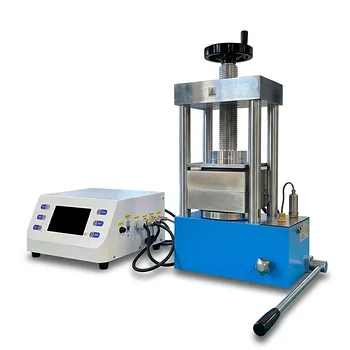
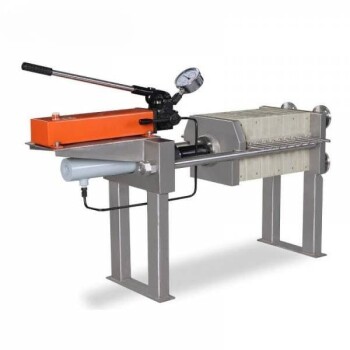
Laboratory hydraulic presses function as the critical densification engine in the manufacturing of carbon-carbon composite components. Their primary purpose is to apply precise, preset pressure that forces powder particles and fibers to rearrange and bond, effectively transforming loose material into a solid "green" compact with controlled initial density.
Core Takeaway: By mechanically compacting materials and eliminating internal voids, these presses establish the necessary microstructure for component integrity. They serve as a vital bridge between raw mixture formulation and the final high-temperature sintering process.
The Mechanics of Density Control
Forcing Particle Rearrangement
The fundamental role of the hydraulic press is mechanical compaction. The equipment applies force to powder particles and fibers, causing them to shift positions and lock together tightly.
Eliminating Internal Pores
This compaction process is essential for eliminating large internal pores found in the raw mixture. By reducing porosity at this stage, the press defines the material's initial density.
Expelling Trapped Air
Beyond simple compaction, the pressure serves to actively expel air trapped between powder particles. Removing this air is a prerequisite for achieving high "green density" (the strength of the material before sintering).
The Specific Role of Isostatic Pressing
Uniform Omnidirectional Pressure
Unlike standard molding presses that might apply force from one direction, isostatic pressing equipment applies pressure equally from all directions.
Consistency in Complex Geometries
This multidirectional approach ensures that components with complex shapes maintain a consistent microstructure. It guarantees that physical properties remain uniform across the entire part, rather than varying based on geometry.
Preparing for Production and Sintering
Preventing Structural Defects
Pre-pressing the material is a preventive measure against future failures. By ensuring uniform density now, the press reduces the risk of lamination (layer separation) and internal pore defects during the subsequent hot-press sintering process.
Ensuring Uniform Shrinkage
A well-compacted part will shrink uniformly when heated. This stability is vital for maintaining the dimensional accuracy and structural integrity of the final composite component.
Process Validation
Laboratory presses allow manufacturers to validate processes on a small scale. This step ensures that the specific recipe and pressure settings yield the correct results before the process is migrated to automated, high-volume production systems.
Understanding the Trade-offs
Precision vs. Speed
While laboratory presses offer high control over pressure and dwell time, they are generally designed for batch processing or testing. They are not optimized for the high-throughput speed required in mass manufacturing.
Complexity of Isostatic Equipment
Isostatic pressing delivers superior uniformity for complex shapes, but the equipment is often more complex to operate and maintain compared to standard uniaxial molding presses.
Making the Right Choice for Your Goal
To select the right pressing strategy for your carbon-carbon composites, consider your specific manufacturing objectives:
- If your primary focus is complex geometries: Prioritize isostatic pressing to ensure uniform density and prevent weak points in non-standard shapes.
- If your primary focus is structural integrity: Ensure your press cycles include sufficient dwell time to fully expel air and prevent lamination during sintering.
- If your primary focus is scaling to mass production: Use the laboratory press strictly for process validation to refine parameters before investing in high-rate automation.
The quality of your final composite is determined by the precision of this initial compaction.
Summary Table:
| Function | Key Mechanism | Benefit for Carbon-Carbon Composites |
|---|---|---|
| Particle Rearrangement | Mechanical Compaction | Transforms loose powder/fibers into a solid 'green' compact |
| Porosity Reduction | Eliminating Internal Pores | Defines initial material density and reduces structural voids |
| Isostatic Pressing | Omnidirectional Pressure | Ensures uniform microstructure in complex, non-standard shapes |
| Defect Prevention | Expelling Trapped Air | Prevents lamination and ensures uniform shrinkage during sintering |
| Process Validation | Small-scale Testing | Refines pressure parameters before moving to mass production |
Precision densification is the foundation of high-performance carbon-carbon composites. KINTEK specializes in advanced laboratory equipment designed to meet your most rigorous material science needs. Whether you require isostatic, pellet, or hot hydraulic presses for critical compaction, or high-temperature furnaces for final sintering, our solutions ensure uniform density and structural integrity. From crushing and milling systems to high-pressure reactors and essential ceramic consumables, KINTEK provides the end-to-end tools necessary for breakthrough research and production. Contact KINTEK today to discover how our expertise can optimize your laboratory's efficiency and material performance!
References
- Taras Yanko, Ганна Володимирівна Карпенко. Possibilities of Using Low-Density C–C Composites for Thermal Protection of Small Unmanned Aerial Vehicles. DOI: 10.2478/tar-2023-0011
This article is also based on technical information from Kintek Solution Knowledge Base .
Related Products
- Automatic Laboratory Hydraulic Press for XRF & KBR Pellet Press
- Laboratory Hydraulic Press Split Electric Lab Pellet Press
- Manual Lab Heat Press
- Automatic High Temperature Heated Hydraulic Press Machine with Heated Plates for Lab
- Ball Press Mold for Lab
People Also Ask
- What is the significance of applying 200 MPa of pressure with a laboratory hydraulic pellet press for composite ceramics?
- What is the role of a laboratory hydraulic pellet press and stainless steel molds in the fabrication of RuO2/NbC anodes?
- What is the necessity of using a laboratory hydraulic pellet press in the preparation of biomass fuel pellets? Guide
- How does a laboratory hydraulic pellet press contribute to SiCw/2024 aluminum composite preforms? Optimize Densification
- What role does a laboratory hydraulic pellet press play in fly ash utilization? Enhancing Adsorption and Flow Control