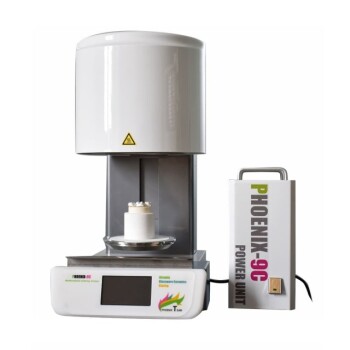
A high-temperature laboratory furnace serves two fundamental functions in the processing of zirconium dioxide: facilitating the phase transformation of the material into stable crystalline structures and removing organic additives to refine the material's physical architecture. This thermal treatment is the critical step that converts raw, often amorphous precursors into functional, high-performance ceramics.
Core Takeaway The calcination process acts as a dual-purpose mechanism for material engineering. It provides the energy necessary to stabilize zirconium dioxide into specific crystalline phases (monoclinic, tetragonal, or cubic) while simultaneously oxidizing organic templates to unlock the material's microporous structure.
The Mechanics of Zirconium Dioxide Calcination
The utility of a high-temperature furnace goes beyond simple drying. It is a precision environment used to dictate the chemical and physical properties of the final product.
Facilitating Phase Transformation
Raw zirconium dioxide often exists in an amorphous state or possesses low crystallinity. This state is generally unstable and unsuitable for high-performance applications.
The furnace provides the specific thermal energy required to rearrange the atomic structure.
Through this heating process, the material transforms into stable crystalline phases, specifically monoclinic, tetragonal, or cubic structures, depending on the temperature profile applied.
Removal of Organic Templates
In many advanced manufacturing processes, organic materials like polystyrene are used as templates to shape the zirconium dioxide.
Once the shape is set, these organic templates become impurities that must be eliminated.
The furnace creates an environment that facilitates the complete oxidation of these organic components, effectively burning them out of the matrix without damaging the ceramic framework.
Revealing Microporous Structures
The removal of organic templates is not just about purification; it is about structural activation.
When the organic material is oxidized and removed, it leaves behind voids where the template used to be.
This process releases the microporous structures inherent to the design, allowing researchers to observe the final particle morphology and utilize the material's specific surface area.
Critical Process Considerations
While the functions are straightforward, achieving the desired result requires balancing several factors.
Complete Volatile Expulsion
Beyond the specific organic templates, the furnace must also drive off absorbed moisture and other volatile constituents like carbon dioxide.
Failure to fully expel these elements can lead to defects or structural weaknesses in the final ceramic product.
Thermal Precision vs. Material Integrity
The temperature must be high enough to induce the desired phase transformation (e.g., reaching the cubic phase).
However, if the heating rate is too aggressive while removing organic templates, the rapid gas release can crack or destroy the delicate microporous structure.
Optimizing Your Thermal Processing Strategy
To get the most out of your calcination process, align your furnace parameters with your specific material goals.
- If your primary focus is Phase Stability: Ensure your furnace can reach and maintain the specific isotherms required to lock the zirconium dioxide into the desired tetragonal or cubic structure.
- If your primary focus is Porosity and Morphology: Prioritize a heating profile that allows for the slow, controlled oxidation of organic templates (like polystyrene) to preserve the integrity of the microporous network.
Success in calcination relies on viewing the furnace not just as a heat source, but as a tool for precise structural and chemical control.
Summary Table:
| Function | Key Mechanism | Resulting Benefit |
|---|---|---|
| Phase Transformation | High-energy thermal rearrangement | Stabilizes monoclinic, tetragonal, or cubic crystalline structures |
| Organic Removal | Oxidation of templates (e.g., polystyrene) | Eliminates impurities and burns out carbon-based binders |
| Structural Activation | Volatile expulsion & void creation | Reveals microporous architecture and final particle morphology |
| Material Refinement | Moisture and CO2 removal | Prevents structural defects and ensures high-performance ceramic integrity |
Elevate Your Material Research with KINTEK Precision
Unlock the full potential of your zirconium dioxide processing with KINTEK’s advanced thermal solutions. Whether you require precise phase stabilization or controlled oxidation for microporous structures, our comprehensive range of high-temperature muffle, tube, and vacuum furnaces provides the exact atmospheric and thermal control your laboratory demands.
Beyond heating, KINTEK specializes in a full suite of laboratory equipment—from crushing and milling systems to high-pressure reactors and PTFE consumables—designed to support every stage of your ceramic and battery research.
Ready to optimize your calcination results? Contact us today to discuss how our laboratory equipment can enhance your research efficiency and material performance.
References
- Siti Machmudah, Motonobu Goto. Synthesis of ZrO2 nanoparticles by hydrothermal treatment. DOI: 10.1063/1.4866753
This article is also based on technical information from Kintek Solution Knowledge Base .
Related Products
- 1700℃ Laboratory High Temperature Tube Furnace with Alumina Tube
- 1400℃ Laboratory High Temperature Tube Furnace with Alumina Tube
- 1200℃ Muffle Furnace Oven for Laboratory
- 1400℃ Muffle Oven Furnace for Laboratory
- 1700℃ Muffle Oven Furnace for Laboratory
People Also Ask
- What functions does a laboratory high-temperature tube furnace perform? Master Catalyst Synthesis & Carbonization
- What roles does a high-temperature tube furnace play in the synthesis of N/O co-doped carbon? Master Precise Doping
- How does a laboratory tube furnace facilitate methane catalyst evaluation & regeneration? Optimize Thermal Performance
- What are the primary applications of muffle and tube furnaces in photocatalysts? Optimize Metal Loading & Support Synthesis
- How does a high-temperature tube furnace influence 253MA steel? Master Microstructure & High-Temp Creep Resistance