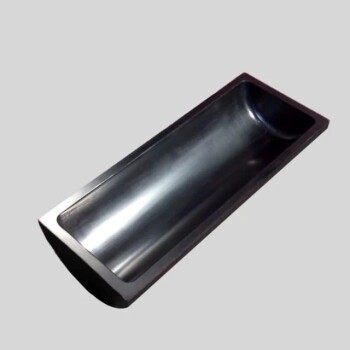
Graphite molds for vacuum hot pressing must possess exceptional hot strength and thermal conductivity. To function effectively as both a containment vessel and a pressure transmitter, the mold must withstand uniaxial mechanical pressures of up to 245 MPa at 550°C without suffering from creep or fracture. Simultaneously, the material must drive heat uniformly to the center of the powder sample to guarantee a consistent microstructure.
Core Takeaway: The success of aluminum matrix composites relies on the mold's ability to maintain total structural rigidity under extreme load while acting as a precise thermal conductor. If the mold deforms or heats unevenly, the resulting material will suffer from density gradients and inconsistent mechanical properties.
Mechanical Integrity Under Load
Withstanding Uniaxial Pressure
In vacuum hot pressing, the mold is not passive; it is an active load-bearing component. It must act as the primary container that transfers force from the hydraulic press directly to the powder mixture.
The graphite must be of sufficiently high strength to endure pressures as high as 245 MPa. This ensures the powder particles are forced into close contact within the restricted space, allowing for the precise consolidation required for high-performance composites.
Resistance to Creep and Deformation
At processing temperatures (typically around 550°C for aluminum), standard materials often soften or yield.
High-quality graphite is required because it resists creep—the tendency to slowly deform under long-term stress. The mold must maintain its exact dimensions throughout the cycle to ensure the geometric precision of the final composite part.
Thermal Dynamics and Microstructure
Uniform Heat Distribution
The second critical requirement is high thermal conductivity. Because heat is applied externally, the mold must transfer thermal energy quickly and evenly to the center of the powder sample.
Ensuring Consistent Microstructure
If the mold has poor or uneven conductivity, temperature gradients will form across the sample.
This leads to uneven sintering, where the outer edges may be fully consolidated while the core remains porous. High-conductivity graphite ensures that the microstructure—and therefore the material performance—is uniform throughout the entire specimen.
Chemical and Surface Requirements
Chemical Inertness
The mold material must be chemically stable in a vacuum environment.
It is vital that the mold does not react with the aluminum matrix or alloying elements like tin (Sn). Reaction layers can contaminate the sample and bond the composite to the mold walls, destroying the part.
Oxidation Prevention
Graphite provides a functional benefit by creating a localized reducing atmosphere.
This helps protect the metal powders from oxidation caused by residual oxygen in the chamber. This feature is particularly important for aluminum, which is highly susceptible to oxide formation that degrades sintering quality.
Lubricity and Demolding
The mold interface must allow for the easy removal of the sample after processing.
Graphite possesses natural lubricity, which facilitates demolding without the need for complex release agents. This preserves the surface finish of the sintered composite.
Understanding the Trade-offs
The Risk of Liquid Phase Leakage
While graphite is excellent for solid-state sintering, challenges arise during liquid phase sintering where temperatures are higher.
If the process temperature drifts even slightly above the target (e.g., rising from 700°C to 720°C), the viscosity of the aluminum melt decreases drastically.
Precision Tolerances are Mandatory
Under high axial pressure, this low-viscosity liquid can easily leak through the clearances of the graphite mold.
This results in component segregation, altering the chemical composition of the composite and ruining its mechanical properties. Therefore, the mold requires high-precision machining and tight tolerances to contain the melt effectively.
Making the Right Choice for Your Goal
To ensure the integrity of your aluminum matrix composites, align your mold selection with your specific processing parameters:
- If your primary focus is Maximum Density: Prioritize graphite grades with the highest compressive strength to safely utilize pressures up to 245 MPa for maximum particle consolidation.
- If your primary focus is Complex Alloy Homogeneity: Prioritize graphite with superior thermal conductivity to prevent segregation and ensure uniform phase distribution across the part.
- If your primary focus is Liquid Phase Sintering: Prioritize dimensional precision and tight mating tolerances to prevent low-viscosity melt leakage during temperature spikes.
Select a graphite grade that balances high-temperature rigidity with thermal precision to ensure your composite meets its design potential.
Summary Table:
| Requirement | Specification / Benefit | Critical Impact |
|---|---|---|
| Mechanical Strength | Up to 245 MPa at 550°C | Prevents fracture and creep under high uniaxial pressure |
| Thermal Conductivity | High & Uniform | Ensures consistent microstructure and prevents density gradients |
| Chemical Stability | Chemically Inert | Avoids reaction with aluminum matrix and contamination |
| Atmospheric Control | Reducing Atmosphere | Naturally protects metal powders from oxidation |
| Surface Property | Natural Lubricity | Facilitates easy demolding and preserves surface finish |
| Precision Tolerances | Tight Machining | Prevents liquid phase leakage and component segregation |
Elevate Your Composite Manufacturing with KINTEK
Maximize the integrity and precision of your materials with KINTEK’s specialized laboratory solutions. Whether you are performing vacuum hot pressing or liquid phase sintering, our high-precision graphite molds and advanced hydraulic presses provide the reliability your research demands.
Why partner with KINTEK?
- Comprehensive Equipment: From high-temperature vacuum furnaces and crushing systems to isostatic and hot presses.
- Precision Engineering: Our molds and consumables, including ceramics and PTFE products, are designed for extreme thermal and mechanical loads.
- Expert Support: We help research labs and industrial manufacturers optimize their workflows for aluminum matrix composites and battery research.
Ready to achieve consistent, high-density results? Contact our technical experts today to find the perfect equipment for your specific processing needs.
Related Products
- Ultra-High Temperature Graphite Vacuum Graphitization Furnace
- Vertical High Temperature Graphite Vacuum Graphitization Furnace
- Horizontal High Temperature Graphite Vacuum Graphitization Furnace
- 2200 ℃ Graphite Vacuum Heat Treat Furnace
- Vacuum Heat Treat and Pressure Sintering Furnace for High Temperature Applications
People Also Ask
- What is the disadvantage of graphite furnace? Managing Reactivity and Contamination Risks
- Is a graphite melting point high or low? Discover Its Extreme Thermal Resilience
- What are the advantages and disadvantages of graphite furnace? Unlock Extreme Heat Performance
- What is the temperature of a graphite furnace? Achieve Extreme Heat Up to 3000°C
- What are the disadvantages of graphite furnace? Key Limitations and Operational Costs