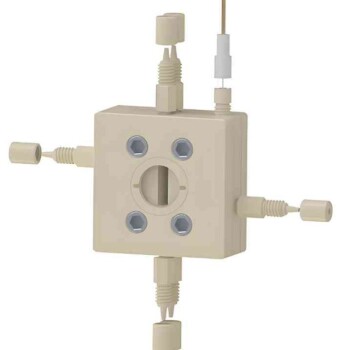
Employing a high-pressure supercritical CO2 extraction system offers a distinct technical advantage by functioning as a highly effective, "green" pretreatment for marine biomass. Its primary utility lies in its ability to physically penetrate dense biological structures to disrupt the lignin matrix, thereby significantly enhancing the efficiency of downstream conversion processes.
Core Takeaway While marine biomass is notoriously dense and resistant to breakdown, supercritical CO2 acts as a solvent wedge that physically loosens the structural lignin barrier. This pretreatment is critical for "unlocking" the material, allowing subsequent processing steps to achieve reducing sugar yields up to 2.9 times higher than those possible with untreated samples.
Mechanics of Structural Disruption
Penetrating Dense Material
Marine biomass possesses a naturally dense structure that resists chemical breakdown. High-pressure supercritical CO2 is unique because it exhibits the diffusivity of a gas while maintaining the density of a liquid.
This dual nature allows the solvent to deeply penetrate the compact biomass architecture that conventional liquids might fail to permeate.
Loosening the Lignin Matrix
Once inside the biomass, the supercritical CO2 acts on the lignin matrix. Lignin serves as a protective barrier in plant matter, cementing fibers together and blocking access to valuable components.
This system effectively physically loosens this matrix. By breaking down this lignin barrier, the system exposes the internal components that are necessary for value-added production.
Enhancing Downstream Efficiency
Increasing Holocellulose Accessibility
The primary technical goal of this pretreatment is not just disruption, but exposure. By loosening the lignin, the system exposes holocellulose (the carbohydrate portion of the biomass).
This accessibility is specifically designed to facilitate subsequent supercritical water treatment. Without this pretreatment, the water treatment would face a significant physical barrier, rendering it less effective.
Significant Yield Amplification
The tangible metric of success for this method is the production of reducing sugars. The primary reference data indicates a massive performance gap between treated and untreated biomass.
Samples subjected to this CO2 pretreatment demonstrate a concentration of reducing sugars in the liquid phase that is up to 2.9 times higher than untreated counterparts. This multiplier confirms that the physical loosening of the matrix directly translates to chemical yield.
Understanding the Process Dependencies
Pretreatment vs. Conversion
It is vital to recognize that supercritical CO2 extraction in this context is a pretreatment step, not a standalone conversion method.
Its value is derived from how well it prepares the biomass for the next phase: supercritical water treatment. The high sugar yields cited (2.9x) are realized only when the loosened biomass is subsequently processed by supercritical water, utilizing the accessibility the CO2 created.
Making the Right Choice for Your Goal
To determine if this extraction system aligns with your specific processing requirements, consider the following technical priorities:
- If your primary focus is maximizing yield: Implement this system to leverage the 2.9x increase in reducing sugars by exposing holocellulose prior to hydrolysis.
- If your primary focus is process synergy: Utilize this pretreatment specifically if you are already employing supercritical water treatment downstream, as the two processes are chemically and physically complementary.
- If your primary focus is environmental compliance: Adopt this method to utilize a "green" solvent (CO2) that avoids the toxicity issues associated with traditional chemical pretreatments.
This system effectively transforms the physical limitations of marine biomass into chemical opportunities.
Summary Table:
| Feature | Supercritical CO2 Pretreatment | Traditional Chemical Pretreatment |
|---|---|---|
| Mechanism | Physical penetration & matrix loosening | Surface-level chemical degradation |
| Environmental Impact | Green solvent, non-toxic | Potential for hazardous waste |
| Yield Improvement | Up to 2.9x higher reducing sugars | Standard/Variable |
| Target Material | Lignin matrix in marine biomass | General biomass fibers |
| System Synergy | Ideal for supercritical water treatment | Limited compatibility |
Maximize Your Biomass Potential with KINTEK Technology
Ready to scale your extraction efficiency? KINTEK specializes in advanced laboratory and industrial equipment, providing the precision high-pressure tools necessary to unlock the value in dense marine biomass. From high-temperature high-pressure reactors and autoclaves to complete crushing and milling systems, we offer the robust solutions required for supercritical fluid applications.
Our team of experts is dedicated to helping you achieve up to 2.9x yield amplification through superior technical integration. Whether you are focused on battery research, specialized ceramics, or green extraction processes, KINTEK delivers the durability and performance your lab demands.
Contact us today to optimize your research workflow!
Get a Quote & Professional Consultation
References
- İrem Deniz. Marin biyokütlenin hidrotermal sıvılaştırılması: Entegre bir proses. DOI: 10.21541/apjes.320484
This article is also based on technical information from Kintek Solution Knowledge Base .
Related Products
- Mini SS High Pressure Autoclave Reactor for Laboratory Use
- Customizable High Pressure Reactors for Advanced Scientific and Industrial Applications
- Customer Made Versatile CVD Tube Furnace Chemical Vapor Deposition Chamber System Equipment
- Customizable Laboratory High Temperature High Pressure Reactors for Diverse Scientific Applications
- Stainless High Pressure Autoclave Reactor Laboratory Pressure Reactor
People Also Ask
- Why use high-pressure reactors for molecular sieve synthesis? Unlock Superior Crystallinity and Framework Control
- What are the advantages of using a high-pressure reactor like an autoclave? Maximize Liquefaction Speed & Yield
- What is the function of a high-pressure reactor autoclave? Enhancing Cu/N Co-Doped Carbon Catalyst Synthesis
- Why are high-pressure reactors or autoclaves necessary for the synthesis of new functional materials? Unlock Precision.
- How are high-pressure reactors used to prepare metaphosphate electrocatalysts? Master In-Situ Precursor Growth