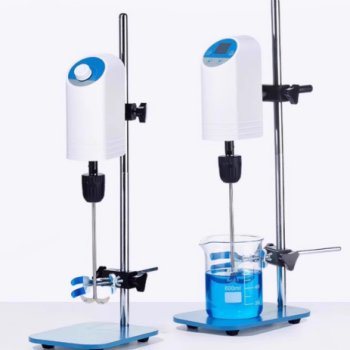
The decisive advantage of using an industrial electric stirrer lies in its ability to apply continuous, uniform mechanical shear force to the mixture. This mechanical action is critical for breaking down stubborn agglomerations of nano-ZrO2 particles, ensuring they are evenly dispersed throughout the PMMA matrix rather than remaining in clumps.
The structural integrity of a composite is defined by its weakest point. Industrial stirring eliminates these weak points by transforming a clumpy mixture into a structurally continuous barrier, which is essential for effective gamma-ray shielding.
Breaking Down Particle Agglomeration
The Role of Mechanical Shear
The primary function of the industrial stirrer is the application of mechanical shear force.
Unlike manual mixing, which varies in intensity, an electric stirrer provides a constant force profile. This consistency is required to physically pull apart particle clusters.
Overcoming Nano-Scale Clumping
Nano-ZrO2 particles have a natural tendency to agglomerate, or stick together, forming larger clusters.
Through extended processing times (such as 20 minutes), the stirrer effectively disintegrates these agglomerations. This ensures the filler exists as individual particles rather than ineffective clumps.
Achieving Structural Continuity
Uniform Dispersion
Once the agglomerations are broken down, the stirrer ensures the particles are distributed evenly within the polymer monomer.
This results in a "high degree of uniform dispersion." The filler becomes an integral part of the matrix rather than a separate suspension.
Eliminating Weak Shielding Zones
The direct result of uniform dispersion is the prevention of "weak zones."
In a poorly mixed composite, areas with low particle density allow radiation to pass through. Industrial stirring homogenizes the density, enhancing the overall gamma-ray blocking effectiveness of the material.
Operational Considerations
Time Intensity
Achieving this level of uniformity is not instantaneous.
The process requires extended periods of operation, such as the referenced 20-minute cycle, to ensure the shear force has sufficient time to act on the entire volume of the mixture.
Equipment Dependency
The results described are specific to the continuous nature of industrial equipment.
Manual or low-power mixing methods cannot sustain the uniform shear force necessary to achieve true structural continuity in nano-particle composites.
Optimizing Your Mixing Protocol
To maximize the performance of your ZrO2/PMMA composite, align your mixing strategy with your specific performance goals:
- If your primary focus is Maximum Radiation Shielding: Ensure the stirring duration is sufficient to eliminate all agglomerations, as even small clumps can create radiation leakage paths.
- If your primary focus is Structural Homogeneity: Prioritize the consistency of the shear force to guarantee that the structural continuity of the polymer monomer is maintained throughout the casting.
The quality of your final composite is directly proportional to the uniformity of the shear force applied during the mixing phase.
Summary Table:
| Feature | Technical Advantage | Impact on Composite |
|---|---|---|
| Mechanical Shear | Continuous, uniform force application | Breaks down nano-ZrO2 agglomerations |
| Dispersion Quality | High degree of uniform particle distribution | Eliminates "weak zones" for radiation leakage |
| Structural Integrity | Homogenized matrix density | Ensures consistent gamma-ray blocking |
| Process Control | Sustained intensity (e.g., 20-min cycles) | Achieves true nano-scale particle integration |
Optimize Your Composite Research with KINTEK Precision Mixing
Achieving the perfect dispersion of nano-particles requires more than just mixing—it requires precise, industrial-grade control. KINTEK specializes in advanced laboratory equipment designed to meet the rigorous demands of material science. Whether you are developing radiation-shielding composites or high-performance polymers, our range of industrial stirring systems, crushing and milling equipment, and high-pressure reactors provides the uniform shear force necessary for structural continuity.
Why choose KINTEK?
- Comprehensive Solutions: From homogenizers and shakers to PTFE consumables and ceramics, we provide everything needed for precise material preparation.
- Expertise in Scale: Our equipment is engineered to eliminate particle clumping and ensure the structural integrity of your matrix.
- Tailored Support: We help researchers select the right tools for battery research, high-temperature processing, and advanced composite synthesis.
Elevate your lab’s output and ensure your materials meet the highest shielding standards. Contact KINTEK today to find the perfect mixing solution for your application!
References
- Mahmoud T. Alabsy, Ahmed M. El‐Khatib. Attenuation properties of poly methyl methacrylate reinforced with micro/nano ZrO2 as gamma-ray shields. DOI: 10.1038/s41598-024-51551-4
This article is also based on technical information from Kintek Solution Knowledge Base .
Related Products
- High Performance Laboratory Stirrers for Diverse Applications
- Laboratory Small Constant Temperature Heated Magnetic Stirrer Heater and Stirrer
- Three-dimensional electromagnetic sieving instrument
- Laboratory Scientific Electric Heating Blast Drying Oven
- Electric Rotary Kiln Pyrolysis Furnace Plant Machine Calciner Small Rotary Kiln Rotating Furnace
People Also Ask
- How does a laboratory stirrer influence MOF product quality? Master Precision in Non-Solvothermal Synthesis
- What critical role does a Laboratory Stirrer play during leaching? Enhance Titanium-Magnesium Waste Recovery
- What is the primary function of laboratory stirring equipment in the preparation of compost leachate? Optimize Extraction
- What is a laboratory mixer? A Guide to Achieving Perfect Sample Homogeneity
- What is a laboratory mixer used for? Choose the Right Tool for Liquids or Solids