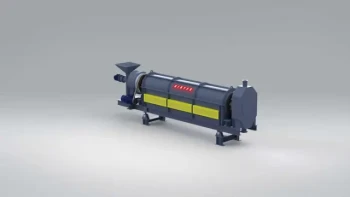
An industrial tube furnace provides a rigorous calcination environment defined by three specific process conditions: a high-temperature ceiling up to 600°C, a controlled heating ramp of 5°C/min, and a constant gas flow rate of 50 mL/min. These parameters are not arbitrary; they are essential for managing the interaction between boron oxides and the cerium dioxide support to ensure the final catalyst achieves the necessary structural integrity.
The primary function of the tube furnace in this application is to enforce structural uniformity. By precisely synchronizing the heating rate with gas flow, the furnace prevents phase aggregation, ensuring boron oxides form highly dispersed, amorphous active sites that maximize the catalyst's acidic strength.
The Critical Process Parameters
Precise Thermal Regulation
The furnace maintains a highly stable high-temperature environment, capable of reaching 600°C. This thermal capacity is required to fully activate the catalyst precursors without inducing thermal degradation.
Equally important is the heating rate, specifically set at 5°C/min. This gradual ramp prevents thermal shock and allows for the orderly evolution of the catalyst structure.
Controlled Gas Dynamics
The equipment facilitates a continuous, controlled gas flow, typically regulated at 50 mL/min. This flow is critical for mass transfer within the heating zone.
It ensures that the atmosphere surrounding the sample remains consistent, preventing the buildup of volatile byproducts that could interfere with surface chemistry.
Impact on Catalyst Structure
Promoting Amorphous Dispersion
The combination of the specific heating ramp and gas flow ensures that boron oxides are uniformly distributed across the cerium dioxide surface.
Rather than forming large crystalline clusters, the boron species form amorphous or highly dispersed active sites. This dispersion is the key differentiator between a high-performance catalyst and a mediocre one.
Enhancing Acidic Properties
The ultimate goal of these process conditions is to manipulate the chemical nature of the active sites.
By ensuring uniform dispersion, the process significantly increases both the number and strength of the catalyst's acid centers, which are the primary drivers of catalytic activity in CeO2@B2O3 systems.
Understanding the Operational Trade-offs
The Risk of Accelerated Heating
While it may be tempting to increase the heating rate above 5°C/min to save time, this often leads to suboptimal results.
Rapid heating can cause the boron oxides to aggregate rather than disperse. This reduces the surface area of active sites and diminishes the final acidity of the catalyst.
Sensitivity to Flow Variance
The gas flow rate of 50 mL/min must be maintained with high precision.
Fluctuations in flow can create uneven thermal gradients or inconsistent atmosphere turnover. This results in localized heterogeneity, where some parts of the catalyst batch are fully activated while others remain under-processed.
Optimizing Your Calcination Protocol
To ensure consistent production of high-quality CeO2@B2O3 catalysts, adhere to the following guidelines:
- If your primary focus is maximizing active sites: Prioritize the 5°C/min heating rate above all else to ensure the boron oxides have sufficient time to disperse into an amorphous state.
- If your primary focus is process reproducibility: Strict control of the 50 mL/min gas flow is essential to minimize batch-to-batch variations in surface uniformity.
Mastering the balance between thermal ramp and atmospheric flow is the definitive step in converting raw precursors into a high-efficiency industrial catalyst.
Summary Table:
| Process Parameter | Specific Requirement | Critical Role in Catalyst Quality |
|---|---|---|
| Temperature Ceiling | Up to 600°C | Ensures full precursor activation without degradation. |
| Heating Ramp | 5°C/min | Prevents phase aggregation; promotes amorphous dispersion. |
| Gas Flow Rate | 50 mL/min | Manages mass transfer and prevents byproduct interference. |
| Target Outcome | High Acidity | Maximizes the number and strength of active catalytic sites. |
Precision Calcination for High-Performance Catalysis
Unlock the full potential of your CeO2@B2O3 catalysts with KINTEK’s advanced industrial tube furnaces. Designed for rigorous research and production, our equipment provides the exact thermal stability and gas flow control needed to ensure uniform active site dispersion and maximum acidic strength.
From high-temperature tube, vacuum, and atmosphere furnaces to specialized crushing, milling, and pelletizing systems, KINTEK empowers material scientists and industrial chemists with the tools for structural perfection.
Ready to optimize your calcination protocol? Contact KINTEK today to discover how our high-precision solutions can enhance your lab's efficiency and process reproducibility.
References
- Luxin Zhang, Meng Hu. Catalytic conversion of carbohydrates into 5-ethoxymethylfurfural using γ-AlOOH and CeO<sub>2</sub>@B<sub>2</sub>O<sub>3</sub> catalyst synergistic effect. DOI: 10.1039/d2ra01866g
This article is also based on technical information from Kintek Solution Knowledge Base .
Related Products
- Vertical Laboratory Tube Furnace
- Electric Rotary Kiln Continuous Working Small Rotary Furnace Heating Pyrolysis Plant
- Customer Made Versatile CVD Tube Furnace Chemical Vapor Deposition Chamber System Equipment
- Electric Rotary Kiln Pyrolysis Furnace Plant Machine Calciner Small Rotary Kiln Rotating Furnace
- 1200℃ Split Tube Furnace with Quartz Tube Laboratory Tubular Furnace
People Also Ask
- What is the function of a laboratory vertical tube furnace in microalgae catalytic pyrolysis? Optimize Your Bio-Fuel.
- How does a laboratory tube furnace provide atmospheric control during the sintering of glass-ceramics? Achieve Precision
- Why is a laboratory tube furnace required for LMTP0.1/CA materials? Achieve Precise Carbon Coating & Crystal Growth
- How does a laboratory tube furnace provide precise temperature control? Expert Simulation for Steam Cracking
- What is the role of a laboratory tube furnace in zeolite nitridation? Precision Engineering for Advanced Catalysts