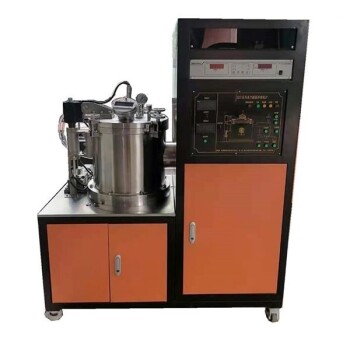
A vacuum vertical tube furnace establishes a critical dual-state environment combining stable high heat with controlled low pressure. Specifically, it maintains a stable heating environment up to 1723 K while sustaining vacuum conditions around 1 KPa. This specific combination alters the thermodynamic landscape of the carbothermic reduction of magnesium, making the process chemically efficient and physically viable.
The primary function of this environment is to significantly reduce the Gibbs free energy required for the reaction. By operating under vacuum, the furnace allows magnesium oxide reduction to occur at lower temperatures than possible at atmospheric pressure, while simultaneously shielding the resulting metallic magnesium from re-oxidation.
The Thermodynamics of the Reaction Environment
Reducing Gibbs Free Energy
The core challenge in carbothermic reduction is the energy barrier.
The vacuum vertical tube furnace addresses this by lowering the system pressure to approximately 1 KPa. This low-pressure environment significantly decreases the Gibbs free energy required for the reaction to proceed.
Enabling Lower Temperature Reactions
Under standard atmospheric pressure, the reduction of magnesium oxide requires extremely high temperatures that are often impractical.
By reducing the Gibbs free energy via vacuum pressure, the furnace allows the reaction to occur at lower temperatures. This thermodynamic shift makes the process energy-efficient and technically feasible within the furnace's operating range.
Stability and Product Protection
Stable High-Temperature Heating
Consistency is vital for reaction kinetics.
The furnace provides a stable high-temperature environment capable of reaching 1723 K. This ensures that once the thermodynamic barrier is lowered by the vacuum, the necessary thermal energy is consistently available to drive the reduction forward.
Preventing Re-Oxidation
Magnesium is highly reactive, especially in its metallic vapor form.
The vacuum environment serves a secondary, critical role: protection. By removing oxygen from the reaction chamber, the furnace ensures that the reduced metallic magnesium is not immediately re-oxidized, preserving the purity of the final yield.
Understanding the Operational Sensitivities
The Pressure-Temperature Balance
The efficiency of this furnace relies entirely on the interplay between pressure and heat.
If the vacuum pressure rises above 1 KPa, the benefit regarding Gibbs free energy diminishes. Consequently, the temperature required to drive the reaction would spike, potentially exceeding the furnace's 1723 K limit or rendering the process inefficient.
Making the Right Choice for Your Process
When evaluating a vacuum vertical tube furnace for magnesium reduction, consider your specific processing goals:
- If your primary focus is Energy Efficiency: Ensure the vacuum system can reliably maintain 1 KPa or lower, as this directly reduces the thermal energy required for the reaction.
- If your primary focus is Product Purity: Prioritize the stability of the vacuum seal to prevent oxygen ingress, which safeguards the metallic magnesium from oxidation.
The success of carbothermic magnesium reduction depends not just on heat, but on the precise manipulation of pressure to alter fundamental thermodynamics.
Summary Table:
| Feature | Operational Requirement | Impact on Carbothermic Reduction |
|---|---|---|
| Temperature | Stable up to 1723 K | Provides consistent thermal energy for kinetics |
| Vacuum Pressure | Approximately 1 KPa | Lowers Gibbs free energy; reduces reaction temperature |
| Atmosphere | Oxygen-Free (Vacuum) | Protects metallic magnesium vapor from re-oxidation |
| Energy State | Thermodynamic Shift | Makes high-energy reactions technically and economically viable |
Optimize Your Magnesium Reduction with KINTEK Precision
Unlock superior thermodynamic control in your laboratory with KINTEK’s high-performance vacuum vertical tube furnaces. Designed to maintain stable 1723 K temperatures and 1 KPa vacuum levels, our equipment ensures maximum efficiency and product purity for complex processes like carbothermic reduction.
Beyond furnace technology, KINTEK specializes in a comprehensive range of laboratory solutions, including:
- High-Temperature Furnaces: Muffle, tube, rotary, and atmosphere-controlled systems.
- Pressure & Reaction Vessels: High-temperature high-pressure reactors and autoclaves.
- Processing Equipment: Crushing, milling, and hydraulic pellet presses.
- Specialized Consumables: High-purity ceramics, crucibles, and PTFE products.
Whether you are conducting advanced metallurgy or battery research, our technical experts are ready to provide the precision tools your research demands. Contact KINTEK today to discuss your laboratory equipment needs!
Related Products
- Vertical High Temperature Graphite Vacuum Graphitization Furnace
- Vacuum Sealed Continuous Working Rotary Tube Furnace Rotating Tube Furnace
- Vertical Laboratory Tube Furnace
- Laboratory Vacuum Tilt Rotary Tube Furnace Rotating Tube Furnace
- Laboratory High Pressure Vacuum Tube Furnace
People Also Ask
- How does a vertical furnace work? Achieve Superior Uniformity in Semiconductor Manufacturing
- What is a vertical furnace? Achieve Superior Temperature Uniformity for Sensitive Processes
- What are the advantages of a vertical furnace versus a horizontal furnace? Maximize Lab Efficiency & Space
- How does a vertical furnace achieve energy-saving sintering? Harness Internal Energy for Efficient Pellet Treatment
- What is the use of graphite furnace? Achieve Extreme-Temperature Processing for Advanced Materials