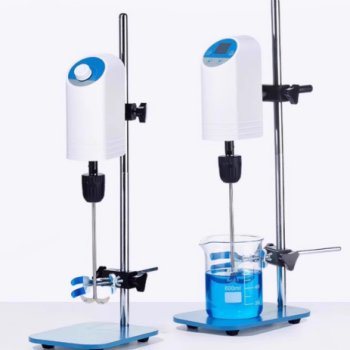
A high-pressure reactor equipped with a turbine stirrer serves as the essential processing unit for overcoming the structural recalcitrance of corncob biomass. This system functions by maintaining a precise high-temperature (170–230 °C) and high-pressure environment that keeps water in a liquid state, allowing it to act as an acid catalyst. Simultaneously, the integrated turbine stirrer drives the mechanical suspension of particles, ensuring that these chemical reactions occur uniformly rather than chaotically.
The Core Utility This technology couples a subcritical aqueous environment with vigorous mechanical agitation to drive the selective hydrolysis of hemicellulose. While the pressure vessel enables the chemical breakdown of lignocellulose by sustaining liquid water above its boiling point, the turbine stirrer is the physical enabler that eliminates thermal gradients, ensuring consistent lignin redistribution and preventing material degradation.
Creating the Thermodynamic Conditions for Hydrolysis
The primary function of the high-pressure reactor is to manipulate the physical state of water to trigger chemical changes in the corncob.
Maintaining the Subcritical State
The reactor is designed to withstand the vapor pressure generated at temperatures between 170 °C and 230 °C. By sealing the vessel, the system prevents water from vaporizing, keeping it in a liquid, subcritical state. This physical condition is a prerequisite for effective hydrothermal processing, as steam alone lacks the solvation capacity required here.
Generating an Autocatalytic Environment
Under these high-pressure and high-temperature conditions, the properties of liquid water change fundamentally. The environment facilitates the generation of hydrogen ions (H+), effectively turning the water itself into an acid-base catalytic medium. These ions catalyze the hydrolysis of hemicellulose into soluble sugars without the need for external chemical catalysts.
The Role of Mechanical Agitation
While the reactor provides the conditions for reaction, the turbine stirrer ensures the quality and completeness of the process.
Ensuring Particle Suspension
The integrated six-blade turbine stirrer prevents the corncob biomass from settling at the bottom of the reactor. By keeping the solid particles suspended in the aqueous medium, the stirrer ensures that every piece of biomass is equally exposed to the reactive subcritical water.
Eliminating Thermal Gradients
Without agitation, static heating leads to "hot spots" near the reactor walls and "cold spots" in the center. The stirrer induces forced convection, which eliminates these temperature gradients. This prevents localized overheating, which could otherwise lead to excessive carbonization or charring of the corncob.
Facilitating Mass Transfer
The mechanical action assists in the physical breakdown of the dense lignocellulosic structure. By ensuring uniform interaction between the solid and liquid phases, the stirrer aids in the efficient dissolution of hemicellulose. It also plays a critical role in the effective redistribution of lignin, preventing it from re-depositing unevenly on the cellulose fibers.
Understanding the Operational Trade-offs
While this system is highly effective, it introduces specific variables that must be managed to avoid process failure.
The Balance of Agitation Speed
While the stirrer is vital for uniformity, the physical interaction must be balanced. The primary goal is suspension and temperature homogenization. However, the system relies on the liquid medium to do the work; the stirrer must simply ensure the medium reaches the biomass, rather than acting as a grinder.
Sensitivity to Temperature Control
The window for effective treatment (170–230 °C) is distinct. Below this range, the water may not generate sufficient hydrogen ions for hydrolysis. Above this range, or if the stirrer fails to prevent hotspots, the biomass risks undergoing unwanted secondary reactions, such as excessive degradation or charring, rather than the intended pretreatment.
Making the Right Choice for Your Goal
When configuring a high-pressure reactor for corncob pretreatment, focus on how the stirring mechanism supports your specific chemical objectives.
- If your primary focus is Hemicellulose Recovery: Ensure the reactor can maintain a stable 170–230 °C range to maximize the generation of hydrogen ions for hydrolysis without degrading the sugars.
- If your primary focus is Lignin Modification: Prioritize a six-blade turbine configuration to maximize particle suspension, ensuring the uniform redistribution of lignin across the solid residue.
Ultimately, the reactor provides the chemical potential, but the turbine stirrer converts that potential into a consistent, high-quality result.
Summary Table:
| Feature | Function in Hydrothermal Pretreatment | Key Benefit |
|---|---|---|
| High-Pressure Vessel | Maintains water in subcritical liquid state (170–230 °C) | Enables autocatalytic hemicellulose hydrolysis |
| Turbine Stirrer | Drives mechanical suspension and forced convection | Eliminates thermal gradients and prevents charring |
| Phase Interaction | Ensures uniform contact between solid and liquid | Maximizes mass transfer and lignin redistribution |
| Reaction Control | Precise temperature and agitation management | Prevents material degradation and secondary reactions |
Maximize Your Biomass Research Yield with KINTEK
Unlock the full potential of your lignocellulosic research with KINTEK’s precision engineering. Whether you are performing hydrothermal pretreatment, chemical synthesis, or advanced material testing, our high-temperature high-pressure reactors and autoclaves provide the stability and control required for consistent results.
Why choose KINTEK?
- Comprehensive Equipment Range: From specialized turbine-stirred reactors to high-temp furnaces (muffle, vacuum, CVD) and hydraulic presses.
- Lab-to-Scale Solutions: We offer everything from battery research tools and cooling solutions to essential consumables like PTFE and ceramics.
- Unmatched Expertise: Our systems are designed to eliminate thermal gradients and ensure the structural integrity of your samples.
Ready to elevate your laboratory capabilities? Contact us today to find the perfect reactor configuration for your application!
References
- Tang-sheng Sun, Feng Xu. Hydrothermal Treatment and Enzymatic Saccharification of Corncobs. DOI: 10.15376/biores.9.2.3000-3013
This article is also based on technical information from Kintek Solution Knowledge Base .
Related Products
- Customizable Laboratory High Temperature High Pressure Reactors for Diverse Scientific Applications
- Stainless High Pressure Autoclave Reactor Laboratory Pressure Reactor
- High Pressure Laboratory Autoclave Reactor for Hydrothermal Synthesis
- Customizable High Pressure Reactors for Advanced Scientific and Industrial Applications
- Mini SS High Pressure Autoclave Reactor for Laboratory Use
People Also Ask
- How do high-pressure and high-temperature reactors ensure the effective treatment of lignocellulosic wastewater in WAO?
- What equipment is required for high-pressure high-temperature reactions? Master Extreme Chemistry Safely
- How do you control high pressure in a reactor? A Guide to Safe & Stable Operation
- Why is argon better than nitrogen for inert atmosphere? Ensure Absolute Reactivity & Stability
- How does initial oxygen pressure affect the wet oxidation of pharmaceutical sludge? Master Your Oxidation Depth