Effective design for molybdenum disilicide (MoSi2) heating elements centers on precise thermal regulation and robust mechanical integration. To ensure longevity and performance, your design must include high-precision instrumentation to rapidly bypass the "pest oxidation" temperature zone (400-700°C) and stable mechanical supports that accommodate the element's physical characteristics. Failing to account for these specific material behaviors will lead to rapid degradation, regardless of the element's quality.
Core Takeaway: The reliability of MoSi2 elements relies on the integrity of a self-healing silicon dioxide protective film. Muffle furnace designs must strictly avoid prolonged operation in the 400-700°C range where this film fails (causing "pest" oxidation) and ensure surface temperatures never exceed the melting point of the quartz layer (approx. 1700°C).
Critical Temperature Management strategies
Avoiding the "Pest" Oxidation Zone
The most critical vulnerability of MoSi2 is a phenomenon known as "pest" oxidation. This occurs within a specific low-temperature range, identified as 400-600°C in some contexts and extending up to 700°C in others.
During prolonged exposure to this range, the material oxidizes aggressively, turning into powder or pulverizing. Therefore, your temperature control system must be programmed to ramp quickly through this zone rather than dwelling there.
Preserving the Protective Film
At high temperatures in oxidizing environments, MoSi2 forms a dense, protective film of silicon dioxide (quartz glass) on its surface. This film prevents further oxidation of the core material.
Your design must ensure the operating environment supports the formation and maintenance of this layer. This is the mechanism that allows the elements to achieve superior performance at temperatures exceeding 1700°C.
Respecting Upper Temperature Limits
While MoSi2 is capable of extreme heat (up to 1800-1850°C), the protective quartz film has a physical limit. If the element surface temperature exceeds 1700°C, the protective film will melt.
At this point, the film forms droplets and loses its protective function. Design your thermal profiles to ensure the element surface temperature—which is hotter than the furnace chamber—does not breach this threshold.
Electrical and Mechanical Integration
Mechanical Support Requirements
MoSi2 elements become ductile at high temperatures and brittle at low temperatures. Consequently, the furnace design must provide stable mechanical support.
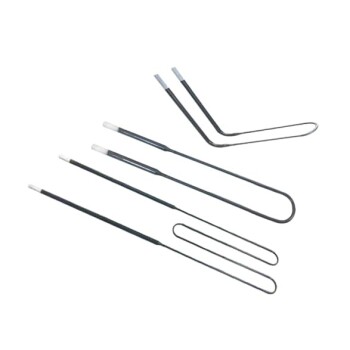
Proper hanging or support structures are necessary to prevent deformation or breakage during thermal expansion and contraction. The elements are available in various shapes (U, W, L, bent), allowing for flexible design configurations provided the support logic is sound.
Electrical Stability and Load
Unlike Silicon Carbide (SiC) elements, MoSi2 maintains constant electrical resistance over time. This offers a significant design advantage: you do not need complex power supplies to adjust for aging.
New and old elements can be connected in series without causing imbalances. This simplifies maintenance and circuit design, allowing for fast thermal cycling and high watt loading.
Understanding the Trade-offs
Low-Temperature Incompatibility
These elements are fundamentally unsuitable for processes requiring sustained holds at lower temperatures. If your application requires dwelling between 400°C and 700°C, MoSi2 is likely the wrong material choice due to the pulverization risk.
Cost vs. Lifecycle
MoSi2 elements are generally more expensive than standard resistance wire (used below 1200°C) or Silicon Carbide (used up to 1400°C). However, their long inherent service life and ability to undergo fast thermal cycling without degradation often justify the initial investment for high-temperature applications (1400-1700°C).
Making the Right Choice for Your Goal
To maximize the efficiency of your muffle furnace design, align your operational protocols with the material science of the heating elements:
- If your primary focus is longevity: Program your controller to minimize time spent in the 400-700°C ramp-up/ramp-down phase to prevent "pest" decay.
- If your primary focus is extreme high heat: Ensure your sensors monitor element surface temperature, not just chamber air temperature, to prevent the protective quartz film from melting above 1700°C.
- If your primary focus is ease of maintenance: Utilize the constant resistance property of MoSi2 to replace single failed elements in a series without replacing the entire bank.
Design your system not just to reach temperature, but to actively protect the chemical stability of the heating element itself.
Summary Table:
| Key Feature | Design Consideration | Critical Parameter |
|---|---|---|
| Pest Oxidation | Rapid ramp-through to prevent pulverization | 400°C - 700°C |
| Protective Film | Support formation of SiO2 quartz layer | Oxidizing environments |
| Temperature Limit | Prevent melting of the protective film | Element surface < 1700°C |
| Resistance | Constant electrical resistance over time | Allows series connection |
| Mechanical State | Support for ductility (hot) and brittleness (cold) | Stable hanging/support |
Maximize Your High-Temperature Precision with KINTEK
Designing high-performance thermal systems requires the right materials and expertise. KINTEK specializes in advanced laboratory equipment and consumables, offering a comprehensive range of high-temperature muffle, tube, and vacuum furnaces specifically engineered to optimize the lifespan of MoSi2 heating elements.
Whether you are conducting battery research, material sintering, or dental applications, our solutions—including crushing systems, hydraulic presses, and high-temperature reactors—ensure your lab operates with unmatched efficiency.
Ready to upgrade your thermal processing capabilities? Contact our experts today to find the perfect furnace solution for your specific temperature requirements!
References
- S. V. Lytovchenko. High-Temperature Silicides: Properties and Application. DOI: 10.26565/2312-4334-2016-3-01
This article is also based on technical information from Kintek Solution Knowledge Base .
Related Products
- 1800℃ Muffle Oven Furnace for Laboratory
- 1200℃ Muffle Furnace Oven for Laboratory
- High Temperature Muffle Oven Furnace for Laboratory Debinding and Pre Sintering
- 1400℃ Muffle Oven Furnace for Laboratory
- Molybdenum Vacuum Heat Treat Furnace
People Also Ask
- Why is calcination in a Muffle Furnace necessary for niobate synthesis? Achieve Perfect Phase-Pure Solid Solutions
- What is the role of a high-temperature muffle furnace in YZAO synthesis? Master Nanocrystalline Phase Transformation
- What role do High-Temperature Muffle Furnaces play in metal oxide precursor pre-treatment? Ensure Structural Integrity
- What role does a high-temperature muffle furnace play in BZCY72 densification? Master Precision Sintering at 1500°C
- What is the role of a High-Temperature Muffle Furnace in the preparation of Ce-Mn catalysts? Boost Structural Reactivity