Knowledge What does ash content indicate? A Key to Material Composition and Quality Control
Author avatar

Tech Team · Kintek Solution

Updated 6 days ago

What does ash content indicate? A Key to Material Composition and Quality Control


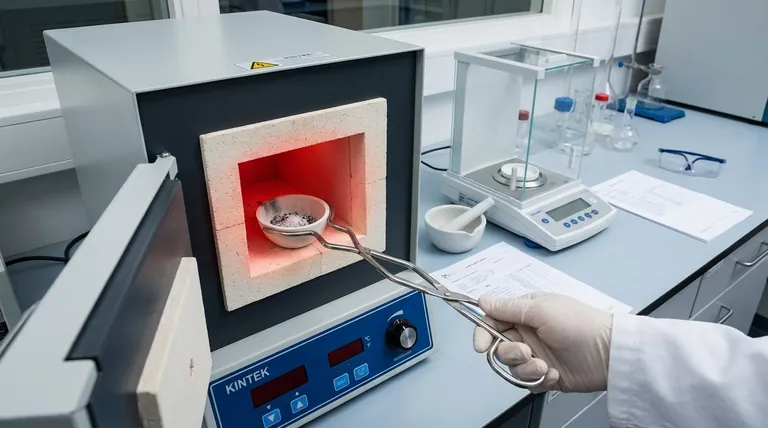
At its core, ash content is a direct measure of the total amount of inorganic, non-combustible material within a substance. After a sample is completely burned under controlled conditions, the residue that remains—the "ash"—is weighed. This value is typically expressed as a percentage of the original sample's weight.

Ash content is not a measure of imperfection; it is a critical data point that reveals the quantity of mineral fillers, reinforcements, or inorganic impurities within a material. It serves as a fundamental indicator of composition, quality, and consistency.
What does ash content indicate? A Key to Material Composition and Quality Control

What Ash Content Reveals About Composition

The ash value provides a clear window into the non-organic components of a material, which are often present by design.

Identifying Inorganic Fillers

Many materials, especially polymers, are not pure. They contain inorganic fillers to modify their properties.

Ash content directly quantifies the percentage of these additives, such as calcium carbonate, talc, or silica.

Quantifying Reinforcements

For high-strength applications, materials are often reinforced with inorganic substances.

The ash test is a simple way to verify the loading percentage of reinforcements like glass fibers or mineral fibers, which are crucial for achieving desired mechanical properties like stiffness and durability.

Detecting Impurities

In materials intended to be pure, any significant ash content can indicate contamination.

This is a red flag in quality control, suggesting the presence of unwanted inorganic residues from the manufacturing process or raw materials.

The Role of Ash Content in Quality Control

For manufacturers, ash content is less of an analytical curiosity and more of a critical process control tool.

Verifying Material Specifications

Products are designed with a specific percentage of filler or reinforcement to meet performance targets.

The ash test is the primary method used to confirm that a batch of material meets these exact specifications before it is used or shipped.

Ensuring Consistency

Consistency is the hallmark of quality manufacturing. Tracking the ash content from batch to batch is a powerful way to monitor process stability.

Deviations in the ash value can signal a problem in mixing ratios or raw material supply long before it affects the final product's performance.

Understanding the Limitations

While incredibly useful, the ash content value does not tell the whole story. It's essential to recognize its limitations.

It Is a Quantitative, Not Qualitative, Measure

The ash test tells you how much inorganic material is present, but it does not tell you what that material is.

For example, a 30% ash content could be 30% glass fiber as intended, or it could be 25% glass fiber and 5% unknown contamination. Further analysis, such as spectroscopy, is required for chemical identification.

Context Is Everything

A "good" or "bad" ash value is entirely dependent on the material's specification.

A 40% ash content is expected for a glass-filled nylon but would indicate massive contamination in a material that is supposed to be a pure polymer. The number is meaningless without its proper context.

Making the Right Choice for Your Goal

Your interpretation of an ash content value depends entirely on your objective.

  • If your primary focus is quality assurance: Use ash content as a fast and reliable check to ensure incoming materials and outgoing products meet their specified filler percentages.
  • If your primary focus is material development: Treat ash content as a key variable that directly influences physical properties like stiffness, strength, and density.
  • If your primary focus is failure analysis: An unexpected ash content can be a critical clue, pointing toward material contamination or an incorrect formulation as the root cause of a problem.

Ultimately, understanding ash content empowers you to validate material composition and guarantee product performance.

Summary Table:

Aspect What Ash Content Reveals
Composition Quantity of inorganic fillers (e.g., talc, calcium carbonate) and reinforcements (e.g., glass fibers).
Quality Control Verifies material meets specifications and ensures batch-to-batch consistency.
Impurity Detection Flags unwanted inorganic contamination in raw materials or final products.
Limitation Measures quantity, not quality; identifies 'how much,' not 'what' the inorganic material is.

Need precise ash content analysis to ensure your material quality and consistency? KINTEK specializes in providing reliable lab equipment and consumables for accurate testing. Our solutions help you verify filler percentages, detect impurities, and maintain strict quality control standards. Contact our experts today to find the right tools for your laboratory's needs!

Visual Guide

What does ash content indicate? A Key to Material Composition and Quality Control Visual Guide

Related Products

People Also Ask

Related Products

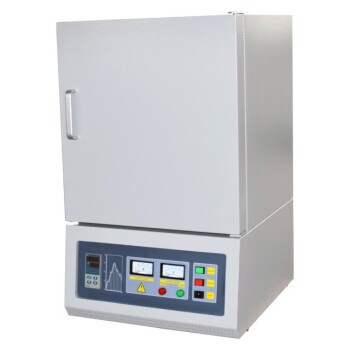
1700℃ Muffle Oven Furnace for Laboratory

1700℃ Muffle Oven Furnace for Laboratory

Get superior heat control with our 1700℃ Muffle Furnace. Equipped with intelligent temperature microprocessor, TFT touch screen controller & advanced insulation materials for precise heating up to 1700C. Order now!

Laboratory Muffle Oven Furnace Bottom Lifting Muffle Furnace

Laboratory Muffle Oven Furnace Bottom Lifting Muffle Furnace

Efficiently produce batches with excellent temperature uniformity using our Bottom Lifting Furnace. Features two electric lifting stages and advanced temperature control up to 1600℃.

1400℃ Muffle Oven Furnace for Laboratory

1400℃ Muffle Oven Furnace for Laboratory

Get precise high-temperature control up to 1500℃ with KT-14M Muffle furnace. Equipped with a smart touch screen controller and advanced insulation materials.

High Temperature Muffle Oven Furnace for Laboratory Debinding and Pre Sintering

High Temperature Muffle Oven Furnace for Laboratory Debinding and Pre Sintering

KT-MD High temperature debinding and pre-sintering furnace for ceramic materials with various molding processes. Ideal for electronic components such as MLCC and NFC.

1400℃ Laboratory Quartz Tube Furnace with Alumina Tube Tubular Furnace

1400℃ Laboratory Quartz Tube Furnace with Alumina Tube Tubular Furnace

Looking for a tube furnace for high-temperature applications? Our 1400℃ Tube Furnace with Alumina Tube is perfect for research and industrial use.

1700℃ Laboratory Quartz Tube Furnace with Alumina Tube Tubular Furnace

1700℃ Laboratory Quartz Tube Furnace with Alumina Tube Tubular Furnace

Looking for a high-temperature tube furnace? Check out our 1700℃ Tube Furnace with Alumina Tube. Perfect for research and industrial applications up to 1700C.

Laboratory Test Sieves and Sieving Machines

Laboratory Test Sieves and Sieving Machines

Precision lab test sieves & sieving machines for accurate particle analysis. Stainless steel, ISO-compliant, 20μm-125mm range. Request specs now!

1200℃ Split Tube Furnace with Quartz Tube Laboratory Tubular Furnace

1200℃ Split Tube Furnace with Quartz Tube Laboratory Tubular Furnace

KT-TF12 split tube furnace: high-purity insulation, embedded heating wire coils, and max. 1200C. Widely used for new materials and chemical vapour deposition.

Laboratory Quartz Tube Furnace Tubular RTP Heating Furnace

Laboratory Quartz Tube Furnace Tubular RTP Heating Furnace

Get lightning-fast heating with our RTP Rapid Heating Tube Furnace. Designed for precise, high-speed heating and cooling with convenient sliding rail and TFT touch screen controller. Order now for ideal thermal processing!

Rotary Tube Furnace Split Multi Heating Zone Rotating Tube Furnace

Rotary Tube Furnace Split Multi Heating Zone Rotating Tube Furnace

Multi zone rotary furnace for high-precision temperature control with 2-8 independent heating zones. Ideal for lithium ion battery electrode materials and high-temperature reactions. Can work under vacuum and controlled atmosphere.

Graphite Vacuum Furnace IGBT Experimental Graphitization Furnace

Graphite Vacuum Furnace IGBT Experimental Graphitization Furnace

IGBT experimental graphitization furnace, a tailored solution for universities and research institutions, with high heating efficiency, user-friendliness, and precise temperature control.

Small Vacuum Heat Treat and Tungsten Wire Sintering Furnace

Small Vacuum Heat Treat and Tungsten Wire Sintering Furnace

The small vacuum tungsten wire sintering furnace is a compact experimental vacuum furnace specially designed for universities and scientific research institutes. The furnace features a CNC welded shell and vacuum piping to ensure leak-free operation. Quick-connect electrical connections facilitate relocation and debugging, and the standard electrical control cabinet is safe and convenient to operate.

Vacuum Sealed Continuous Working Rotary Tube Furnace Rotating Tube Furnace

Vacuum Sealed Continuous Working Rotary Tube Furnace Rotating Tube Furnace

Experience efficient material processing with our vacuum-sealed rotary tube furnace. Perfect for experiments or industrial production, equipped with optional features for controlled feeding and optimized results. Order now.

Vacuum Heat Treat and Molybdenum Wire Sintering Furnace for Vacuum Sintering

Vacuum Heat Treat and Molybdenum Wire Sintering Furnace for Vacuum Sintering

A vacuum molybdenum wire sintering furnace is a vertical or bedroom structure, which is suitable for withdrawal, brazing, sintering and degassing of metal materials under high vacuum and high temperature conditions. It is also suitable for dehydroxylation treatment of quartz materials.

Laboratory Sterilizer Lab Autoclave Vertical Pressure Steam Sterilizer for Liquid Crystal Display Automatic Type

Laboratory Sterilizer Lab Autoclave Vertical Pressure Steam Sterilizer for Liquid Crystal Display Automatic Type

Liquid crystal display automatic vertical sterilizer is a safe, reliable and automatic control sterilization equipment, which is composed of heating system, microcomputer control system and overheating and overvoltage protection system.

Vacuum Dental Porcelain Sintering Furnace

Vacuum Dental Porcelain Sintering Furnace

Get precise and reliable results with KinTek's Vacuum Porcelain Furnace. Suitable for all porcelain powders, it features hyperbolic ceramic furnace function, voice prompt, and automatic temperature calibration.

Graphite Vacuum Furnace High Thermal Conductivity Film Graphitization Furnace

Graphite Vacuum Furnace High Thermal Conductivity Film Graphitization Furnace

The high thermal conductivity film graphitization furnace has uniform temperature, low energy consumption and can operate continuously.

Laboratory Sterilizer Lab Autoclave Pulse Vacuum Lifting Sterilizer

Laboratory Sterilizer Lab Autoclave Pulse Vacuum Lifting Sterilizer

The pulse vacuum lifting sterilizer is a state-of-the-art equipment for efficient and precise sterilization. It uses pulsating vacuum technology, customizable cycles, and a user-friendly design for easy operation and safety.

Benchtop Laboratory Freeze Dryer for Lab Use

Benchtop Laboratory Freeze Dryer for Lab Use

Premium benchtop laboratory freeze dryer for lyophilization, preserving samples with ≤ -60°C cooling. Ideal for pharmaceuticals & research.

Vacuum Hot Press Furnace Machine for Lamination and Heating

Vacuum Hot Press Furnace Machine for Lamination and Heating

Experience clean and precise lamination with Vacuum Lamination Press. Perfect for wafer bonding, thin-film transformations, and LCP lamination. Order now!


Leave Your Message