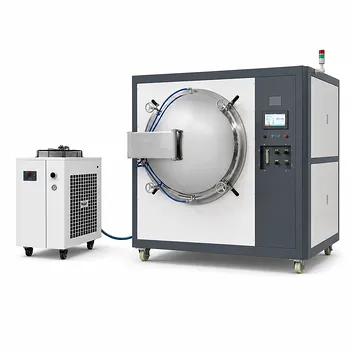
To fabricate high-density Ti/Al2O3 laminated ceramic composites, a vacuum hot-press furnace delivers a precise triad of conditions: a high temperature of 1450°C, a strictly controlled high-vacuum environment, and a mechanical pressure of 25 MPa. These parameters must be applied simultaneously to overcome the natural resistance of the materials to bonding and densification.
The success of this process relies on the "coupling effect" of thermal and pressure fields, which drives inter-layer diffusion and densification flow. Crucially, the vacuum environment is the safeguard that prevents the rapid oxidation of the reactive Titanium layers, ensuring the structural integrity of the final composite.
The Mechanisms of Densification and Bonding
The vacuum hot-press furnace is not merely a heater; it is a system designed to force two dissimilar materials—metal (Ti) and ceramic (Al2O3)—to become a unified structure.
Thermal Activation of Diffusion
The application of 1450°C serves as the activation energy for the system.
At this specific temperature, atomic mobility increases significantly. This thermal energy allows atoms to migrate across the interface between the Titanium and Alumina layers, initiating the fundamental chemical bonding required for a composite structure.
Mechanical Pressure for Void Elimination
While heat mobilizes atoms, it is the 25 MPa of mechanical pressure that forces physical consolidation.
Diffusion alone often leaves behind isolated pores. The external pressure generates densification flow, mechanically closing internal voids and ensuring the material reaches near-theoretical density.
Creating a Tight Interfacial Bond
The simultaneous application of heat and pressure eliminates the physical gaps between layers.
This coupling effect promotes a "tight bond," ensuring that the transition between the metal and ceramic layers is continuous and free of defects that could act as stress concentrators.
The Critical Role of Environmental Control
For systems containing Titanium, temperature control is insufficient without strict environmental control.
Preventing Titanium Oxidation
Titanium is highly reactive, particularly at elevated temperatures.
Without a high-vacuum environment, the Titanium layers would rapidly oxidize before bonding could occur. This oxidation would create a brittle oxide layer at the interface, severely compromising the mechanical properties of the laminate.
Ensuring Chemical Purity
The vacuum does not just prevent oxidation; it actively maintains the purity of the matrix.
By removing atmospheric gases, the furnace ensures that the resulting diffusion and densification are purely predominantly between the Ti and Al2O3 constituents, preventing the formation of unwanted contaminants or brittle phases.
Understanding the Trade-offs
While vacuum hot pressing is effective for high-performance composites, it introduces specific constraints that must be managed.
Uniaxial Pressure Limitations
Standard hot pressing typically applies pressure in one direction (uniaxial).
This can lead to density gradients in complex shapes. While effective for laminated plates (like Ti/Al2O3 stacks), it may not provide uniform densification for geometries with significant vertical variations or complex contours.
Production Throughput
The process is inherently a batch operation.
The requirement to pull a high vacuum and slowly ramp temperature to 1450°C—and then cool down under controlled conditions—means cycle times are long. This makes the process excellent for high-value, critical components but less suitable for high-volume mass production.
Making the Right Choice for Your Goal
When configuring a vacuum hot-press cycle for Ti/Al2O3 composites, prioritize your parameters based on the specific mechanical property you need to maximize.
- If your primary focus is interfacial bond strength: Prioritize the thermal dwell time at 1450°C to allow sufficient atomic diffusion between the Ti and Al2O3 layers.
- If your primary focus is maximum density: Ensure the mechanical pressure is maintained at 25 MPa throughout the cooling phase to prevent pore formation during solidification.
- If your primary focus is material purity: Verify the vacuum integrity is fully established before the temperature exceeds the oxidation threshold of Titanium.
The vacuum hot-press furnace is the definitive tool for this application because it forces materials to bond that would otherwise remain distinct, turning raw layers into a unified, high-performance solid.
Summary Table:
| Process Parameter | Required Value | Critical Function |
|---|---|---|
| Temperature | 1450°C | Provides activation energy for atomic diffusion and bonding |
| Mechanical Pressure | 25 MPa | Drives densification flow and eliminates internal voids/pores |
| Atmosphere | High Vacuum | Prevents Titanium oxidation and ensures chemical purity |
| System Result | Coupled Field | Achieves near-theoretical density and tight interfacial bonding |
Elevate Your Material Research with KINTEK Precision
Fabricating high-performance Ti/Al2O3 laminated ceramic composites requires more than just heat; it demands the absolute control provided by KINTEK’s advanced vacuum hot-press furnaces.
Our specialized laboratory equipment is designed to meet the rigorous demands of material science, offering:
- Precision Control: Master the 1450°C/25 MPa coupling effect for flawless densification.
- Versatile Solutions: From vacuum and atmosphere furnaces to high-pressure reactors and hydraulic presses, we provide the tools needed for advanced sintering and bonding.
- Comprehensive Support: We supply essential consumables, including ceramics, crucibles, and milling systems, to ensure your entire workflow is optimized.
Ready to achieve superior structural integrity and purity in your high-value components?
Related Products
- Vacuum Hot Press Furnace Heated Vacuum Press Machine Tube Furnace
- 600T Vacuum Induction Hot Press Furnace for Heat Treat and Sintering
- Vacuum Hot Press Furnace Machine Heated Vacuum Press
- Vacuum Hot Press Furnace Machine for Lamination and Heating
- Vacuum Heat Treat and Pressure Sintering Furnace for High Temperature Applications
People Also Ask
- What advantages does a vacuum hot press furnace provide for LSLBO ceramic electrolytes? Achieve 94% Relative Density
- What role does a Vacuum Hot Press (VHP) furnace play in the densification of austenitic stainless steel 316 composites?
- What are the advantages of using a vacuum hot pressing furnace? Superior Densification for 2024Al/Gr/SiC Composites
- What are the advantages of a vacuum hot press furnace for LTPO solid electrolytes? Boost Density and Conductivity
- What core processing conditions does a vacuum hot press furnace provide? Achieve High-Density Cu-SiC/Diamond Composites