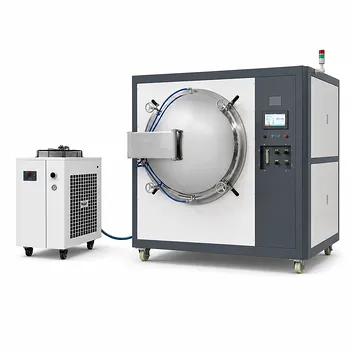
A vacuum hot press furnace provides a critical processing advantage by enabling the simultaneous application of high temperature and uniaxial pressure within a vacuum environment. This combination allows for full densification of fluoride ceramics at significantly lower temperatures (e.g., 625°C) compared to pressureless sintering.
Core Takeaway The primary value of this technology is pressure-assisted densification. By substituting thermal energy with mechanical force, you can fully densify the material while keeping the temperature low enough to effectively inhibit abnormal grain growth, which is essential for achieving both high optical transparency and superior mechanical strength.
Achieving High Density at Lower Temperatures
The Mechanism of Pressure-Assisted Sintering
The defining feature of a vacuum hot press is its ability to apply uniaxial mechanical pressure during the heating cycle. This pressure acts as an external driving force for densification.
By adding mechanical force (often around 30–50 MPa), you induce plastic deformation and particle rearrangement. This allows the ceramic powder to compact and bond without relying solely on the high thermal energy required in conventional sintering.
Inhibiting Abnormal Grain Growth
For fine-grained fluoride ceramics, temperature control is paramount. High temperatures typically trigger rapid, abnormal grain growth, which degrades mechanical properties and scatters light.
Because the hot press achieves density at lower temperatures, the grain boundaries remain stable. This "low-temperature" approach effectively arrests grain growth, preserving a fine, uniform microstructure that is critical for the material's final performance.
Enhancing Optical Transparency
Eliminating Residual Porosity
Transparency in ceramics is easily compromised by internal pores, which act as scattering centers for light. Achieving theoretical density is non-negotiable for optical applications.
The mechanical pressure applied in a hot press physically forces particles together, effectively closing internal voids. This process drives the material density near its theoretical limit (often >99.8%), resulting in the elimination of scattering centers and high optical transmittance.
Vacuum-Enabled Environment Control
The vacuum environment (often between $10^{-1}$ Pa and $10^{-5}$ mbar) plays a dual role in ensuring optical clarity. First, it facilitates the removal of gaseous byproducts and adsorbed gases trapped within the powder compact.
Second, it prevents the oxidation of the fluoride materials. Maintaining a pristine chemical composition is vital, as oxides or impurities can introduce absorption bands that ruin the transparency of the final ceramic.
Understanding the Trade-offs
Geometric Limitations
While hot pressing is superior for material quality, it is geometrically constrained. Because the pressure is uniaxial (applied from top and bottom), this method is generally limited to simple shapes like flat disks, plates, or cylinders. Fabricating complex, near-net-shape components is difficult without extensive post-processing.
Throughput and Scalability
Vacuum hot pressing is inherently a batch process. The cycle times—including vacuuming, heating, dwelling under pressure, and cooling—can be long. This makes it less suitable for high-volume mass production compared to continuous sintering methods, although it remains the standard for high-performance optical ceramics.
Making the Right Choice for Your Goal
When selecting a processing route for fluoride ceramics, align your choice with your specific material requirements:
- If your primary focus is Optical Transparency: Prioritize the vacuum level and pressure magnitude to ensure the complete elimination of pores and gaseous impurities.
- If your primary focus is Mechanical Strength: Focus on optimizing the pressure-to-temperature ratio to minimize the peak temperature, thereby keeping the grain size as small as possible.
By leveraging the synergy of pressure and vacuum, you can produce fluoride ceramics that refuse to compromise between optical clarity and structural integrity.
Summary Table:
| Feature | Advantage | Impact on Fluoride Ceramics |
|---|---|---|
| Uniaxial Pressure | Pressure-assisted densification | Full density at lower temperatures; inhibits grain growth. |
| Vacuum Environment | Removal of gaseous byproducts | Prevents oxidation and eliminates light-scattering impurities. |
| Low-Temp Sintering | Microstructure control | Preserves fine grain size for superior mechanical strength. |
| High Theoretical Density | Pore elimination | Achieves >99.8% density for maximum optical transmittance. |
Elevate Your Material Research with KINTEK Precision
Unlock the full potential of your advanced materials with KINTEK’s high-performance vacuum hot press furnaces. Whether you are developing fine-grained fluoride transparent ceramics, specialized dental materials, or high-strength composites, our equipment provides the precise control over temperature and uniaxial pressure required to achieve theoretical density without compromising microstructure.
From high-temperature furnaces and hydraulic presses to specialized PTFE and ceramic consumables, KINTEK specializes in laboratory solutions tailored for researchers and manufacturers who demand excellence.
Ready to optimize your fabrication process?
Contact our technical experts today to find the perfect solution for your lab!
Related Products
- Vacuum Hot Press Furnace Heated Vacuum Press Machine Tube Furnace
- 600T Vacuum Induction Hot Press Furnace for Heat Treat and Sintering
- Vacuum Hot Press Furnace Machine Heated Vacuum Press
- Vacuum Hot Press Furnace Machine for Lamination and Heating
- Vacuum Heat Treat and Pressure Sintering Furnace for High Temperature Applications
People Also Ask
- What advantages does a vacuum hot press furnace provide for LSLBO ceramic electrolytes? Achieve 94% Relative Density
- What role does a Vacuum Hot Press (VHP) furnace play in the densification of austenitic stainless steel 316 composites?
- What are the advantages of using a vacuum hot pressing furnace? Superior Densification for 2024Al/Gr/SiC Composites
- What are the advantages of a vacuum hot press furnace for LTPO solid electrolytes? Boost Density and Conductivity
- What core processing conditions does a vacuum hot press furnace provide? Achieve High-Density Cu-SiC/Diamond Composites