Knowledge How does a vacuum hot press furnace improve the density of Ti2AlN ceramics? Achieve 98.5%+ Density & Superior Strength
Author avatar

Tech Team · Kintek Solution

Updated 1 day ago

How does a vacuum hot press furnace improve the density of Ti2AlN ceramics? Achieve 98.5%+ Density & Superior Strength


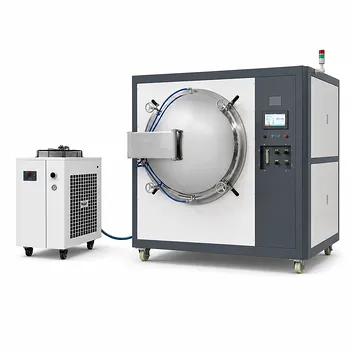
A vacuum hot press furnace significantly improves density by applying axial mechanical pressure simultaneously with high-temperature sintering. While pressureless methods rely solely on thermal energy to bond particles, the hot press creates a pressure-assisted environment that forces particle rearrangement and plastic flow. This mechanism effectively eliminates internal pores, allowing Ti2AlN ceramics to achieve a relative density exceeding 98.5%, a level of compactness that is difficult to attain through standard pressureless sintering.

Core Takeaway: Pressureless sintering relies on time and temperature to fuse particles, often leaving voids. Vacuum hot pressing adds mechanical force to physically compress the material while it is pliable, closing pores and maximizing density.

The Mechanics of Densification

The superior density of Ti2AlN ceramics produced in a vacuum hot press is not accidental; it is the result of specific physical mechanisms triggered by the combination of heat and force.

Forcing Particle Rearrangement

In pressureless sintering, powder particles bond loosely and slowly based on contact points established by gravity.

Vacuum hot pressing changes this dynamic by applying axial mechanical pressure. This external force physically shoves particles into empty spaces, optimizing their packing structure before bonding even begins.

Activating Plastic Flow

Heat softens the material, but pressure dictates where that material goes.

Under the influence of mechanical force, the powder particles undergo plastic flow. The material behaves somewhat like a viscous fluid, sliding and deforming to fill the microscopic voids between particles that pressureless sintering would leave behind.

Accelerated Diffusion

The applied pressure does more than just move particles; it enhances the atomic interaction between them.

The force facilitates diffusion creep and plastic slip mechanisms. By increasing the contact area between particles, the furnace accelerates the movement of atoms across boundaries, leading to faster and more complete densification.

Comparing the Outcomes

The difference between pressureless and pressure-assisted sintering is measurable in the final microstructure of the Ti2AlN ceramic.

The 98.5% Density Benchmark

The primary reference confirms that Ti2AlN ceramics produced via vacuum hot pressing achieve a relative density exceeding 98.5%.

This is a critical threshold for structural ceramics. High density correlates directly with improved mechanical strength, hardness, and resistance to wear.

Elimination of Internal Pores

Pressureless methods, such as using an atmosphere tube furnace, are excellent for synthesizing powders through solid-phase reactions.

However, they often lack the driving force to remove stubborn internal pores. Vacuum hot pressing mechanically collapses these voids, resulting in a solid, non-porous bulk material.

Understanding the Trade-offs

While vacuum hot pressing offers superior density, it is essential to recognize the operational constraints compared to pressureless methods.

Geometry Limitations

Vacuum hot presses typically apply uniaxial pressure (pressure from one direction).

This makes the process ideal for simple shapes like flat discs or plates. It is poorly suited for parts with complex geometries or undercuts, which are easier to manage with pressureless sintering or isostatic pressing.

Complexity and Cost

A vacuum hot press is a sophisticated system integrating hydraulics, vacuum pumps, and high-current heating elements.

This equipment is significantly more expensive and complex to operate than a standard tube or box furnace. It creates a barrier to entry for projects where extreme density is not the primary engineering requirement.

Making the Right Choice for Your Goal

To determine whether vacuum hot pressing is necessary for your Ti2AlN application, consider your specific performance requirements.

  • If your primary focus is Maximum Mechanical Strength: Choose vacuum hot pressing. The >98.5% density is essential for load-bearing applications and structural integrity.
  • If your primary focus is Powder Synthesis: Choose pressureless sintering (tube furnace). It provides the controlled atmosphere needed for phase purity without the complexity of hydraulic pressure.
  • If your primary focus is Complex Part Geometry: Choose pressureless sintering followed by post-processing, as hot pressing is generally limited to simple plate or disc shapes.

Ultimately, vacuum hot pressing transforms Ti2AlN from a porous aggregate into a fully dense, structural-grade ceramic.

Summary Table:

Feature Pressureless Sintering Vacuum Hot Pressing
Driving Force Thermal energy only Thermal energy + Axial pressure
Relative Density Lower (contains voids) >98.5% (High compactness)
Microstructure Prone to internal pores Collapsed voids/Non-porous
Ideal Geometry Complex shapes Simple shapes (discs/plates)
Primary Use Powder synthesis Structural-grade ceramics

Elevate Your Material Performance with KINTEK

Don't settle for porous results when your application demands structural integrity. KINTEK specializes in advanced laboratory solutions, providing high-performance vacuum hot presses and hydraulic presses designed to achieve near-theoretical density in advanced ceramics like Ti2AlN.

Whether you are conducting battery research, developing aerospace materials, or optimizing ceramic sintering, our comprehensive portfolio—from high-temperature furnaces and isostatic presses to PTFE consumables—ensures your lab has the precision it needs.

Ready to transform your material synthesis? Contact our technical experts today to find the perfect equipment for your research goals.

Related Products

People Also Ask

Related Products

Vacuum Hot Press Furnace Heated Vacuum Press Machine Tube Furnace

Vacuum Hot Press Furnace Heated Vacuum Press Machine Tube Furnace

Reduce forming pressure & shorten sintering time with Vacuum Tube Hot Press Furnace for high-density, fine-grain materials. Ideal for refractory metals.

Vacuum Hot Press Furnace Machine Heated Vacuum Press

Vacuum Hot Press Furnace Machine Heated Vacuum Press

Discover the advantages of Vacuum Hot Press Furnace! Manufacture dense refractory metals & compounds, ceramics, and composites under high temp and pressure.

600T Vacuum Induction Hot Press Furnace for Heat Treat and Sintering

600T Vacuum Induction Hot Press Furnace for Heat Treat and Sintering

Discover the 600T Vacuum Induction Hot Press Furnace, designed for high-temperature sintering experiments in vacuum or protected atmospheres. Its precise temperature and pressure control, adjustable working pressure, and advanced safety features make it ideal for nonmetal materials, carbon composites, ceramics, and metal powders.

2200 ℃ Tungsten Vacuum Heat Treat and Sintering Furnace

2200 ℃ Tungsten Vacuum Heat Treat and Sintering Furnace

Experience the ultimate refractory metal furnace with our Tungsten vacuum furnace. Capable of reaching 2200℃, perfect for sintering advanced ceramics and refractory metals. Order now for high-quality results.

High Pressure Laboratory Vacuum Tube Furnace Quartz Tubular Furnace

High Pressure Laboratory Vacuum Tube Furnace Quartz Tubular Furnace

KT-PTF High Pressure Tube Furnace: Compact split tube furnace with strong positive pressure resistance. Working temp up to 1100°C and pressure up to 15Mpa. Also works under controller atmosphere or high vacuum.

Vacuum Heat Treat Furnace with Ceramic Fiber Liner

Vacuum Heat Treat Furnace with Ceramic Fiber Liner

Vacuum furnace with polycrystalline ceramic fiber insulation liner for excellent heat insulation and uniform temperature field. Choose from 1200℃ or 1700℃ max. working temperature with high vacuum performance and precise temperature control.

2200 ℃ Graphite Vacuum Heat Treat Furnace

2200 ℃ Graphite Vacuum Heat Treat Furnace

Discover the power of the KT-VG Graphite Vacuum Furnace - with a maximum working temperature of 2200℃, it's perfect for vacuum sintering of various materials. Learn more now.

Molybdenum Vacuum Heat Treat Furnace

Molybdenum Vacuum Heat Treat Furnace

Discover the benefits of a high-configuration molybdenum vacuum furnace with heat shield insulation. Ideal for high-purity, vacuum environments like sapphire crystal growth and heat treatment.

Vacuum Heat Treat and Molybdenum Wire Sintering Furnace for Vacuum Sintering

Vacuum Heat Treat and Molybdenum Wire Sintering Furnace for Vacuum Sintering

A vacuum molybdenum wire sintering furnace is a vertical or bedroom structure, which is suitable for withdrawal, brazing, sintering and degassing of metal materials under high vacuum and high temperature conditions. It is also suitable for dehydroxylation treatment of quartz materials.

Vacuum Heat Treat Sintering Brazing Furnace

Vacuum Heat Treat Sintering Brazing Furnace

A vacuum brazing furnace is a type of industrial furnace used for brazing, a metalworking process that joins two pieces of metal using a filler metal that melts at a lower temperature than the base metals. Vacuum brazing furnaces are typically used for high-quality applications where a strong, clean joint is required.

1700℃ Muffle Oven Furnace for Laboratory

1700℃ Muffle Oven Furnace for Laboratory

Get superior heat control with our 1700℃ Muffle Furnace. Equipped with intelligent temperature microprocessor, TFT touch screen controller & advanced insulation materials for precise heating up to 1700C. Order now!

1400℃ Muffle Oven Furnace for Laboratory

1400℃ Muffle Oven Furnace for Laboratory

Get precise high-temperature control up to 1500℃ with KT-14M Muffle furnace. Equipped with a smart touch screen controller and advanced insulation materials.

Vertical High Temperature Graphite Vacuum Graphitization Furnace

Vertical High Temperature Graphite Vacuum Graphitization Furnace

Vertical high temperature graphitization furnace for carbonization and graphitization of carbon materials up to 3100℃.Suitable for shaped graphitization of carbon fiber filaments and other materials sintered in a carbon environment.Applications in metallurgy, electronics, and aerospace for producing high-quality graphite products like electrodes and crucibles.

1700℃ Laboratory High Temperature Tube Furnace with Alumina Tube

1700℃ Laboratory High Temperature Tube Furnace with Alumina Tube

Looking for a high-temperature tube furnace? Check out our 1700℃ Tube Furnace with Alumina Tube. Perfect for research and industrial applications up to 1700C.

Horizontal High Temperature Graphite Vacuum Graphitization Furnace

Horizontal High Temperature Graphite Vacuum Graphitization Furnace

Horizontal Graphitization Furnace: This type of furnace is designed with the heating elements placed horizontally, allowing for uniform heating of the sample. It's well-suited for graphitizing large or bulky samples that require precise temperature control and uniformity.

1800℃ Muffle Oven Furnace for Laboratory

1800℃ Muffle Oven Furnace for Laboratory

KT-18 muffle furnace with Japan Al2O3 polycrystalline fibe and Silicon Molybdenum heating element, up to 1900℃, PID temperature control and 7" smart touch screen. Compact design, low heat loss, and high energy efficiency. Safety interlock system and versatile functions.

Vacuum Heat Treat and Sintering Furnace with 9MPa Air Pressure

Vacuum Heat Treat and Sintering Furnace with 9MPa Air Pressure

The air pressure sintering furnace is a high-tech equipment commonly used for the sintering of advanced ceramic materials. It combines vacuum sintering and pressure sintering techniques to achieve high-density and high-strength ceramics.

Ultra-High Temperature Graphite Vacuum Graphitization Furnace

Ultra-High Temperature Graphite Vacuum Graphitization Furnace

The ultra-high temperature graphitization furnace utilizes medium frequency induction heating in a vacuum or inert gas environment. The induction coil generates an alternating magnetic field, inducing eddy currents in the graphite crucible, which heats up and radiates heat to the workpiece, bringing it to the desired temperature. This furnace is primarily used for graphitization and sintering of carbon materials, carbon fiber materials, and other composite materials.

1700℃ Controlled Atmosphere Furnace Nitrogen Inert Atmosphere Furnace

1700℃ Controlled Atmosphere Furnace Nitrogen Inert Atmosphere Furnace

KT-17A Controlled atmosphere furnace: 1700℃ heating, vacuum sealing technology, PID temperature control, and versatile TFT smart touch screen controller for laboratory and industrial use.

Vacuum Dental Porcelain Sintering Furnace

Vacuum Dental Porcelain Sintering Furnace

Get precise and reliable results with KinTek's Vacuum Porcelain Furnace. Suitable for all porcelain powders, it features hyperbolic ceramic furnace function, voice prompt, and automatic temperature calibration.


Leave Your Message