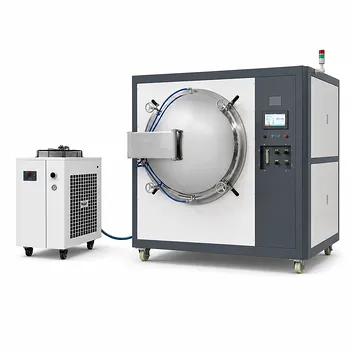
The core role of a vacuum hot pressing sintering furnace is to drive the densification of nanocopper powder by simultaneously applying mechanical pressure and high temperatures within a controlled vacuum environment. This equipment goes beyond simple thermal treatment, acting as a kinetic accelerator that forces the closure of pores and promotes grain fusion to achieve densities impossible with heat alone.
By introducing a mechanical pressure field into the thermal cycle, this process overcomes the "kinetic delays" inherent in pressureless sintering. It actively transitions pores from a connected network to isolated states and finally eliminates them, resulting in a material with superior structural and electrical integrity.
Overcoming Kinetic Barriers
Addressing Lattice Mismatches
In traditional pressureless sintering, the densification process often stalls due to lattice orientation mismatches. These mismatches create bottlenecks that thermal energy alone cannot easily resolve.
The Power of the Pressure Field
The vacuum hot pressing furnace introduces external mechanical pressure to forcibly overcome these barriers. This pressure acts as a driving force, ensuring that particles bond even when lattice orientations are not perfectly aligned.
The Mechanics of Pore Elimination
Evolution of Pore States
The central mechanism of densification involves changing the physical state of the pores within the powder. The applied pressure drives pores to evolve from a "connected" state (an open network) into an "isolated" state (closed pockets).
Utilizing Plastic Flow
Once pores are isolated, the furnace eliminates residual voids located at the grain boundaries. This is achieved through plastic flow, where the material deforms under pressure to fill the remaining microscopic gaps.
Achieving High Density
The result of this forced evolution is a highly dense nanocopper material. By eliminating complex residual pore defects, the process yields significantly lower porosity compared to traditional methods.
The Function of the Vacuum Environment
Preventing Material Degradation
The vacuum chamber is engineered to withstand high temperatures while strictly controlling the atmosphere. Its primary function is to prevent the oxidation of the copper matrix, which is highly reactive at elevated temperatures.
Enabling Diffusion Bonding
By removing oxygen and contaminants, the vacuum environment facilitates cleaner contact between particles. This promotes effective diffusion bonding, which is essential for the structural cohesion of the final sintered part.
Understanding the Process Requirements
The Necessity of Simultaneous Forces
It is critical to understand that neither heat nor pressure is sufficient on its own for this application. The superiority of this method relies on the simultaneous application of both forces to override kinetic delays.
Equipment Capability
To achieve these results, the furnace must be capable of significant output. For example, specific processes may require temperatures around 950°C and pressures up to 40 MPa to ensure near-net-shape accuracy and full densification.
Making the Right Choice for Your Goal
When evaluating sintering methods for nanocopper, consider your performance requirements:
- If your primary focus is maximizing conductivity: Rely on vacuum hot pressing to eliminate the residual pore defects that act as barriers to electrical and thermal flow.
- If your primary focus is structural integrity: Use this method to induce plastic flow at grain boundaries, ensuring the material is dense and free of connected voids.
The vacuum hot pressing sintering furnace effectively replaces the uncertainty of kinetic delays with the certainty of mechanical force, ensuring consistent, high-performance results.
Summary Table:
| Feature | Pressureless Sintering | Vacuum Hot Pressing (KINTEK) |
|---|---|---|
| Densification Force | Thermal energy only | Simultaneous heat & mechanical pressure |
| Pore Structure | Often leaves connected pores | Forced transition to isolated/eliminated pores |
| Kinetic Barriers | High (stalls at lattice mismatches) | Overcome by external pressure field |
| Oxidation Risk | High (in ambient air) | Minimal (controlled vacuum environment) |
| Material Integrity | Lower density/conductivity | Maximum density & structural integrity |
Elevate Your Material Research with KINTEK Precision
Unlock the full potential of your nanocopper powders and advanced ceramics with KINTEK’s high-performance vacuum hot pressing systems. Our furnaces are engineered to provide the precise simultaneous application of temperatures up to 950°C and pressures reaching 40 MPa, ensuring your materials achieve near-net-shape accuracy and zero-defect densification.
Why partner with KINTEK?
- Comprehensive Range: From high-temperature vacuum and atmosphere furnaces to specialized hydraulic pellet presses and crushing systems.
- Advanced Solutions: Expertise in CVD, PECVD, and MPCVD systems for cutting-edge material synthesis.
- Lab Essentials: A complete portfolio including ULT freezers, electrolytic cells, and high-quality PTFE or ceramic consumables.
Don't let kinetic delays stall your innovation. Contact KINTEK today to find the perfect sintering solution for your laboratory!
Related Products
- 600T Vacuum Induction Hot Press Furnace for Heat Treat and Sintering
- Vacuum Heat Treat and Pressure Sintering Furnace for High Temperature Applications
- Vacuum Heat Treat and Sintering Furnace with 9MPa Air Pressure
- Vacuum Hot Press Furnace Heated Vacuum Press Machine Tube Furnace
- Vacuum Hot Press Furnace Machine Heated Vacuum Press
People Also Ask
- What role does an induction vacuum hot pressing furnace play in sintering? Achieve 98% Density in Carbide Blocks
- What advantages does a vacuum hot press furnace provide for LSLBO ceramic electrolytes? Achieve 94% Relative Density
- What role does a Vacuum Hot Press (VHP) furnace play in the densification of austenitic stainless steel 316 composites?
- What role does mechanical pressure play during the vacuum diffusion bonding of tungsten and copper? Keys to Solid Bonding
- What are the advantages of a vacuum hot press furnace for W-50%Cu? Achieve 99.6% Density at Lower Temperatures