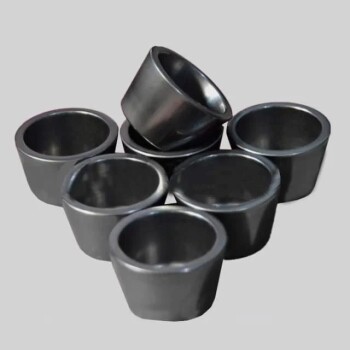
High-purity graphite molds serve as the primary interface for both thermal and mechanical energy transfer. During the induction hot-pressing of Li7La3Zr2O12 (LLZO) ceramics, they function simultaneously as a heating susceptor to generate heat from induction currents and as a structural base to distribute uniaxial mechanical pressure uniformly to the powder.
By acting as a conductive intermediary, high-purity graphite molds solve the challenge of heating non-conductive LLZO powder. They convert electromagnetic energy into heat while maintaining the structural rigidity necessary to shape the ceramic pellet under high pressure.
The Dual-Role Mechanism
Generating Heat via Induction
LLZO is a ceramic material and typically does not conduct electricity well enough to heat up directly through induction.
The graphite mold solves this by acting as a susceptor. It couples with the induction field to generate heat internally through induced currents.
Because graphite possesses high thermal conductivity, it rapidly and effectively transfers this generated heat to the LLZO powder contained within.
Transmitting Uniaxial Pressure
Sintering LLZO requires significant mechanical pressure to achieve high density.
The graphite mold acts as a piston and container, transmitting force from the press directly to the ceramic powder.
It creates a uniform pressure distribution (uniaxial) across the green body, which is critical for particle rearrangement and densification.
Ensuring Material Integrity
Achieving Microstructural Uniformity
Inconsistent heating is a primary cause of defects in ceramics.
The superior thermal conductivity of high-purity graphite ensures that heat is distributed evenly throughout the mold and the sample.
This prevents thermal gradients, ensuring that the microstructure of the LLZO ceramic remains uniform from the center to the edge.
Maintaining Dimensional Accuracy
The process exposes the mold to extreme thermal and mechanical stress.
High-purity graphite retains exceptional strength at high temperatures (hot strength).
This allows the mold to resist deformation under load, ensuring the final ceramic pellet maintains precise dimensional accuracy and geometric shape.
Understanding the Trade-offs
The Consumable Nature of Molds
While graphite is robust, it is ultimately a consumable component in this process.
Repeated exposure to high mechanical pressures (e.g., 25–30 MPa) and extreme thermal cycling can eventually lead to wear or structural fatigue.
Atmospheric Considerations
Graphite naturally creates a reducing atmosphere at high temperatures.
While this protects many ceramics from oxidation, it requires careful process management when working with oxides like LLZO to prevent unwanted surface reactions or oxygen deficiency.
Making the Right Choice for Your Goal
To optimize your sintering process, align your mold usage with your specific processing objectives:
- If your primary focus is Maximum Density: Prioritize mold designs with thick walls to withstand higher uniaxial pressures (up to 30 MPa) without lateral deformation.
- If your primary focus is Microstructural Homogeneity: Ensure the graphite grade used has the highest possible thermal conductivity to eliminate hot spots during the heating ramp.
Success in sintering LLZO relies on viewing the graphite mold not just as a container, but as an active thermal component that dictates the quality of energy transfer.
Summary Table:
| Function | Role in LLZO Sintering | Key Benefit |
|---|---|---|
| Heating Susceptor | Converts induction currents into thermal energy | Enables heating of non-conductive ceramic powder |
| Pressure Transmitter | Distributes uniaxial mechanical force (25-30 MPa) | Achieves high density and particle rearrangement |
| Thermal Conductor | Distributes heat evenly across the sample | Prevents thermal gradients and microstructural defects |
| Structural Base | Retains hot strength under extreme loads | Maintains precise dimensional accuracy and shape |
Elevate Your Advanced Ceramic Research with KINTEK
Precision in sintering Li7La3Zr2O12 (LLZO) requires equipment that masters both thermal and mechanical extremes. KINTEK specializes in high-performance laboratory solutions, providing the induction melting systems, hydraulic hot presses, and high-purity graphite consumables essential for solid-state battery research.
Whether you are aiming for maximum density or microstructural homogeneity, our comprehensive range of high-temperature furnaces and precision-engineered molds ensures your materials meet the highest standards of integrity. Partner with KINTEK to optimize your laboratory efficiency—contact our experts today to find the perfect solution for your sintering needs!
Related Products
- High Purity Pure Graphite Crucible for Evaporation
- High Purity Pure Graphite Crucible for Electron Beam Evaporation
- Special Shape Press Mold for Lab
- Anti-Cracking Press Mold for Lab Use
- Ball Press Mold for Lab
People Also Ask
- Why are high-purity graphite crucibles preferred for sulfide solid electrolytes? Achieve Superior Material Purity
- Why is a high-purity graphite crucible required for Chromel-TaC composites? Ensure Peak Purity at 1400°C
- What role do high-purity graphite crucibles play in molten salt corrosion research? Ensure Reactor-Grade Precision
- Why are high-purity graphite crucibles used for magnesium distillation? Ensure 3N8 Purity & Thermal Stability
- Why is a high-purity graphite crucible ideal for nitrogen-doped graphene at 1500 °C? Maximize Purity and Stability