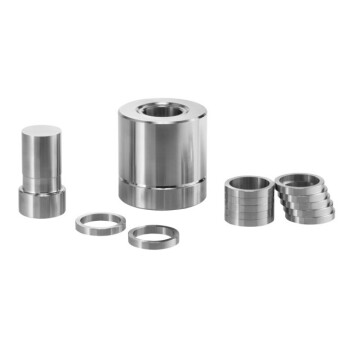
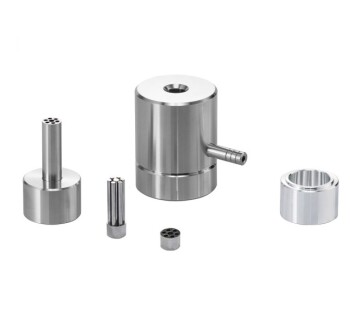
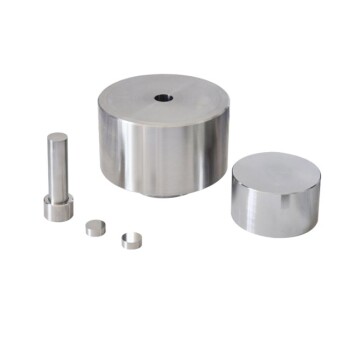
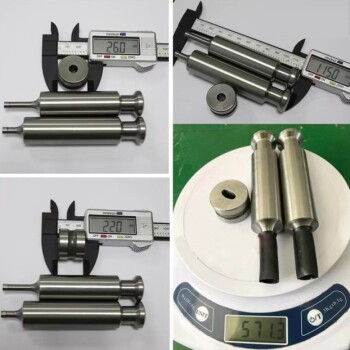
Specialized high-strength molds function as the primary enablers of complex stress states in Multi-directional Upsetting-Extrusion (MUE) processing. These molds force Ferritic-Martensitic (FM) steel to undergo severe multi-directional deformation while maintaining structural integrity within the critical ferrite phase stability temperature range of 575 to 750 °C.
The primary value of these molds lies in their ability to facilitate "deep refinement" of the microstructure. By ensuring uniform deformation under extreme conditions, they directly enhance the material's high-temperature mechanical performance and creep resistance.
The Mechanics of Deformation
Generating Complex Stress States
The fundamental role of the high-strength mold is to apply force from multiple vectors simultaneously. Unlike simple forging, the mold constrains the material, creating a complex stress state that is necessary for severe plastic deformation.
Ensuring Uniformity
Without a specialized mold design, multi-directional force often leads to uneven material flow. These molds are engineered to ensure uniform deformation throughout the workpiece, preventing localized weak points or structural inconsistencies.
Maintaining Structural Integrity
The process subjects the FM steel to intense physical stress. The high-strength mold acts as a containment vessel, maintaining the structural integrity of the billet preventing cracking or failure during the aggressive upsetting and extrusion phases.
Thermal and Microstructural Implications
Deep Microstructural Refinement
The severe deformation enabled by the mold leads to deep refinement of the steel's microstructure. This refinement is the physical mechanism that upgrades the properties of the base material.
Operating in the Ferrite Phase
The molds are designed to function effectively within the ferrite phase stability temperature range (575 to 750 °C). Controlling deformation within this specific thermal window is essential for achieving the desired phase characteristics in FM steel.
Understanding the Operational Trade-offs
High Stress Requirements
Because the goal is severe deformation, the molds themselves are subjected to immense internal pressures. This necessitates the use of premium, high-strength materials for the molds to prevent premature tool failure.
Complexity in Design
Achieving a truly uniform complex stress state requires precise mold geometry. Any deviation in the mold design can lead to non-uniform deformation, negating the benefits of the MUE process.
Strategic Application for Material Design
Assessing MUE for Your Material Goals
- If your primary focus is Microstructural Homogeneity: Utilize these molds to enforce uniform deformation, ensuring consistent grain refinement throughout the entire cross-section of the steel.
- If your primary focus is High-Temperature Durability: Leverage the deep refinement capabilities of the process to specifically enhance creep resistance for components exposed to prolonged heat.
The effective use of high-strength molds transforms FM steel from a standard alloy into a high-performance material capable of withstanding extreme thermal and mechanical environments.
Summary Table:
| Feature | Function in MUE Process | Impact on FM Steel |
|---|---|---|
| Stress State | Generates complex, multi-directional stress | Enables severe plastic deformation |
| Deformation Control | Ensures uniform material flow | Prevents localized weak points |
| Structural Support | Maintains billet integrity at 575–750 °C | Prevents cracking and structural failure |
| Refinement Ability | Facilitates "deep" grain refinement | Enhances creep resistance & durability |
Elevate Your Material Research with KINTEK Precision Solutions
Precision in MUE processing starts with high-performance tooling. KINTEK specializes in advanced laboratory equipment and consumables, including high-strength hydraulic presses (pellet, hot, and isostatic) and custom crushing and milling systems designed to withstand extreme stresses.
Whether you are refining Ferritic-Martensitic steel or developing next-generation alloys, our range of high-temperature furnaces, isostatic presses, and specialized ceramics and crucibles provides the reliability your research demands.
Ready to optimize your lab's performance? Contact us today to discuss how our tailored equipment solutions can help you achieve deeper microstructural refinement and superior mechanical results.
References
- H.Yu. Rostova, G.D. Tolstolutska. A REVIEW: FERRITIC-MARTENSITIC STEELS – TREATMENT, STRUCTURE AND MECHANICAL PROPERTIES. DOI: 10.46813/2022-140-066
This article is also based on technical information from Kintek Solution Knowledge Base .
Related Products
- XRF & KBR steel ring lab Powder Pellet Pressing Mold for FTIR
- Isostatic Molding Pressing Molds for Lab
- Special Shape Press Mold for Lab
- Round Bidirectional Press Mold for Lab
- Anti-Cracking Press Mold for Lab Use
People Also Ask
- What is the purpose of using a mold for pellet pressing when preparing catalyst test samples? Ensure Data Consistency
- What are the advantages of using the pressed pellet method for XRF sample preparation? Optimize Your XRF Analysis
- What is the pressed powder pellet method? A Guide to Accurate FTIR Sample Preparation
- How does the selection of a pressure mold affect the performance of all-solid-state batteries? Expert Pelletizing Guide
- What are the different types of XRF samples? A Guide to Solid, Powder, and Liquid Prep