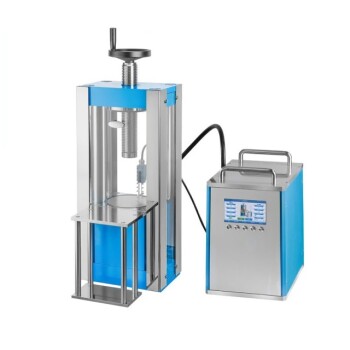
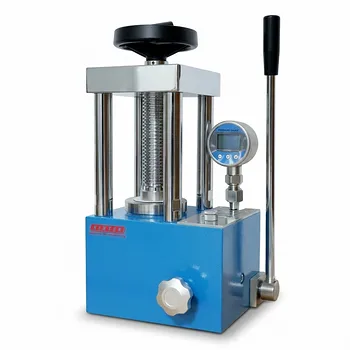
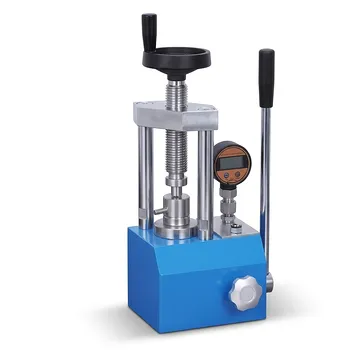
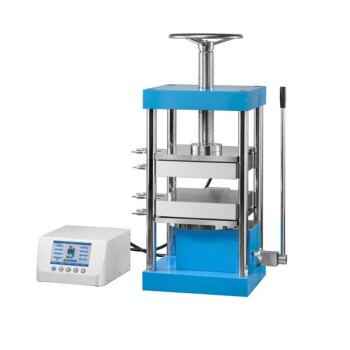
A laboratory hydraulic press is the primary instrument used to densify loose LLZTO powder into solid "green" pellets. It applies high, precise uniaxial pressure to force calcined powder particles together, eliminating air voids and establishing the structural integrity required for subsequent handling and processing.
The Core Takeaway The hydraulic press does not merely shape the material; it determines the baseline density of the ceramic. This "green density" is the single most critical predictor of the final material's ionic conductivity and mechanical strength, whether the pellet is destined for high-temperature sintering or used in a non-sintered composite application.
The Mechanics of Densification
Reducing Inter-particle Voids
The primary function of the press is to mechanically reduce porosity. By applying significant force, the press minimizes the distance between individual powder particles. This reduction in void space is essential because air acts as an insulator against lithium-ion transport.
Creating the "Green" Compact
The press converts loose powder into a cohesive solid known as a "green pellet." This compact possesses specific geometric dimensions and sufficient mechanical strength to be handled without crumbling. It provides the physical foundation necessary for the material to survive the transfer to a furnace or a battery assembly.
Impact on Electrochemical Performance
Prerequisite for Sintering Success
For standard ceramic electrolytes, the press prepares the material for high-temperature sintering. Achieving a high initial "green" density—often requiring pressures around 300 MPa—is critical. It ensures that during sintering, the material can densify further to reach over 90% of its theoretical density, enabling strong grain bonding.
Facilitating Ion Transport Networks
In non-sintered or polymer-composite LLZTO applications, the press serves a slightly different but equally vital function. High pressure (e.g., 8 tons) forces polymer coatings to deform and fill the voids between LLZTO particles. This establishes a continuous, tight contact network required for efficient ion movement.
Critical Process Variables
The Necessity of High Pressure
Standard molding pressures (e.g., 10-12 MPa) are sufficient for basic shaping, but high-performance electrolytes often demand much higher loads. To minimize inter-particle porosity effectively, specific high-pressure treatments are required to maximize the contact area between grains.
Consistency and Control
The hydraulic press must deliver constant and precise pressure. Fluctuations during the molding stage lead to density gradients within the pellet. These inconsistencies can result in weak points, poor conductivity, or structural failure during the final application.
Making the Right Choice for Your Goal
Depending on your specific fabrication route for LLZTO, the function of the press shifts slightly in focus.
- If your primary focus is High-Temperature Sintering: Prioritize extreme pressure (approx. 300 MPa) to maximize green density, as this is the prerequisite for achieving strong grain bonding and high final density.
- If your primary focus is Non-Sintered/Composite Electrolytes: Focus on applying sufficient tonnage (e.g., 8 tons) to ensure the polymer binder completely fills inter-particle voids, creating a continuous ion transport path without relying on heat.
The hydraulic press is the bridge between raw chemical synthesis and a functional, high-density battery component.
Summary Table:
| Process Function | Key Role in LLZTO Preparation | Desired Outcome |
|---|---|---|
| Densification | Eliminates inter-particle voids and air pockets | High "green density" and ion transport |
| Compaction | Converts loose powder into a cohesive "green pellet" | Structural integrity for handling/sintering |
| Pressure Application | Provides precise uniaxial force (up to 300 MPa) | Uniform grain contact and reduced porosity |
| Composite Optimization | Forces polymer binders into voids (for composites) | Continuous, tight contact network |
Elevate Your Battery Research with KINTEK Precision
Maximize the electrochemical performance of your LLZTO ceramic electrolytes with KINTEK’s premium laboratory hydraulic presses. Whether you are preparing pellets for high-temperature sintering or developing advanced non-sintered composite materials, our high-precision equipment ensures the uniform density and structural integrity your research demands.
Why choose KINTEK?
- Comprehensive Range: From pellet and hot presses to isostatic systems for superior density.
- Total Lab Solutions: We specialize in high-temperature furnaces (muffle, vacuum, CVD), crushing/milling systems, and essential consumables like ceramics and crucibles.
- Targeted Performance: Our tools are designed specifically for battery research and advanced material science applications.
Ready to achieve over 90% theoretical density in your pellets? Contact us today to find the perfect hydraulic press for your lab!
Related Products
- Laboratory Hydraulic Press Split Electric Lab Pellet Press
- Laboratory Hydraulic Press Lab Pellet Press Machine for Glove Box
- Laboratory Hydraulic Press Lab Pellet Press for Button Battery
- Automatic Laboratory Hydraulic Pellet Press Machine for Lab Use
- Automatic Laboratory Hydraulic Press for XRF & KBR Pellet Press
People Also Ask
- What role does a laboratory hydraulic press play in platinum recovery research? Enhancing Sample Precision
- What are the specific applications of a lab hydraulic press in biochar evaluation? Optimize density and data accuracy.
- What are the roles of a laboratory hydraulic press and stainless steel molds in the preparation of graphite samples?
- What is the role of a laboratory hydraulic press in electrode prep? Maximize Energy Density & Sealing Precision
- Why must a laboratory hydraulic press equipped with cylindrical molds be used when preparing BZY green bodies? High Density