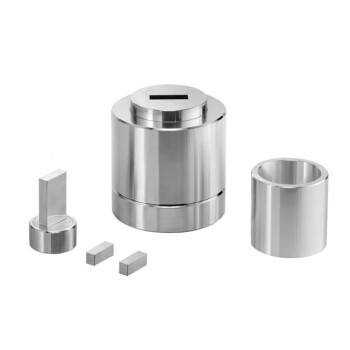
The primary function of a uniaxial hydraulic press in the preparation of Li1.5Al0.5Ti1.5(PO4)3 (LATP) is to mechanically compact loose ceramic powder into solid, pellet-shaped "green bodies." By applying significant pressure—often as high as 226 MPa—the press forces particle rearrangement to minimize void space, creating the necessary physical density and structural integrity required before the material undergoes high-temperature sintering.
The compaction step is not merely about shaping; it is a critical determinant of performance. The initial density achieved during pressing directly dictates the final density and ionic conductivity of the sintered LATP pellet, making the hydraulic press essential for optimizing the material's electrochemical properties.
The Mechanics of Densification
Particle Rearrangement and Void Reduction
The most immediate physical change induced by the press is the reduction of inter-particle volume.
Loose LATP powder contains significant air gaps and voids. The uniaxial press applies axial force to overcome friction between particles, forcing them into a tighter packing arrangement. This macro-level compression eliminates large pores that would otherwise persist as defects in the final ceramic.
Establishing Inter-Particle Contact
Beyond simple packing, the pressure creates intimate physical contact between individual powder grains.
Supplementary data suggests that high pressure can induce slight plastic deformation or simply force tight mechanical interlocking. This proximity is vital because it reduces the diffusion distance required for mass transport during the subsequent sintering phase.
Creating Structural "Green" Strength
Before a ceramic is fired, it is fragile. The hydraulic press compacts the powder into a coherent shape—typically a cylinder or pellet—with sufficient mechanical strength to be handled.
This "green strength" ensures the sample maintains its geometric integrity when being transferred from the mold to the furnace, preventing crumbling or deformation prior to heating.
Impact on Final Material Properties
Correlation to Ionic Conductivity
The primary objective of LATP is to serve as a solid electrolyte, where ionic conductivity is paramount.
There is a direct causal link between the pressure applied by the hydraulic press and the final conductivity. Higher green body density leads to higher sintered density. A denser final ceramic facilitates easier lithium-ion movement, whereas a porous body creates resistance and lowers performance.
Facilitating Solid-State Diffusion
Sintering relies on atoms diffusing across particle boundaries to fuse the material together.
By using the press to maximize the initial contact area between particles, you lower the energy barrier for this diffusion. This promotes effective grain growth and bonding, ensuring the final material is chemically and mechanically homogeneous.
Understanding the Trade-offs
Uniaxial Pressure Gradients
While effective, uniaxial pressing applies force from one direction (typically top-down).
This can occasionally lead to density gradients within the green body, where the powder closer to the punch is denser than the powder in the center. For LATP, ensuring the pellet is thin enough or using lubricants can help mitigate non-uniform density that might lead to warping during sintering.
Balancing Pressure and Defect Formation
Applying pressure is critical, but the specific amount (e.g., 226 MPa vs. 42 MPa) must be optimized for the specific powder morphology.
Insufficient pressure results in a porous, weak conductor. Conversely, excessive pressure without proper de-airing can trap air pockets or cause lamination cracks (capping) in the green body, which effectively ruins the sample's structural integrity.
Making the Right Choice for Your Goal
When configuring your hydraulic press parameters for LATP preparation, consider your end-goal requirements:
- If your primary focus is maximizing Ionic Conductivity: Target higher pressures (e.g., nearing 226 MPa) to maximize green density, as this minimizes porosity in the final electrolyte.
- If your primary focus is Sample Consistency: Ensure the aspect ratio (height vs. diameter) of your pellet is low to minimize density gradients caused by the uniaxial nature of the press.
- If your primary focus is Process Stability: Utilize a lower pre-pressure (around 0.3 MPa) to set the shape before ramping up to the final compaction pressure to ensure uniform air removal.
The hydraulic press is the gatekeeper of quality; it establishes the structural baseline that limits or enables the ultimate performance of the LATP ceramic.
Summary Table:
| Process Step | Function of Hydraulic Press | Impact on Final LATP Property |
|---|---|---|
| Powder Compaction | Reduces inter-particle void space and air gaps | Increases final sintered density |
| Contact Formation | Establishes intimate grain-to-grain contact | Facilitates efficient solid-state diffusion |
| Green Strength | Creates a coherent, handleable pellet shape | Prevents crumbling and geometric deformation |
| Pressure Optimization | Minimizes porosity through high-pressure (up to 226 MPa) | Maximizes lithium-ion conductivity |
Elevate Your Battery Research with KINTEK Precision
Precision in powder compaction is the foundation of high-performance solid electrolytes. KINTEK specializes in advanced laboratory equipment, providing high-performance hydraulic presses (pellet, hot, isostatic) designed to achieve the critical green body density your LATP research demands.
Beyond compaction, our comprehensive portfolio supports your entire workflow—from high-temperature muffle and vacuum furnaces for sintering to PTFE products, ceramics, and crucibles for material purity. Whether you are developing LATP pellets or exploring next-generation battery chemistries, KINTEK offers the tools and expertise to ensure consistent, high-conductivity results.
Ready to optimize your material performance? Contact KINTEK today for expert guidance and tailored equipment solutions!
Related Products
- Automatic Laboratory Hydraulic Pellet Press Machine for Lab Use
- Manual Lab Heat Press
- Laboratory Manual Hydraulic Pellet Press for Lab Use
- Automatic Laboratory Hydraulic Press for XRF & KBR Pellet Press
- Heated Hydraulic Press Machine with Integrated Manual Heated Plates for Lab Use
People Also Ask
- What is the role of a laboratory hydraulic pellet press and stainless steel molds in the fabrication of RuO2/NbC anodes?
- What role does a laboratory pellet press play in the enhancement of biomass energy products? Optimize Fuel Efficiency
- What is the purpose of using a laboratory pellet press when evaluating the electronic conductivity of carbon powders? Guide
- How does a laboratory hydraulic pellet press contribute to SiCw/2024 aluminum composite preforms? Optimize Densification
- What is the significance of applying 200 MPa of pressure with a laboratory hydraulic pellet press for composite ceramics?