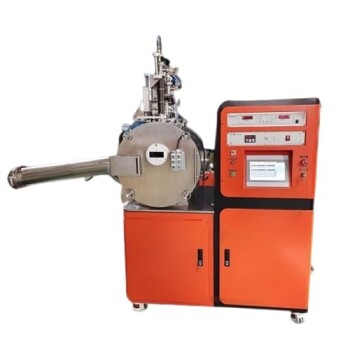
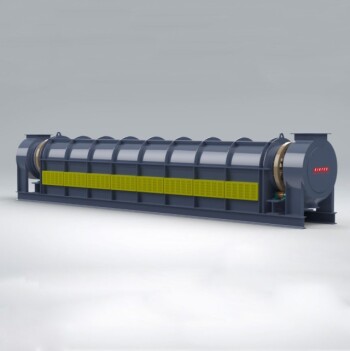
At its most fundamental level, a Spark Plasma Sintering (SPS) machine is an advanced manufacturing tool that uses electricity and pressure to rapidly forge powdered materials into dense, solid parts. It functions like a specialized hot press but utilizes a powerful, pulsed direct current that flows through the mold and the powder itself. This direct heating method is exceptionally fast and is the key to creating high-performance materials with unique microstructures that are often impossible to achieve with conventional furnaces.
The core innovation of SPS is not just heating, but the speed of heating. By using a direct electrical current to consolidate powders in minutes instead of hours, SPS prevents the undesirable grain growth common in traditional methods, resulting in materials with superior density and strength.
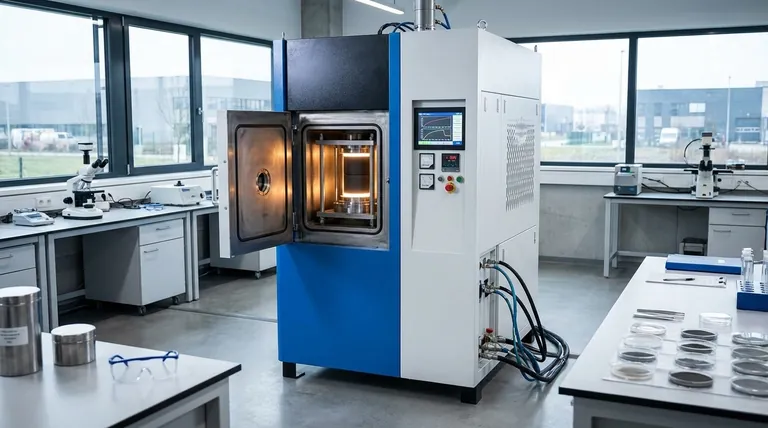
How an SPS Machine Works: The Core Process
To understand what makes an SPS machine unique, we must look at how it combines three critical elements: a conductive die, a pulsed electrical current, and mechanical pressure.
The Physical Setup
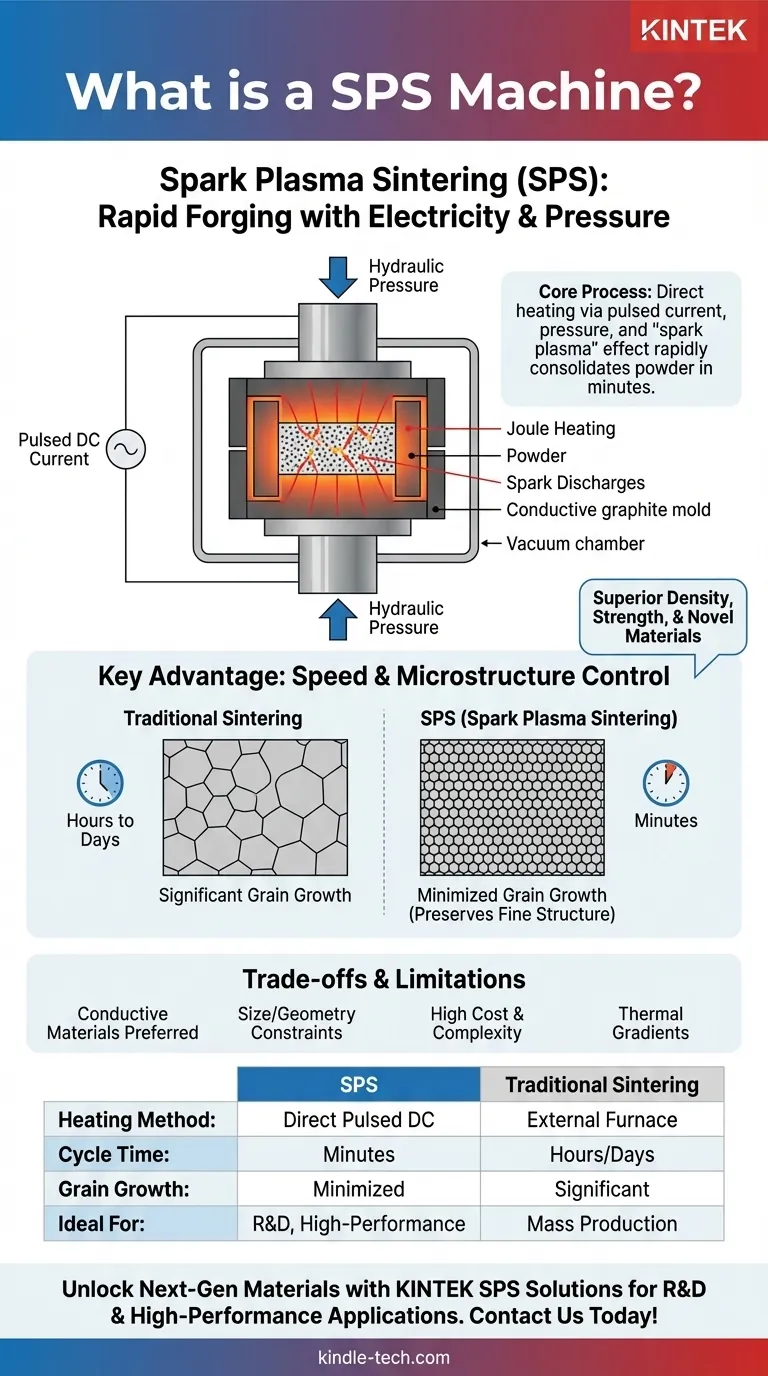
An SPS process begins by loading a powdered material into a conductive mold, which is almost always made of graphite. This mold assembly is then placed inside a vacuum chamber between two large electrodes. A hydraulic system applies significant mechanical pressure to the mold.
The Unique Heating Mechanism
Unlike a conventional furnace that heats the chamber, an SPS machine sends a high-amperage, pulsed DC current directly through the electrodes and the graphite mold. Because the mold and (often) the powder are electrically conductive, they heat up incredibly rapidly due to Joule heating. This is the same principle that makes a toaster element glow.
The "Spark Plasma" Effect
The name "Spark Plasma Sintering" suggests that plasma is generated between the powder particles. While the exact mechanism is a subject of scientific debate, it is widely understood that the process generates spark discharges in the gaps between powder grains.
These sparks clean the particle surfaces by stripping away contaminants and oxides. This pristine surface condition dramatically enhances the bonding between particles when pressure is applied.
Densification Under Pressure
As the powder rapidly heats to sintering temperature, the applied mechanical pressure forces the particles together. The combination of clean surfaces, intense heat, and high pressure causes the material to consolidate into a solid, highly dense part in a very short amount of time—often just a few minutes.
The Key Advantage: Speed and Microstructure Control
The primary reason to use SPS over other methods lies in its ability to control the final material's internal structure, or microstructure.
Preventing Grain Growth
In traditional sintering, long heating times allow the individual crystals, or grains, within the material to grow larger. For many advanced applications, larger grains are undesirable as they can reduce strength and hardness.
The extreme speed of the SPS process densifies the material before the grains have a chance to grow. This preserves the fine-grained, or even nano-structured, nature of the starting powder, leading to superior mechanical properties.
Enabling Novel Materials
By inhibiting grain growth and avoiding equilibrium states, SPS allows for the creation of materials that simply cannot be made otherwise. This includes advanced ceramics, functionally graded materials, and metal matrix composites with enhanced performance characteristics for aerospace, defense, and medical applications.
Understanding the Trade-offs and Limitations
While powerful, SPS technology is not a universal solution. Its application comes with specific constraints and considerations.
Material and Geometry Constraints
SPS works best with materials that are at least partially electrically conductive. While insulating materials like some ceramics can be sintered, it requires specialized mold designs to ensure proper heating. Additionally, the size and shape of the final part are limited by the graphite molds, which are typically simple cylinders.
Cost and Complexity
SPS machines are sophisticated and expensive pieces of equipment. They require more operational expertise than conventional furnaces and are best suited for high-value applications where the performance benefits justify the cost.
Thermal Gradients
The extremely rapid heating can sometimes create temperature differences, or gradients, across a large part. Managing these gradients is critical to ensure the final component is uniform and free of internal stress.
Making the Right Choice for Your Goal
Selecting a manufacturing process depends entirely on the desired outcome for your material. SPS is a specialized tool for demanding applications.
- If your primary focus is high-performance components: SPS is an exceptional choice for creating dense, fine-grained materials with superior strength, hardness, and other mechanical properties.
- If your primary focus is rapid research and development: SPS is invaluable for its ability to quickly produce test samples of novel materials and alloys, drastically shortening development cycles.
- If your primary focus is mass production of simple parts: Traditional, lower-cost methods like conventional sintering or hot pressing are often more economical for applications that do not require elite material properties.
Ultimately, an SPS machine empowers engineers and scientists to create next-generation materials by controlling their structure at the microscopic level.
Summary Table:
| Feature | SPS Machine | Traditional Sintering |
|---|---|---|
| Heating Method | Direct pulsed DC current (Joule heating) | External furnace heating |
| Cycle Time | Minutes | Hours to days |
| Grain Growth | Minimized (preserves fine/nano-structure) | Significant (larger grains) |
| Key Advantage | Superior density & strength; novel materials | Cost-effective for simple parts |
| Ideal For | R&D, high-performance ceramics & composites | Mass production of standard components |
Ready to unlock the potential of next-generation materials in your lab?
At KINTEK, we specialize in providing advanced lab equipment like Spark Plasma Sintering (SPS) machines that enable rapid, high-performance material fabrication. Whether you're in R&D for aerospace, medical devices, or advanced ceramics, our SPS solutions can help you achieve superior material density and strength while drastically shortening your development cycles.
Contact our experts today to discuss how an SPS machine can transform your material synthesis process and bring your innovative projects to life.
Visual Guide
Related Products
- Spark Plasma Sintering Furnace SPS Furnace
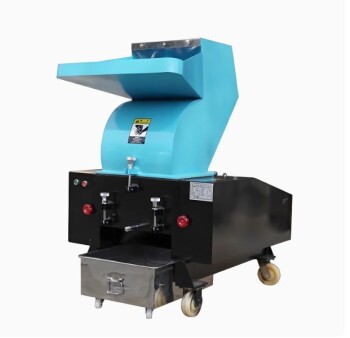
- Powerful Plastic Crusher Machine
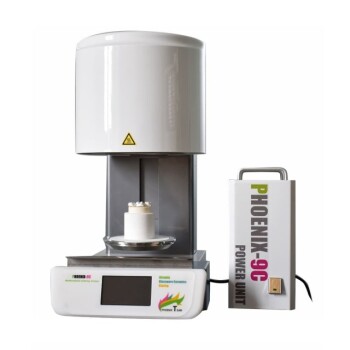
- Vacuum Dental Porcelain Sintering Furnace
- Vacuum Heat Treat and Pressure Sintering Furnace for High Temperature Applications
- Dental Porcelain Zirconia Sintering Ceramic Vacuum Press Furnace
People Also Ask
- What is the theory of spark plasma sintering? A Guide to Rapid, Low-Temperature Densification
- What technical advantages does a Spark Plasma Sintering (SPS) furnace offer for LZP ceramics? Enhance Ionic Conductivity
- What is the pressure for spark plasma sintering? A Guide to Optimizing SPS Parameters
- Why are Spark Plasma Sintering (SPS) furnaces or hot presses utilized in the preparation of Li3PS4 solid electrolytes?
- What is the mechanism of SPS process? A Deep Dive into Rapid, Low-Temperature Sintering