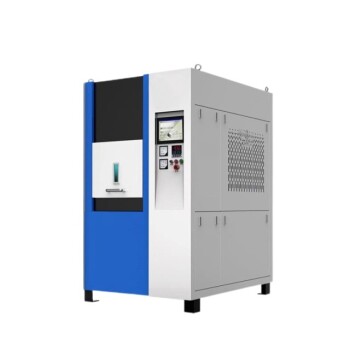
Spark Plasma Sintering (SPS) fundamentally alters the microstructure of LiZr2(PO4)3 (LZP) ceramics by utilizing pulsed direct current (DC) and simultaneous mechanical pressure. This technique allows for rapid densification at significantly lower temperatures and shorter timeframes than conventional methods, directly addressing the challenge of maintaining high ionic conductivity.
Core Takeaway The distinct advantage of SPS is its ability to break the traditional link between high density and large grain size. By densifying LZP rapidly at lower temperatures, SPS inhibits excessive grain growth, resulting in a superior microstructure that maximizes the material's ionic conductivity.
The Mechanics of Rapid Densification
Utilizing Pulsed Current and Pressure
Unlike traditional sintering, which relies on external heating elements to slowly warm a sample, SPS generates heat internally. It applies a pulsed DC voltage directly through the powder particles, creating Joule heat and plasma activation effects. Simultaneously, mechanical pressure is applied to the material, assisting in physical compaction.
Achieving Speed and Efficiency
This internal heating mechanism allows for outstanding heating rates, sometimes reaching up to 1000 K/min. Consequently, the sintering process is measured in minutes rather than the hours or days required for traditional methods. This efficiency drastically reduces energy consumption and operational costs.
Lowering Process Temperatures
The combination of electrical impulses and mechanical pressure facilitates densification at much lower temperatures. Because the particles are physically forced together while being activated by the current, the material consolidates without needing the extreme thermal soaking of conventional kilns.
Optimizing Microstructure and Performance
Inhibiting Grain Growth
For LZP ceramics, grain size control is critical. Traditional methods require long dwell times at high heat, which invariably leads to grain coarsening (growth). The rapid heating and short holding time of SPS effectively stop this growth, preserving fine, nanostructured grain boundaries.
Eliminating Defects
Traditional sintering often results in an uneven distribution of defects, voids, and pores. SPS utilizes rapid self-heating to eliminate agglomeration and minimize porosity. The result is a highly dense ceramic body that is largely free of the structural defects that hamper performance.
Maximizing Ionic Conductivity
The primary goal in producing LZP is achieving high ionic conductivity. The superior microstructure produced by SPS—characterized by high density and controlled grain size—provides a more efficient pathway for ion transport. This makes SPS a benchmark technology for preparing high-performance solid electrolytes.
Understanding the Operational Trade-offs
Equipment Complexity and Cost
While SPS offers superior material properties, the equipment is significantly more complex and expensive than a standard sintering furnace. It requires precise control over vacuum systems, hydraulic pressure, and high-power electrical pulses.
Scalability Constraints
SPS is typically a batch process constrained by the size of the die (usually graphite) and the vacuum chamber. While excellent for high-value components or research, it generally has lower throughput compared to continuous tunnel kilns used in mass production.
Making the Right Choice for Your Goal
When deciding between SPS and traditional sintering for LZP ceramics, consider your primary constraints:
- If your primary focus is maximizing ionic conductivity: Choose SPS, as the refined microstructure and high density are essential for peak electrochemical performance.
- If your primary focus is rapid prototyping: Choose SPS for its ability to produce fully dense samples in minutes rather than days.
- If your primary focus is low-cost mass production: Evaluate if the performance dip from traditional sintering is acceptable, as SPS may present scalability challenges for high-volume commodity manufacturing.
SPS transforms the production of LZP from a thermal management challenge into a precise microstructural engineering process.
Summary Table:
| Feature | Traditional Sintering | Spark Plasma Sintering (SPS) |
|---|---|---|
| Heating Mechanism | External Heating (Convection) | Internal Pulsed DC (Joule Heat) |
| Heating Rate | Slow (typically <10 K/min) | Ultra-fast (up to 1000 K/min) |
| Process Duration | Hours to Days | Minutes |
| Grain Size | Coarse/Large (due to long dwell) | Fine/Nanostructured (inhibited growth) |
| Density & Defects | Higher porosity risk | High density, minimal defects |
| Primary Goal | Mass production economy | Maximum ionic conductivity & performance |
Elevate Your Material Research with KINTEK
Precision engineering demands advanced thermal processing. KINTEK specializes in high-performance laboratory equipment, providing the cutting-edge tools you need for superior material synthesis. Whether you are developing LZP solid electrolytes or high-value advanced ceramics, our range of SPS-compatible systems, vacuum furnaces, and crushing and milling systems ensures optimal density and microstructure every time.
Our value to you:
- Comprehensive Portfolio: From high-temperature furnaces and hydraulic presses to specialized electrolytic cells and crucibles.
- Technical Expertise: Reliable solutions for battery research, material science, and precision dental applications.
- End-to-End Support: Quality consumables like PTFE and ceramics to support your entire workflow.
Ready to maximize your lab’s efficiency and material performance? Contact us today to find your perfect solution!
Related Products
- Spark Plasma Sintering Furnace SPS Furnace
- Vacuum Heat Treat and Sintering Furnace with 9MPa Air Pressure
- 600T Vacuum Induction Hot Press Furnace for Heat Treat and Sintering
- Vacuum Heat Treat and Pressure Sintering Furnace for High Temperature Applications
- High Temperature Muffle Oven Furnace for Laboratory Debinding and Pre Sintering
People Also Ask
- What is SPS sintering method? A Guide to High-Speed, High-Performance Material Fabrication
- Why are Spark Plasma Sintering (SPS) furnaces or hot presses utilized in the preparation of Li3PS4 solid electrolytes?
- What is the difference between spark plasma sintering and flash sintering? A Guide to Advanced Sintering Methods
- What is the theory of spark plasma sintering? A Guide to Rapid, Low-Temperature Densification
- What are the fundamentals of spark plasma sintering process? Unlock Rapid, High-Performance Material Consolidation