Knowledge cvd machine What is chemical vapor deposition in semiconductor fabrication? Build High-Quality Thin Films for Your Chips
Author avatar

Tech Team · Kintek Solution

Updated 2 months ago

What is chemical vapor deposition in semiconductor fabrication? Build High-Quality Thin Films for Your Chips


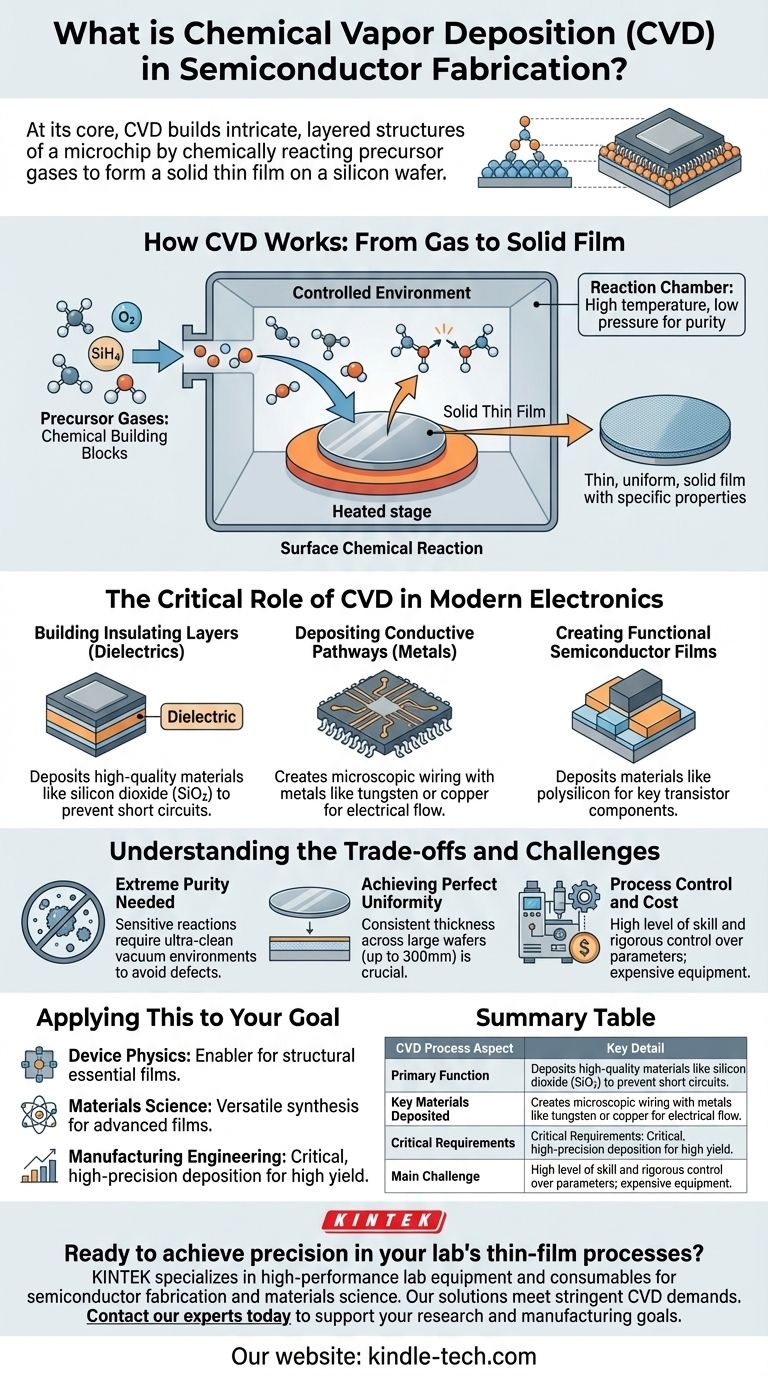
At its core, Chemical Vapor Deposition (CVD) in semiconductor fabrication is a process used to build up the intricate, layered structure of a microchip. It involves introducing specific gases, known as precursors, into a reaction chamber where they chemically react to form a solid thin film on the surface of a silicon wafer. This method is fundamental for creating the insulating and conductive layers that define a modern electronic circuit.

The key to understanding CVD is to see it not as a simple coating technique, but as a precise chemical construction process. It allows engineers to "grow" highly specific materials, atom by atom, onto a substrate, forming the essential electrical pathways and insulators that make a transistor function.
What is chemical vapor deposition in semiconductor fabrication? Build High-Quality Thin Films for Your Chips

How CVD Works: From Gas to Solid Film

To appreciate why CVD is so vital, you must understand the controlled environment in which it operates. The process is far more sophisticated than simply spraying a material onto a surface.

The Reaction Chamber: A Controlled Environment

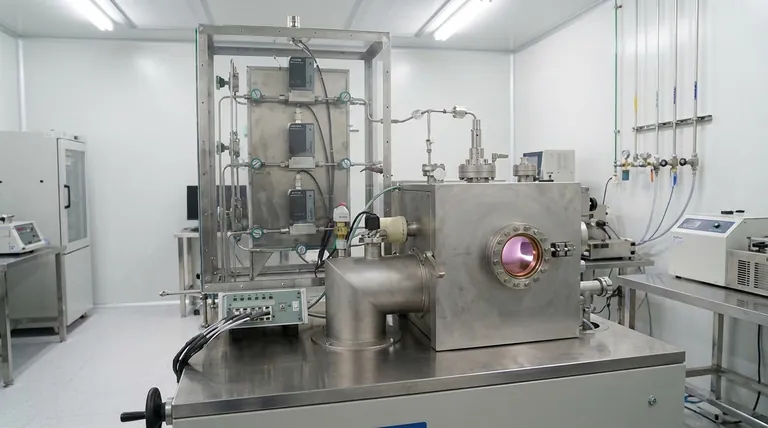
A silicon wafer is placed inside a highly controlled reaction chamber. This chamber is typically held at a specific temperature and pressure, often in a vacuum, to ensure process purity and stability. The controlled environment is critical for preventing contamination and enabling the desired chemical reactions.

Precursor Gases: The Chemical Building Blocks

Specific gaseous chemicals, called precursors, are carefully introduced into the chamber. Each precursor contains the atoms needed for the final film. For example, to create a silicon dioxide (SiO₂) insulating layer, precursors like silane (SiH₄) and oxygen (O₂) might be used. The combination and flow rates of these gases are a precise recipe.

The Deposition Process: A Surface Chemical Reaction

The heat and pressure within the chamber energize the precursor gases, causing them to react on the hot surface of the wafer. This chemical reaction breaks the gases down and re-forms them into a new, solid material that deposits evenly across the wafer's surface. The result is a thin, uniform, and solid film with specific electrical or physical properties.

The Critical Role of CVD in Modern Electronics

CVD is not an optional step; it is used repeatedly during chip manufacturing to build circuits layer by layer. Its versatility allows it to deposit the different types of materials required for a functional device.

Building Insulating Layers (Dielectrics)

In a microchip, billions of transistors are packed together. To prevent electrical signals from short-circuiting, they must be separated by insulating materials, or dielectrics. CVD is the primary method for depositing high-quality dielectrics like silicon dioxide and silicon nitride.

Depositing Conductive Pathways (Metals)

CVD is also used to create the microscopic "wiring" that connects transistors. It can deposit metallic films, such as tungsten or copper, that serve as conductive pathways for electricity to flow through the integrated circuit.

Creating Functional Semiconductor Films

Beyond simple insulators and conductors, CVD is used to deposit functional semiconductor materials themselves. For instance, polycrystalline silicon (polysilicon), a key component in a transistor's gate structure, is often deposited using a CVD process.

Understanding the Trade-offs and Challenges

While powerful, CVD is a demanding process with inherent complexities that engineers must manage to ensure high manufacturing yields.

The Need for Extreme Purity

The chemical reactions in CVD are highly sensitive. Any unwanted particles or contaminant gases in the chamber can interfere with the reaction, leading to defects in the film. This is why the process is performed in a vacuum or an ultra-clean environment.

Achieving Perfect Uniformity

For a chip to function correctly, the deposited film must have a consistent thickness across the entire wafer, which can be up to 300mm in diameter. Variations in temperature or gas flow can lead to non-uniformity, causing device performance to vary across the chip.

Process Control and Cost

CVD equipment is highly sophisticated and expensive. The process requires a high level of skill and rigorous control over parameters like temperature, pressure, and gas chemistry to produce reliable and repeatable results.

Applying This to Your Goal

Understanding CVD is essential, but its relevance depends on your specific focus. Use the following to frame its importance for your work.

  • If your primary focus is semiconductor device physics: See CVD as the enabler for creating the specific dielectric (insulator) and conductive films that are structurally essential for a transistor to operate as designed.
  • If your primary focus is materials science: View CVD as a versatile synthesis technique for creating a wide range of advanced thin films, from standard electronics materials to novel structures like carbon nanotubes and nanowires.
  • If your primary focus is manufacturing engineering: Recognize CVD as a critical, high-precision deposition step that demands rigorous process control to ensure consistent film quality, high yield, and cost-effectiveness.

Chemical vapor deposition is a cornerstone of modern technology, enabling the fabrication of the complex micro-devices that power our world.

Summary Table:

CVD Process Aspect Key Detail
Primary Function Deposits thin, solid films on silicon wafers via chemical reactions.
Key Materials Deposited Dielectrics (e.g., SiO₂), Conductive Metals (e.g., Tungsten), Semiconductors (e.g., Polysilicon).
Critical Requirements Extreme purity, precise temperature/pressure control, and perfect uniformity.
Main Challenge Sophisticated process control needed to prevent defects and ensure high yield.

Ready to achieve precision in your lab's thin-film processes? KINTEK specializes in high-performance lab equipment and consumables for semiconductor fabrication and materials science. Whether you are developing next-generation chips or advanced materials, our solutions are designed to meet the stringent demands of CVD and other deposition techniques. Contact our experts today to discuss how we can support your research and manufacturing goals with reliable, cutting-edge technology.

Visual Guide
What is chemical vapor deposition in semiconductor fabrication? Build High-Quality Thin Films for Your Chips Visual Guide

Related Products

People Also Ask

Related Products

Microwave Plasma Chemical Vapor Deposition MPCVD Machine System Reactor for Lab and Diamond Growth

Microwave Plasma Chemical Vapor Deposition MPCVD Machine System Reactor for Lab and Diamond Growth

Get high-quality diamond films with our Bell-jar Resonator MPCVD machine designed for lab and diamond growth. Discover how Microwave Plasma Chemical Vapor Deposition works for growing diamonds using carbon gas and plasma.

915MHz MPCVD Diamond Machine Microwave Plasma Chemical Vapor Deposition System Reactor

915MHz MPCVD Diamond Machine Microwave Plasma Chemical Vapor Deposition System Reactor

915MHz MPCVD Diamond Machine and its multi-crystal effective growth, the maximum area can reach 8 inches, the maximum effective growth area of single crystal can reach 5 inches. This equipment is mainly used for the production of large-size polycrystalline diamond films, the growth of long single crystal diamonds, the low-temperature growth of high-quality graphene, and other materials that require energy provided by microwave plasma for growth.

Customer Made Versatile CVD Tube Furnace Chemical Vapor Deposition Chamber System Equipment

Customer Made Versatile CVD Tube Furnace Chemical Vapor Deposition Chamber System Equipment

Get your exclusive CVD furnace with KT-CTF16 Customer Made Versatile Furnace. Customizable sliding, rotating, and tilting functions for precise reactions. Order now!

Cylindrical Resonator MPCVD Machine System Reactor for Microwave Plasma Chemical Vapor Deposition and Lab Diamond Growth

Cylindrical Resonator MPCVD Machine System Reactor for Microwave Plasma Chemical Vapor Deposition and Lab Diamond Growth

Learn about Cylindrical Resonator MPCVD Machine, the microwave plasma chemical vapor deposition method used for growing diamond gemstones and films in the jewelry and semi-conductor industries. Discover its cost-effective advantages over traditional HPHT methods.

Split Chamber CVD Tube Furnace with Vacuum Station Chemical Vapor Deposition System Equipment Machine

Split Chamber CVD Tube Furnace with Vacuum Station Chemical Vapor Deposition System Equipment Machine

Efficient split chamber CVD furnace with vacuum station for intuitive sample checking and quick cooling. Up to 1200℃ max temperature with accurate MFC mass flowmeter control.

Chemical Vapor Deposition CVD Equipment System Chamber Slide PECVD Tube Furnace with Liquid Gasifier PECVD Machine

Chemical Vapor Deposition CVD Equipment System Chamber Slide PECVD Tube Furnace with Liquid Gasifier PECVD Machine

KT-PE12 Slide PECVD System: Wide power range, programmable temp control, fast heating/cooling with sliding system, MFC mass flow control & vacuum pump.

Multi Heating Zones CVD Tube Furnace Machine Chemical Vapor Deposition Chamber System Equipment

Multi Heating Zones CVD Tube Furnace Machine Chemical Vapor Deposition Chamber System Equipment

KT-CTF14 Multi Heating Zones CVD Furnace - Precise Temperature Control and Gas Flow for Advanced Applications. Max temp up to 1200℃, 4 channels MFC mass flow meter, and 7" TFT touch screen controller.

Inclined Rotary Plasma Enhanced Chemical Vapor Deposition PECVD Equipment Tube Furnace Machine

Inclined Rotary Plasma Enhanced Chemical Vapor Deposition PECVD Equipment Tube Furnace Machine

Upgrade your coating process with PECVD coating equipment. Ideal for LED, power semiconductors, MEMS and more. Deposits high-quality solid films at low temps.

HFCVD Machine System Equipment for Drawing Die Nano-Diamond Coating

HFCVD Machine System Equipment for Drawing Die Nano-Diamond Coating

The nano-diamond composite coating drawing die uses cemented carbide (WC-Co) as the substrate, and uses the chemical vapor phase method ( CVD method for short ) to coat the conventional diamond and nano-diamond composite coating on the surface of the inner hole of the mold.

RF PECVD System Radio Frequency Plasma-Enhanced Chemical Vapor Deposition RF PECVD

RF PECVD System Radio Frequency Plasma-Enhanced Chemical Vapor Deposition RF PECVD

RF-PECVD is an acronym for "Radio Frequency Plasma-Enhanced Chemical Vapor Deposition." It deposits DLC (Diamond-like carbon film) on germanium and silicon substrates. It is utilized in the 3-12um infrared wavelength range.

Inclined Rotary Plasma Enhanced Chemical Vapor Deposition PECVD Equipment Tube Furnace Machine

Inclined Rotary Plasma Enhanced Chemical Vapor Deposition PECVD Equipment Tube Furnace Machine

Introducing our inclined rotary PECVD furnace for precise thin film deposition. Enjoy automatic matching source, PID programmable temperature control, and high accuracy MFC mass flowmeter control. Built-in safety features for peace of mind.

Custom CVD Diamond Coating for Lab Applications

Custom CVD Diamond Coating for Lab Applications

CVD Diamond Coating: Superior Thermal Conductivity, Crystal Quality, and Adhesion for Cutting Tools, Friction, and Acoustic Applications

CVD Diamond Dressing Tools for Precision Applications

CVD Diamond Dressing Tools for Precision Applications

Experience the Unbeatable Performance of CVD Diamond Dresser Blanks: High Thermal Conductivity, Exceptional Wear Resistance, and Orientation Independence.

Laboratory CVD Boron Doped Diamond Materials

Laboratory CVD Boron Doped Diamond Materials

CVD boron-doped diamond: A versatile material enabling tailored electrical conductivity, optical transparency, and exceptional thermal properties for applications in electronics, optics, sensing, and quantum technologies.

Customizable High Pressure Reactors for Advanced Scientific and Industrial Applications

Customizable High Pressure Reactors for Advanced Scientific and Industrial Applications

This laboratory-scale high-pressure reactor is a high-performance autoclave engineered for precision and safety in demanding research and development environments.

Customizable Laboratory High Temperature High Pressure Reactors for Diverse Scientific Applications

Customizable Laboratory High Temperature High Pressure Reactors for Diverse Scientific Applications

High-pressure lab reactor for precise hydrothermal synthesis. Durable SU304L/316L, PTFE liner, PID control. Customizable volume & materials. Contact us!

Visual High-Pressure Reactor for In-Situ Observation

Visual High-Pressure Reactor for In-Situ Observation

The visual high-pressure reactor uses transparent sapphire or quartz glass, maintaining high strength and optical clarity under extreme conditions for real-time reaction observation.

Molybdenum Tungsten Tantalum Evaporation Boat for High Temperature Applications

Molybdenum Tungsten Tantalum Evaporation Boat for High Temperature Applications

Evaporation boat sources are used in thermal evaporation systems and are suitable for depositing various metals, alloys and materials. Evaporation boat sources are available in different thicknesses of tungsten, tantalum and molybdenum to ensure compatibility with a variety of power sources. As a container, it is used for vacuum evaporation of materials. They can be used for thin film deposition of various materials, or designed to be compatible with techniques such as electron beam fabrication.

High Pressure Laboratory Autoclave Reactor for Hydrothermal Synthesis

High Pressure Laboratory Autoclave Reactor for Hydrothermal Synthesis

Discover the applications of Hydrothermal Synthesis Reactor - a small, corrosion-resistant reactor for chemical labs. Achieve rapid digestion of insoluble substances in a safe and reliable way. Learn more now.

Stainless High Pressure Autoclave Reactor Laboratory Pressure Reactor

Stainless High Pressure Autoclave Reactor Laboratory Pressure Reactor

Discover the versatility of Stainless High Pressure Reactor - a safe and reliable solution for direct and indirect heating. Built with stainless steel, it can withstand high temperatures and pressures. Learn more now.


Leave Your Message