Knowledge What is considered high pressure for hydraulics? A Guide to Modern System Ranges
Author avatar

Tech Team · Kintek Solution

Updated 5 days ago

What is considered high pressure for hydraulics? A Guide to Modern System Ranges


In modern hydraulics, "high pressure" generally refers to systems operating from 3,000 PSI up to around 6,000 PSI (210 to 420 bar). However, the term is highly relative; what is considered high pressure for one application may be standard for another. The most accurate definition depends entirely on the context of the industry and the specific equipment involved.

The concept of "high pressure" is a moving target that has evolved with technology. Instead of a single number, it's more useful to think in terms of pressure ranges, as each range corresponds to different design principles, component requirements, and safety considerations.
What is considered high pressure for hydraulics? A Guide to Modern System Ranges

The Evolution of "High Pressure"

The definition of high pressure has changed significantly over the decades. As material science, sealing technology, and manufacturing precision have advanced, the operational pressures of standard hydraulic systems have consistently increased.

A Shifting Standard

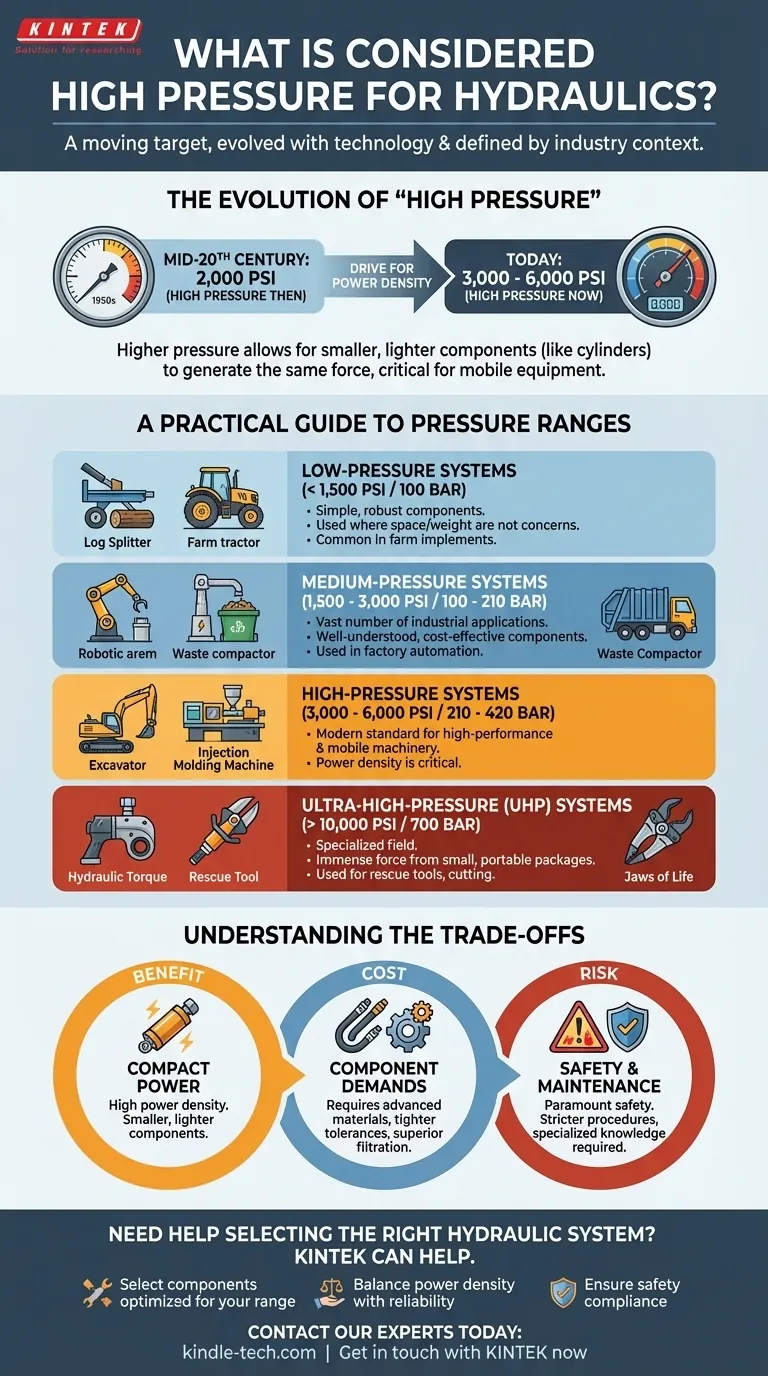
In the mid-20th century, a 2,000 PSI system was considered high pressure. Today, that is often seen as a medium-pressure workhorse for many standard industrial applications.

The Drive for Power Density

The primary driver for increasing pressure is power density. Higher pressure allows for the same amount of force to be generated by smaller, lighter components like cylinders and motors. This is especially critical in mobile equipment like excavators and aircraft.

A Practical Guide to Hydraulic Pressure Ranges

To navigate this, it's best to categorize systems by their typical operating pressure. This provides a clear framework for understanding component selection and application suitability.

Low-Pressure Systems (< 1,500 PSI / 100 bar)

These systems are characterized by simple, robust components. They are often used where space and weight are not primary concerns.

Common applications include log splitters, farm implements, and basic hydraulic presses.

Medium-Pressure Systems (1,500 - 3,000 PSI / 100 - 210 bar)

This range represents a vast number of industrial and older mobile hydraulic systems. It is a well-understood domain with a wide variety of readily available and cost-effective components.

You will find this range in factory automation, machine tools, and waste management equipment like compactors.

High-Pressure Systems (3,000 - 6,000 PSI / 210 - 420 bar)

This is the modern standard for high-performance applications, especially in mobile machinery where power density is critical.

Heavy construction equipment (excavators, loaders), modern injection molding machines, and advanced industrial presses operate in this range.

Ultra-High-Pressure (UHP) Systems (> 10,000 PSI / 700 bar)

This is a specialized field. UHP systems are used where immense force is required from a very small and often portable package.

Applications include hydraulic torque wrenches, rescue tools (e.g., "Jaws of Life"), and hydrodemolition equipment for cutting concrete.

Understanding the Trade-offs

Pushing for higher pressure provides significant benefits but also introduces critical engineering challenges and risks. Choosing the right pressure is a matter of balancing these factors.

The Benefit: Compact Power

The core advantage is power density. Doubling the pressure allows you to get the same force from a cylinder with half the piston area, leading to smaller, lighter, and often faster-actuating systems.

The Cost: Component Demands

Higher pressures demand more from every part of the system. Hoses must have more reinforcement, seals must be made from more advanced materials, and component bodies must be stronger. Tolerances become much tighter, requiring superior filtration to prevent damage.

The Risk: Safety and Maintenance

Safety is paramount. A pinhole leak in a 3,000+ PSI system can inject hydraulic fluid through skin, causing catastrophic injury. Maintenance requires stricter procedures, proper depressurization, and specialized knowledge.

Making the Right Choice for Your Goal

Your system's ideal pressure is dictated by its primary objective.

  • If your primary focus is maximum power in a compact space: A high-pressure system (3,000 - 6,000 PSI) is the necessary choice, but be prepared for higher component costs and stricter maintenance.
  • If your primary focus is reliability and cost-effectiveness for a stationary application: A medium-pressure system (1,500 - 3,000 PSI) often provides the best balance of performance and total cost of ownership.
  • If your primary focus is simplicity and ease of maintenance: A low-pressure system (<1,500 PSI) is the most forgiving and uses the most basic, readily available components.

Understanding these pressure ranges and their associated trade-offs empowers you to select the right approach for your specific hydraulic challenge.

Summary Table:

Pressure Range Typical PSI Common Applications Key Characteristics
Low-Pressure < 1,500 PSI Log splitters, farm implements Simple, robust components, cost-effective
Medium-Pressure 1,500 - 3,000 PSI Factory automation, machine tools Balanced performance, wide component availability
High-Pressure 3,000 - 6,000 PSI Excavators, injection molding machines High power density, requires advanced components
Ultra-High-Pressure (UHP) > 10,000 PSI Hydraulic torque wrenches, rescue tools Specialized, extreme force from compact packages

Need Help Selecting the Right Hydraulic System?

Choosing the correct pressure range is critical for your equipment's performance, safety, and cost-effectiveness. KINTEK specializes in providing laboratory and industrial equipment solutions, including hydraulic components tailored to your specific pressure requirements.

We can help you:

  • Select components optimized for your target pressure range (low, medium, high, or UHP)
  • Balance power density with reliability and maintenance needs
  • Ensure safety compliance for high-pressure applications

Contact our experts today to discuss your hydraulic system goals and get a solution that delivers the right balance of power and practicality. Get in touch with KINTEK now!

Visual Guide
What is considered high pressure for hydraulics? A Guide to Modern System Ranges Visual Guide

Related Products

People Also Ask

Related Products

Vacuum Heat Treat and Pressure Sintering Furnace for High Temperature Applications

Vacuum Heat Treat and Pressure Sintering Furnace for High Temperature Applications

Vacuum pressure sintering furnaces are designed for high temperature hot pressing applications in metal and ceramic sintering. Its advanced features ensure precise temperature control, reliable pressure maintenance, and a robust design for seamless operation.

Ultra-Vacuum Electrode Feedthrough Connector Flange Power Electrode Lead for High-Precision Applications

Ultra-Vacuum Electrode Feedthrough Connector Flange Power Electrode Lead for High-Precision Applications

Discover the Ultra-Vacuum Electrode Feedthrough Connector Flange, perfect for high-precision applications. Ensure reliable connections in ultra-vacuum environments with advanced sealing and conductive technology.

High Purity Pure Graphite Crucible for Evaporation

High Purity Pure Graphite Crucible for Evaporation

Vessels for high temperature applications, where materials are kept at extremely high temperatures to evaporate, allowing thin films to be deposited on substrates.

CVD Diamond for Thermal Management Applications

CVD Diamond for Thermal Management Applications

CVD diamond for thermal management: High-quality diamond with thermal conductivity up to 2000 W/mK, ideal for heat spreaders, laser diodes, and GaN on Diamond (GOD) applications.

Electron Beam Evaporation Coating Tungsten Crucible and Molybdenum Crucible for High Temperature Applications

Electron Beam Evaporation Coating Tungsten Crucible and Molybdenum Crucible for High Temperature Applications

Tungsten and molybdenum crucibles are commonly used in electron beam evaporation processes due to their excellent thermal and mechanical properties.

High Shear Homogenizer for Pharmaceutical and Cosmetic Applications

High Shear Homogenizer for Pharmaceutical and Cosmetic Applications

Enhance lab efficiency with our high-speed Laboratory Emulsifier Homogenizer for precise, stable sample processing. Ideal for pharmaceuticals & cosmetics.

Engineering Advanced Fine Ceramics Alumina Crucibles (Al2O3) for Thermal Analysis TGA DTA

Engineering Advanced Fine Ceramics Alumina Crucibles (Al2O3) for Thermal Analysis TGA DTA

TGA/DTA thermal analysis vessels are made of aluminum oxide (corundum or aluminum oxide). It can withstand high temperature and is suitable for analyzing materials that require high temperature testing.

Arc-Shaped Alumina Ceramic Crucible High Temperature Resistant for Engineering Advanced Fine Ceramics

Arc-Shaped Alumina Ceramic Crucible High Temperature Resistant for Engineering Advanced Fine Ceramics

In the journey of scientific exploration and industrial production, every detail is crucial. Our arc-shaped alumina ceramic crucibles, with their excellent high temperature resistance and stable chemical properties, have become a powerful assistant in laboratories and industrial fields. They are made of high-purity alumina materials and manufactured through precision processes to ensure excellent performance in extreme environments.

Engineering Advanced Fine Ceramics Alumina Al2O3 Crucible With Lid Cylindrical Laboratory Crucible

Engineering Advanced Fine Ceramics Alumina Al2O3 Crucible With Lid Cylindrical Laboratory Crucible

Cylindrical Crucibles Cylindrical crucibles are one of the most common crucible shapes, suitable for melting and processing a wide variety of materials, and are easy to handle and clean.

Electron Beam Evaporation Coating Gold Plating Tungsten Molybdenum Crucible for Evaporation

Electron Beam Evaporation Coating Gold Plating Tungsten Molybdenum Crucible for Evaporation

These crucibles act as containers for the gold material evaporated by the electron evaporation beam while precisely directing the electron beam for precise deposition.

Engineering Advanced Fine Alumina Al2O3 Ceramic Crucible for Laboratory Muffle Furnace

Engineering Advanced Fine Alumina Al2O3 Ceramic Crucible for Laboratory Muffle Furnace

Alumina ceramic crucibles are used in some materials and metal melting tools, and flat-bottomed crucibles are suitable for melting and processing larger batches of materials with better stability and uniformity.

40L Chiller Water Bath Cooling Circulator Low Temperature Constant Temperature Reaction Bath

40L Chiller Water Bath Cooling Circulator Low Temperature Constant Temperature Reaction Bath

Get efficient and reliable chilling power with KinTek KCP circulating chiller. With a max. temp of -120℃, it's an ideal equipment for different working circumstances.

50L Chiller Water Bath Cooling Circulator Low Temperature Constant Temperature Reaction Bath

50L Chiller Water Bath Cooling Circulator Low Temperature Constant Temperature Reaction Bath

KinTek KCP 50L chilling circulator is a reliable and efficient equipment for supplying constant chilling power with circulating fluids in various working circumstances.

30L Chiller Water Bath Cooling Circulator Low Temperature Constant Temperature Reaction Bath

30L Chiller Water Bath Cooling Circulator Low Temperature Constant Temperature Reaction Bath

Keep your lab cool with the KinTek KCP chilling circulator - ideal for constant chilling power and adaptable to meet all your working needs.

High Purity Pure Graphite Crucible for Electron Beam Evaporation

High Purity Pure Graphite Crucible for Electron Beam Evaporation

A technology mainly used in the field of power electronics. It is a graphite film made of carbon source material by material deposition using electron beam technology.

Alumina Al2O3 Ceramic Crucible Semicircle Boat with Lid for Engineering Advanced Fine Ceramics

Alumina Al2O3 Ceramic Crucible Semicircle Boat with Lid for Engineering Advanced Fine Ceramics

Crucibles are containers widely used for melting and processing various materials, and semicircular boat-shaped crucibles are suitable for special smelting and processing requirements. Their types and uses vary by material and shape.

Sub-Lance Probe for Molten Steel Temperature Carbon Content Oxygen Content Measurement and Steel Sample Collection

Sub-Lance Probe for Molten Steel Temperature Carbon Content Oxygen Content Measurement and Steel Sample Collection

Optimize steelmaking with sub-lance probes for precise temperature, carbon, and oxygen measurements. Enhance efficiency and quality in real-time.

Horizontal High Temperature Graphite Vacuum Graphitization Furnace

Horizontal High Temperature Graphite Vacuum Graphitization Furnace

Horizontal Graphitization Furnace: This type of furnace is designed with the heating elements placed horizontally, allowing for uniform heating of the sample. It's well-suited for graphitizing large or bulky samples that require precise temperature control and uniformity.

Custom Machined and Molded PTFE Teflon Parts Manufacturer with PTFE Crucible and Lid

Custom Machined and Molded PTFE Teflon Parts Manufacturer with PTFE Crucible and Lid

PTFE crucibles, made from pure Teflon, offer chemical inertness and resistance from -196°C to 280°C, ensuring compatibility with a wide range of temperatures and chemicals. These crucibles feature machine-finished surfaces for easy cleaning and prevention of contamination, making them ideal for precise laboratory applications.

Graphite Vacuum Furnace Bottom Discharge Graphitization Furnace for Carbon Materials

Graphite Vacuum Furnace Bottom Discharge Graphitization Furnace for Carbon Materials

Bottom-out graphitization furnace for carbon materials, ultra-high temperature furnace up to 3100°C, suitable for graphitization and sintering of carbon rods and carbon blocks. Vertical design, bottom discharging, convenient feeding and discharging, high temperature uniformity, low energy consumption, good stability, hydraulic lifting system, convenient loading and unloading.


Leave Your Message