
In essence, hydrogen annealing is a specialized heat treatment process that uses a 100% hydrogen atmosphere to soften metal while simultaneously cleaning its surface. Unlike other methods, the hydrogen actively removes oxides, resulting in a clean, bright finish, which is why it is often called "bright annealing." This process improves the metal's ductility and relieves internal stresses, making it more workable for subsequent manufacturing steps.
While standard annealing makes a metal softer and less brittle, hydrogen annealing adds a critical second benefit: it acts as a high-performance cleaning agent at the atomic level, delivering an exceptionally clean, oxide-free surface straight from the furnace.
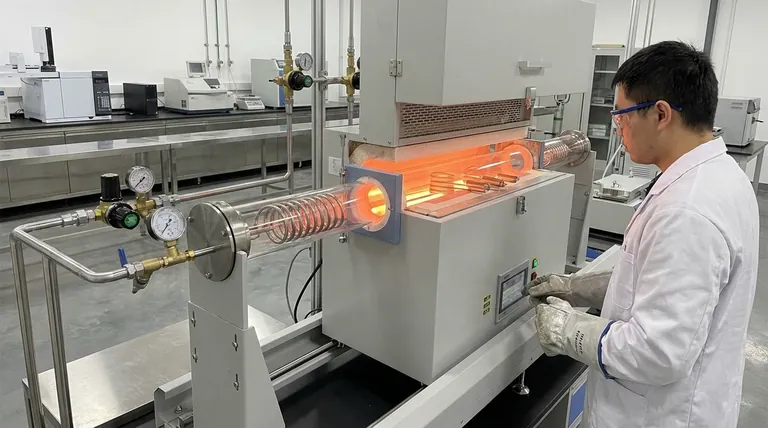
The Core Principle of Annealing
What is Annealing?
Annealing is a heat treatment process that alters a material's microstructure to achieve specific properties. It involves three fundamental stages: heating the metal to a specific temperature, holding it there for a set time, and then slowly cooling it.
The primary goal is to release internal stresses built up during processes like cold forming, bending, drawing, or welding. This stress relief makes the material more uniform and stable.
The Effect on Material Properties
By realigning the material's crystal structure, annealing significantly increases ductility (the ability to be drawn or deformed) and reduces hardness. This makes the material easier to machine, form, or shape without cracking.
The process effectively reverses the effects of work hardening, restoring the metal's workability for additional processing. It can also be used to refine grain structure and improve a material's electrical or magnetic properties.
Why Use a Hydrogen Atmosphere? The "Bright Annealing" Advantage
When metal is heated to high temperatures, it reacts readily with oxygen in the air, forming a layer of scale or discoloration. The atmosphere inside the annealing furnace is therefore critical for controlling the final surface quality.
Preventing Oxidation
The most basic function of a furnace atmosphere is to displace oxygen and prevent oxidation. A pure hydrogen atmosphere provides a completely oxygen-free environment, protecting the part's surface integrity during the high-temperature cycle.
Active Surface Cleaning
Hydrogen is a highly reducing gas. This means it doesn't just prevent new oxides from forming; it actively strips oxygen atoms from existing oxides on the metal's surface. This chemical reaction effectively cleans the part while it is being annealed.
The Result: A Superior Finish
The combination of oxidation prevention and active surface reduction produces an exceptionally clean, bright, and scale-free surface. This "bright annealed" finish is often a final requirement, eliminating the need for post-treatment cleaning or pickling processes.
Understanding the Trade-offs and Risks
While powerful, hydrogen annealing is not a universal solution. It involves specific risks and considerations that are critical to understand.
The Risk of Decarburization in Steel
For carbon steels, hydrogen can be a problem. At high temperatures, hydrogen can react with the carbon within the steel, removing it from the surface. This effect, known as decarburization, can soften the surface layer and compromise the material's intended mechanical properties.
The High Cost Factor
Pure hydrogen is the most expensive gas used for creating a furnace atmosphere. This cost must be justified by the need for the superior surface finish it provides. For less critical applications, lower-cost blends of nitrogen and hydrogen can offer a good balance of performance and economy.
A Note on Hydrogen Embrittlement
It is important to distinguish bright annealing from another process: dehydrogenation. After processes like welding or electroplating, hydrogen atoms can become trapped within the metal, causing hydrogen embrittlement.
A separate, lower-temperature bake-out (often 200–300°C) is used to allow this trapped hydrogen to diffuse out of the material. While this also occurs in a controlled atmosphere, its primary goal is to remove internal hydrogen, not to anneal the material.
Making the Right Choice for Your Application
Selecting the correct thermal process requires balancing the desired material properties, surface finish, and cost.
- If your primary focus is a pristine, oxide-free surface: Hydrogen annealing is the superior choice, delivering a "bright" finish that may eliminate the need for secondary cleaning.
- If you are working with high-carbon steel: You must use precise controls for temperature and atmosphere composition to prevent detrimental decarburization.
- If your primary focus is cost-effectiveness for general-purpose annealing: Consider less expensive nitrogen-hydrogen blends or other inert atmospheres if a bright finish is not a critical requirement.
- If your goal is to prevent material failure after welding or plating: You likely need a lower-temperature dehydrogenation bake-out specifically designed to remove trapped hydrogen, which is a different process than a full anneal.
Ultimately, choosing hydrogen annealing is a strategic decision made when surface purity is as important as the mechanical properties of the final part.
Summary Table:
| Aspect | Standard Annealing | Hydrogen Annealing |
|---|---|---|
| Primary Goal | Relieve stress, increase ductility | Relieve stress AND clean surface |
| Atmosphere | Air, inert gas, or vacuum | 100% hydrogen |
| Surface Finish | May have scale/discoloration | Bright, oxide-free ('bright annealed') |
| Key Benefit | Improves workability | Improves workability & eliminates post-cleaning |
| Ideal For | General stress relief | Applications requiring pristine surfaces |
Need a pristine, oxide-free finish for your metal components? Hydrogen annealing is a specialized process that delivers both superior material properties and a clean, bright surface straight from the furnace. At KINTEK, we specialize in providing the precise lab equipment and consumables needed for controlled atmosphere heat treatments. Our expertise ensures your laboratory can achieve the perfect balance of ductility and surface quality for critical applications. Contact us today to discuss how our solutions can enhance your manufacturing process. Get in touch via our Contact Form
Visual Guide

Related Products
- Controlled Nitrogen Inert Hydrogen Atmosphere Furnace
- Vacuum Heat Treat Furnace with Ceramic Fiber Liner
- 1400℃ Controlled Atmosphere Furnace with Nitrogen and Inert Atmosphere
- 1200℃ Controlled Atmosphere Furnace Nitrogen Inert Atmosphere Furnace
- High Temperature Muffle Oven Furnace for Laboratory Debinding and Pre Sintering
People Also Ask
- What is the function of an atmosphere control furnace in tungsten carbide production? Achieve High-Purity Synthesis
- Why is a furnace equipped with a controlled atmosphere necessary for the preparation of active metal catalysts?
- What role does an atmosphere furnace utilizing hydrogen gas play in Cu-Cr-Nb alloy powder pretreatment? (Key Insights)
- Why is hydrogen used in furnaces? Achieve Superior Purity and Bright Finishes
- What is the use of hydrogen in furnace? A Key to Oxygen-Free High-Temperature Processing



















