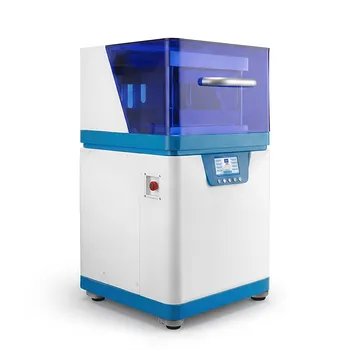
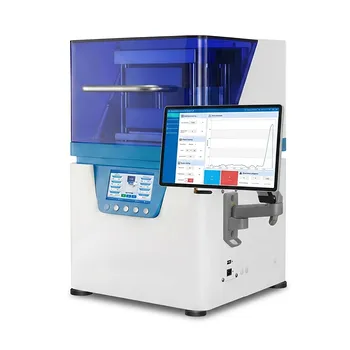
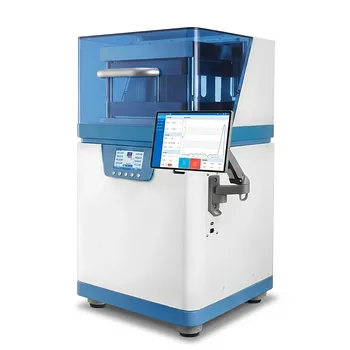
The laboratory hydraulic press is the primary tool for uniaxial static pressing, which transforms loose In-Dy-O nanopowders into dense, geometrically precise "green bodies." By applying high axial pressure—often ranging from 155 MPa to 775 MPa—the press facilitates the immediate rearrangement and bonding of powder particles, establishing the essential density and structural foundation required for subsequent high-temperature sintering.
The critical function of the hydraulic press is to convert homogenized nanopowders into a stable physical prototype, ensuring uniform particle contact and minimizing voids to enable successful solid-state chemical reactions during firing.
Establishing the Foundation for Densification
Particle Rearrangement and Initial Bonding
The primary role of the press is to utilize uniaxial static pressing to force In-Dy-O nanopowders into a compact state. This high-pressure environment overcomes the internal friction of the loose powder, causing particles to shift and nestle together tightly.
This initial mechanical interlocking and bonding are vital. Without this step, the powder would lack the structural integrity to be handled or to undergo the intense thermal stresses of the sintering furnace.
Creating the Geometric Profile
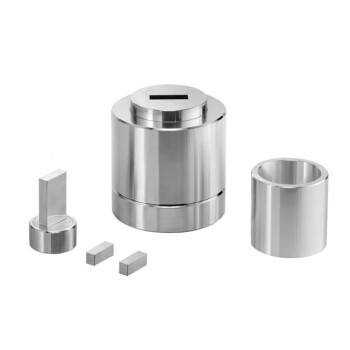
Using high-precision molds, the hydraulic press defines the exact geometric profile of the ceramic target. For In-Dy-O targets, this typically results in cylindrical pellets with a diameter of 9mm and a thickness of 3–6mm.
Establishing these standardized dimensions is necessary for high-precision measurements. It allows researchers to use tools like dilatometry to accurately track how the material shrinks or expands during the densification process.
Enhancing Chemical and Physical Reactivity
Reducing Diffusion Distance
By compacting the powder, the hydraulic press significantly reduces the physical distance between individual particles. This increased contact area is a prerequisite for diffusion-controlled solid-state reactions.
When the green body is later heated, the proximity of the particles allows atoms to migrate across grain boundaries more efficiently. This leads to a more homogeneous and dense final ceramic structure.
Eliminating Large Voids
The application of axial pressure, sometimes reaching several tons, effectively eliminates large air pockets or voids within the powder mass. This creates a uniform internal environment that prevents localized weaknesses.
A green body with a high, uniform internal density is far less likely to suffer from deformation or cracking during the sintering stage. This ensures the final In-Dy-O target remains structurally intact and free of internal flaws.
Understanding the Trade-offs and Constraints
The Risk of Non-Uniform Density
While uniaxial pressing is efficient, it can lead to density gradients within the green body. Friction between the powder and the mold walls often results in the center of the pellet being less dense than the areas directly under the plunger.
Pressure Sensitivity and Cracking
Applying too much pressure or releasing it too quickly can cause elastic recovery issues, where the material expands slightly upon exit from the mold. This can lead to "capping" or laminations—horizontal cracks that ruin the specimen's integrity.
Scaling Limitations
Laboratory presses are optimized for small, standardized specimens. If the goal is to produce very large or complex shapes, uniaxial pressing may be less effective than isostatic pressing, which applies pressure equally from all directions to ensure perfectly uniform compaction.
Applying Pressing Techniques to Your Research
Selecting the correct pressing parameters is essential for achieving the desired material properties in In-Dy-O ceramics.
- If your primary focus is maximizing final density: Utilize higher pressing forces (up to 775 MPa) to ensure the highest possible initial green density and minimal void space.
- If your primary focus is preventing structural cracks: Opt for moderate pressures (near 155 MPa) and ensure a slow, controlled release of the hydraulic load to minimize internal stress.
- If your primary focus is evaluating chemical additives: Maintain a consistent "unit pressure" across all samples to ensure that variations in sintering performance are due to chemistry rather than physical preparation.
The laboratory hydraulic press is not merely a shaper of powder, but the architect of the ceramic's internal microstructure and ultimate performance.
Summary Table:
| Feature | Mechanism | Impact on Ceramic Quality |
|---|---|---|
| Compaction | Uniaxial pressing (155-775 MPa) | Establishes high initial green density and structural integrity. |
| Geometry | Precision mold shaping | Creates standardized profiles (e.g., 9mm pellets) for accurate testing. |
| Reactivity | Reducing particle distance | Shortens diffusion paths to facilitate efficient solid-state reactions. |
| Homogeneity | Void elimination | Prevents localized weaknesses, deformation, and cracking during sintering. |
Optimize Your Material Research with KINTEK Precision
Achieving the perfect In-Dy-O green body requires more than just pressure—it requires precision. KINTEK specializes in high-performance laboratory equipment designed to meet the rigorous demands of advanced material science.
Whether you need robust hydraulic presses (pellet, hot, or isostatic) for uniform compaction, or high-temperature furnaces (muffle, vacuum, CVD) for flawless sintering, our solutions ensure consistency and reliability in every sample. We also offer a full suite of crushing and milling systems, PTFE products, and high-purity ceramics to support your entire workflow.
Ready to elevate your lab's efficiency and output quality? Contact KINTEK today to consult with our experts on the right equipment for your specific research goals.
References
- T. D. Malinovskaya, Valentina Zhek. Synthesis of nanopowders by the glycine-nitrate method in the In-Dy-O system. DOI: 10.15826/chimtech.2023.10.3.03
This article is also based on technical information from Kintek Solution Knowledge Base .
Related Products
- Automatic Hydraulic Hot Press with 500x500mm Heating Plates and Multi Stage PLC Control for Material Sintering
- Fully Automatic Heated Hydraulic Lab Press for Materials Sintering and Sample Preparation
- kbr pellet press 2t
- Automatic Laboratory Hydraulic Press for XRF & KBR Pellet Press
- Laboratory Manual Hydraulic Pellet Press for Lab Use
People Also Ask
- How do hydraulic presses facilitate material solidification in Low-Temperature LPS? Optimize Your Material Densification
- Why is 800 MPa required for TiNiPdCu alloy green bodies? Master High-Density Compaction for Superior Material Strength
- How does KBr pellet preparation facilitate FTIR of high-ash mud? Precision Sample Prep for Structural Analysis
- Why is an industrial hydraulic press with precision stainless steel molds used? For Uniform Mo-Fe Precursor Compacts.
- Purpose of Coaxial Ring Molds & Presses in EM Testing? Achieve Precise VNA Data & Fit