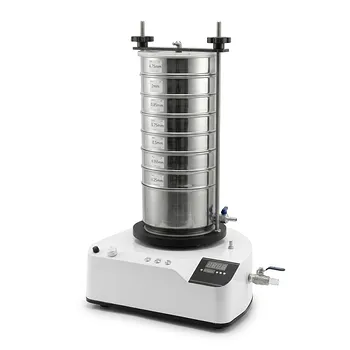
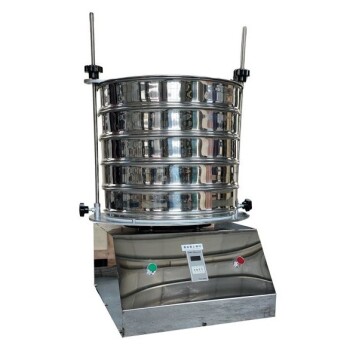
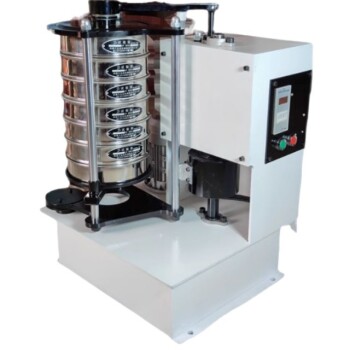
The critical function of high-precision sieving equipment in processing aluminum matrix composite powders is to enforce a strict particle size distribution by physically removing residual large-particle impurities. Following air classification, this equipment often utilizes ultra-fine meshes (such as 20 micrometers) to guarantee that the final powder mixture remains below a specific size threshold, typically 10 micrometers, which is essential for material integrity.
High-precision sieving acts as the final quality control gate to eliminate coarse defects that act as stress concentrators. By ensuring particle uniformity, the process prevents fracture initiation in the finished composite and enables consistent processing characteristics.
Preventing Material Failure
Removing Coarse Impurities
The primary role of the sieving stage is to capture large particles that escape the initial air classification process. Even a small number of oversized particles can compromise the entire batch of aluminum matrix and reinforcement powders.
Eliminating Fracture Initiation Sites
In high-performance composites, structural consistency is paramount. Large particles or impurities left in the powder create coarse defects within the final material.
These defects serve as initiation points for cracks and fractures under stress. By strictly limiting particle size to less than 10 micrometers, the sieving process directly contributes to the mechanical longevity and reliability of the composite.
Ensuring Process Homogeneity
Achieving Uniform Mixing
For aluminum matrix composites to function correctly, the reinforcement phase must be distributed evenly throughout the matrix.
High-precision sieving ensures that all particles fall within a narrow, compatible size range. This uniformity allows for homogeneous mixing, preventing segregation where larger particles might separate from finer ones.
Facilitating Uniform Heating
When particle sizes are inconsistent, they react differently to thermal processing.
Strict size control ensures that the powder stream—whether in mixing or downstream heating—absorbs energy uniformly. This prevents defects such as the incomplete melting of oversized particles or the excessive oxidation of undersized, dust-like particles.
Understanding the Trade-offs
Balancing Precision with Flow
While finer sieving (e.g., 20 micrometers) yields higher structural integrity, it can introduce processing challenges.
Extremely fine powders have higher surface energy and may agglomerate, potentially reducing flowability. Conversely, aiming for larger particle ranges (such as 50 to 150 µm) improves flow for equipment like nozzles but may sacrifice the micro-structural benefits of ultra-fine distribution.
Equipment constraints
Selecting the correct mesh size is a compromise between material properties and equipment capability.
For example, Direct Laser Deposition (DLD) requires specific ranges to prevent nozzle clogging, while thermal spraying requires ranges that optimize packing density. The sieving process must be tuned to the specific "sweet spot" of the application, rather than simply aiming for the smallest possible particle.
Making the Right Choice for Your Goal
To select the appropriate sieving strategy for your aluminum matrix composites, consider the downstream application:
- If your primary focus is Structural Integrity: Prioritize ultra-fine sieving (approx. 20 µm mesh) to maintain particle sizes under 10 µm, effectively eliminating fracture-initiating defects.
- If your primary focus is Direct Laser Deposition (DLD): Target a distribution range of 50–150 µm to ensure stable nozzle operation and consistent powder delivery.
- If your primary focus is Thermal Spraying: Maintain a range of 150–300 mesh to guarantee uniform heating, preventing both incomplete melting and excessive oxidation.
Precision sieving is not just about sorting; it is the fundamental step that aligns raw material physics with manufacturing realities.
Summary Table:
| Application Focus | Recommended Sieving Strategy | Key Benefit |
|---|---|---|
| Structural Integrity | Ultra-fine mesh (approx. 20 µm) | Eliminates fracture-initiating defects |
| Laser Deposition (DLD) | 50–150 µm distribution | Ensures stable nozzle flow & delivery |
| Thermal Spraying | 150–300 mesh range | Prevents oxidation & ensures uniform melting |
| Quality Control | Strict <10 µm threshold | Removes coarse defects & stress concentrators |
Elevate Your Material Precision with KINTEK
Don't let coarse impurities compromise your high-performance composites. KINTEK specializes in advanced laboratory solutions, providing high-precision sieving equipment and crushing and milling systems designed specifically for the rigorous demands of aluminum matrix composite processing.
From achieving ultra-fine particle uniformity to optimizing flowability for DLD and thermal spraying, our expertise ensures your powders meet the highest structural and mechanical standards. Whether you need robust sieving tools, hydraulic presses, or high-temperature furnaces, our team is ready to support your lab's research and production goals.
Ready to optimize your powder pre-processing? Contact KINTEK today for a customized consultation!
Related Products
- Three-dimensional electromagnetic sieving instrument
- Laboratory Vibratory Sieve Shaker Machine for Dry and Wet Three-Dimensional Sieving
- High Purity Alumina Granulated Powder for Engineering Advanced Fine Ceramics
- Custom PTFE Teflon Parts Manufacturer for PTFE Mesh F4 Sieve
- Laboratory Test Sieves and Sieving Machines
People Also Ask
- Why is sieving equipment essential for the classification of processed bio-activated carbon? Optimize Performance
- What are the limitations of sieving? Understanding the Constraints of Particle Size Analysis
- What are advantages and disadvantages of sieving method? A Guide to Reliable & Cost-Effective Particle Sizing
- How is sieving important? The Critical Role of Particle Size Analysis in Quality Control
- What is sieving and how does it work? A Guide to Accurate Particle Size Analysis