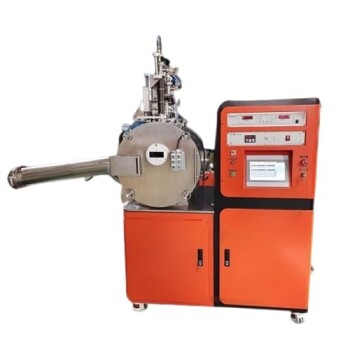
The critical role of a Vacuum Induction Furnace (VIF) is to act as a protective barrier against oxidation during the melting of Reduced Activation Ferritic/Martensitic (RAFM) steel. By establishing an ultra-low pressure environment—typically below 15 Pa—the furnace prevents highly reactive elements like Yttrium (Y) and Titanium (Ti) from burning off at melting temperatures of 1570 °C. This ensures the final alloy retains its intended chemical composition while minimizing the intrusion of harmful impurities.
The Vacuum Induction Furnace serves as the foundational processing step for high-purity alloys, isolating molten metal from atmospheric interference. Its primary function is to preserve the precise stoichiometry of reactive elements by preventing their reaction with oxygen and nitrogen, thereby ensuring a clean, inclusion-free microstructure.
The Chemistry of Containment
Protecting Reactive Elements
In standard melting environments, elements such as Yttrium (Y) and Titanium (Ti) possess a high affinity for oxygen. At processing temperatures reaching 1570 °C, these elements will oxidize rapidly if exposed to air.
The VIF mitigates this thermodynamic inevitability by removing the reactive atmosphere. This preservation is vital because if these elements oxidize, they are lost as slag rather than integrating into the steel matrix to provide the desired material properties.
Precision Composition Control
Creating RAFM steel requires exact adherence to a chemical recipe. The vacuum environment allows metallurgists to introduce volatile alloying elements with the confidence that they will remain in the melt.
This strictly controlled environment prevents the "unintended loss" of alloying elements, ensuring that the theoretical composition matches the actual output of the master alloy.
Refining Material Purity
Controlling Interstitial Impurities
Beyond preserving intended elements, the VIF actively manages unwanted interstitial impurities. The vacuum allows for the precise control of oxygen and nitrogen content within the molten steel.
By keeping these gas levels low, the furnace prevents the embrittlement that often plagues high-performance steels.
Minimizing Macroscopic Inclusions
When reactive elements like Titanium contact oxygen, they form oxide inclusions. These inclusions act as stress concentrators and failure points in the final material.
The VIF minimizes the formation of these macroscopic inclusions by eliminating the oxygen source. This results in a cleaner, more uniform material distribution that is essential for experimental accuracy and structural reliability.
Understanding the Process Context
The Foundation, Not the Finish
While the VIF is essential for chemical precision, it is often just the first step in a complex manufacturing chain. References indicate that VIF is frequently used to manufacture initial experimental electrodes or blanks.
Structural Optimization Requirements
The VIF excels at chemical homogeneity, but it may not always provide the final structural refinement needed for critical applications.
It often establishes the necessary high-purity base material, which is subsequently subjected to processes like Vacuum Arc Remelting (VAR). The VAR process further refines the structure, solidifying the chemically pure base created by the VIF.
Making the Right Choice for Your Goal
To maximize the effectiveness of a Vacuum Induction Furnace in your metallurgical workflow, consider the following:
- If your primary focus is Chemical Precision: Prioritize maintaining a vacuum pressure below 15 Pa to ensure near-zero loss of Yttrium and Titanium during the melt.
- If your primary focus is Structural Integrity: View the VIF as the preparation stage that creates a clean, chemically accurate electrode for secondary refining processes like VAR.
The Vacuum Induction Furnace is the non-negotiable gatekeeper of purity for any alloy relying on highly reactive elements.
Summary Table:
| Feature | Role in RAFM Steel Production | Benefit to Material Properties |
|---|---|---|
| Vacuum Environment | Pressure < 15 Pa prevents oxidation | Preserves reactive elements (Y, Ti) |
| Atmospheric Isolation | Eliminates oxygen/nitrogen contact | Minimizes interstitial impurities and embrittlement |
| Composition Control | Maintains precise stoichiometry | Ensures actual output matches theoretical alloy recipe |
| Inclusion Management | Prevents oxide formation | Reduces stress concentrators for better structural reliability |
Elevate Your Advanced Material Research with KINTEK
Precision in metallurgical engineering begins with the right thermal processing environment. KINTEK specializes in high-performance laboratory equipment, providing the foundational tools needed to produce high-purity alloys and advanced steels.
Our extensive portfolio features specialized high-temperature vacuum and induction melting furnaces designed to maintain the strict chemical integrity required for reactive elements like Yttrium and Titanium. Beyond melting, we support your entire workflow with:
- Advanced Thermal Systems: Muffle, tube, and rotary furnaces.
- Refinement & Preparation: Crushing, milling, and sieving equipment.
- Sample Processing: Hydraulic presses, isostatic presses, and high-pressure reactors.
- Essential Consumables: High-purity ceramics, crucibles, and PTFE products.
Whether you are developing RAFM steel for nuclear applications or researching the next generation of high-performance batteries, KINTEK provides the reliability and precision your lab demands.
Ready to optimize your alloy development? Contact our technical experts today to find the perfect furnace or equipment solution for your specific research goals.
References
- Guoxing Qiu, Huishu Zhang. Influence of Inclusions on the Mechanical Properties of RAFM Steels Via Y and Ti Addition. DOI: 10.3390/met9080851
This article is also based on technical information from Kintek Solution Knowledge Base .
Related Products
- 600T Vacuum Induction Hot Press Furnace for Heat Treat and Sintering
- Lab-Scale Vacuum Induction Melting Furnace
- Non Consumable Vacuum Arc Induction Melting Furnace
- Vacuum Heat Treat Furnace and Levitation Induction Melting Furnace
- Vacuum Arc Induction Melting Furnace
People Also Ask
- What role does an induction vacuum hot pressing furnace play in sintering? Achieve 98% Density in Carbide Blocks
- What advantages does a vacuum hot press furnace provide for LSLBO ceramic electrolytes? Achieve 94% Relative Density
- What role does a Vacuum Hot Press (VHP) furnace play in the densification of austenitic stainless steel 316 composites?
- What role does mechanical pressure play during the vacuum diffusion bonding of tungsten and copper? Keys to Solid Bonding
- What are the advantages of a vacuum hot press furnace for W-50%Cu? Achieve 99.6% Density at Lower Temperatures