
At a fundamental level, the difference between coreless and channel induction furnaces lies in their heating mechanism and physical construction. A coreless furnace functions like a crucible placed inside a large coil, directly heating the metal charge within it. In contrast, a channel furnace operates like a transformer, where a loop of molten metal itself forms a secondary circuit around an iron core to generate heat.
The choice between these furnaces is not about which is superior, but which is the correct tool for the job. Coreless furnaces are highly versatile melters for a wide range of metals, including steel. Channel furnaces are specialized, highly efficient units for holding large volumes of metal or melting lower-temperature alloys.
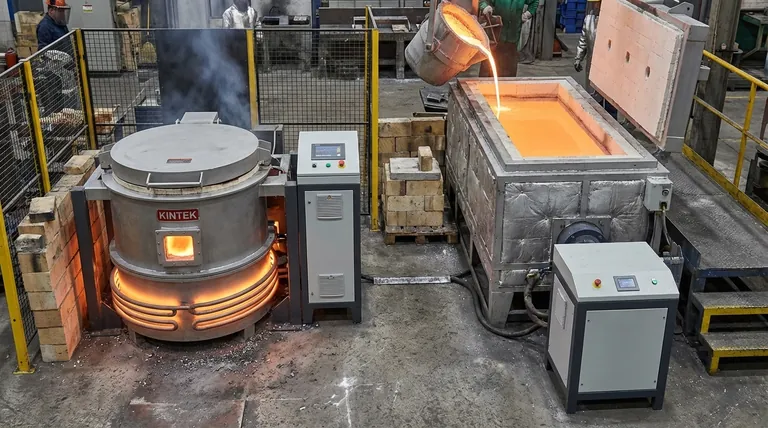
The Coreless Furnace: A Direct Heating Vessel
A coreless furnace is the more conceptually straightforward of the two designs. It is essentially a refractory-lined crucible surrounded by a water-cooled induction coil.
Principle of Operation
When alternating current flows through the coil, it creates a powerful and rapidly changing magnetic field. This field penetrates the metal charge inside the crucible, inducing strong electrical currents (eddy currents) directly within the metal. The resistance of the metal to these currents generates intense heat, causing it to melt.
Key Characteristics
This design creates a strong stirring action within the molten bath, which is excellent for mixing alloys and ensuring temperature uniformity. Because the entire charge is the target of the magnetic field, these furnaces can be started efficiently from a cold, solid charge and can be completely emptied between melts.
Common Applications
The flexibility and power of coreless furnaces make them suitable for a very broad range of applications. They are commonly used for melting steel, cast iron, and a wide variety of non-ferrous alloys. Their ability to handle different metals and batch sizes makes them a mainstay in many foundries.
The Channel Furnace: An Efficient Transformer
The channel furnace uses a more complex design that is engineered for thermal efficiency in specific applications, particularly holding molten metal.
Principle of Operation
This furnace has a main refractory-lined vessel connected to a smaller, distinct induction unit below. This unit contains a primary induction coil wrapped around an iron core. A channel or "loop" of molten metal from the main bath passes through this inductor, acting as a single-turn secondary winding of a transformer.
The current induced in this molten metal loop generates intense heat. The magnetic forces created by this process cause the superheated metal in the loop to circulate back up into the main bath, transferring its heat and creating a gentle, consistent stirring motion.
Common Applications
The channel furnace's high efficiency makes it ideal for holding large quantities of molten metal at a specific temperature for extended periods. It is also used for melting lower-melting-point alloys like copper, zinc, and aluminum. It requires a continuous "heel" of molten metal to maintain the circuit, making it perfect for continuous or semi-continuous operations.
Understanding the Practical Trade-offs
The distinct designs of these furnaces lead to clear operational differences that dictate their use.
Operational Flexibility
Coreless furnaces are highly flexible. They can be started and stopped easily, completely emptied, and used to melt a wide variety of different alloys in succession.
Channel furnaces are less flexible. They must maintain a continuous molten heel to function, making them poorly suited for frequent cold starts or rapid changes in alloy composition.
Thermal Efficiency
For holding metal at temperature, the channel furnace is generally more energy-efficient due to its contained, focused heating loop and lower heat losses.
For melting a solid charge from cold, the coreless furnace is more effective, as it applies energy directly to the entire mass of the charge.
Metal Versatility
The coreless furnace is the clear winner for versatility. Its simple crucible design can handle nearly any metal, including high-temperature alloys and steel.
The channel furnace is more specialized. The high energy density in the narrow channel can pose challenges with certain high-temperature metals and refractory wear, making it better suited for a more limited range of alloys.
Making the Right Choice for Your Operation
Your ideal furnace choice depends entirely on your primary operational goal.
- If your primary focus is melting diverse alloys or steel from a solid state: The coreless furnace offers the necessary versatility and power for a wide range of materials and batch operations.
- If your primary focus is holding large volumes of molten metal at a consistent temperature with high efficiency: The channel furnace is purpose-built for this task, acting as an ideal reservoir in a large foundry.
- If your primary focus is continuous melting of lower-temperature alloys: The channel furnace's efficient, steady operation makes it a superior choice for dedicated production lines.
By understanding their fundamental design differences, you can select the tool that directly aligns with your metallurgical process and economic goals.
Summary Table:
| Feature | Coreless Furnace | Channel Furnace |
|---|---|---|
| Primary Function | Melting from cold, versatile alloy changes | Holding molten metal, continuous melting |
| Heating Principle | Direct induction in the entire charge | Transformer principle with a molten metal loop |
| Operational Flexibility | High (easy start/stop, empty completely) | Low (requires a continuous molten heel) |
| Best For | Steel, cast iron, diverse non-ferrous alloys | High-efficiency holding, lower-melting-point alloys (e.g., Cu, Zn, Al) |
Ready to Optimize Your Melting Process?
Choosing between a coreless and channel furnace is a critical decision that impacts your efficiency, versatility, and bottom line. KINTEK, your trusted partner in lab equipment and consumables, specializes in helping laboratories and foundries like yours select the perfect induction furnace for their specific needs.
We provide expert guidance and high-performance equipment to ensure you achieve superior melting results. Whether you need the versatility of a coreless furnace or the holding efficiency of a channel furnace, we have the solution.
Contact us today via our contact form to discuss your application and discover how KINTEK can enhance your metallurgical processes.
Visual Guide

Related Products
- 600T Vacuum Induction Hot Press Furnace for Heat Treat and Sintering
- Lab-Scale Vacuum Induction Melting Furnace
- Non Consumable Vacuum Arc Induction Melting Furnace
- Vacuum Arc Induction Melting Furnace
- Controlled Nitrogen Inert Hydrogen Atmosphere Furnace
People Also Ask
- What role does a Vacuum Hot Press (VHP) furnace play in the densification of austenitic stainless steel 316 composites?
- Why is the gradient heating function of a vacuum hot press furnace essential? Enhance Graphite-Aluminum Composites
- What advantages does a vacuum hot press furnace provide for LSLBO ceramic electrolytes? Achieve 94% Relative Density
- What core challenges does a vacuum hot press furnace address? Achieve Superior WCp/Cu FGM Structural Integrity
- Why is a high-precision temperature control system in a vacuum hot press furnace critical? Perfect Cu-Ti3SiC2 Synthesis



















