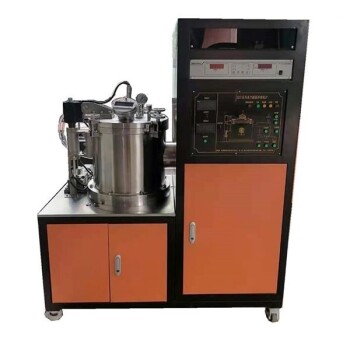
At its core, the difference between gas brazing and induction brazing lies entirely in the method of heating. Gas brazing uses a direct, external flame to heat the components, while induction brazing uses an electromagnetic field to generate precise, internal heat within the metal parts themselves. This single distinction in heating method dictates every other difference in speed, control, and application.
The choice between gas and induction brazing is a fundamental trade-off: you are choosing between the low-cost flexibility of a gas torch versus the unparalleled speed, precision, and repeatability of an induction system designed for production environments.
The Fundamental Difference: How Heat is Generated
To understand which process is right for you, you must first understand how each one delivers thermal energy to the joint.
Gas Brazing: External Flame Heating
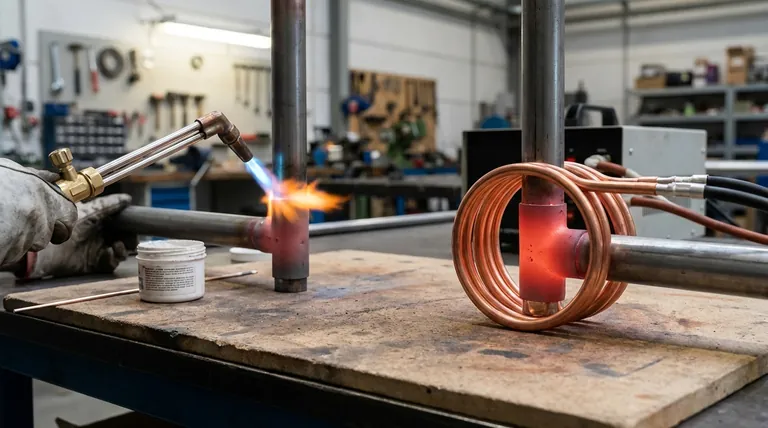
Gas brazing, often using an oxy-fuel torch, is a manual process. An operator applies a direct flame to the surface of the parts that need to be joined.
The heat is transferred from the flame to the part's surface, slowly conducting inward until the entire joint area reaches the brazing temperature. This process relies entirely on the operator's skill to apply heat evenly without overheating or underheating the materials.
To ensure the filler metal flows correctly, a flux is typically required. The flux cleans the base metals and protects the joint area from oxidation caused by the open flame.
Induction Brazing: Internal Electromagnetic Heating
Induction brazing is a non-contact process that uses electrical power to generate heat. The parts are placed inside or near a custom-shaped copper coil.
When a high-frequency alternating current is passed through the coil, it creates a powerful magnetic field. This field induces electrical currents (eddy currents) directly within the metal parts, causing them to heat up rapidly from the inside.
Because the heat is generated within the part itself and is confined to the area defined by the coil, the process is extremely fast, efficient, and precise.
Comparing Key Process Characteristics
The different heating mechanisms lead to significant operational differences in performance, quality, and cost.
Speed and Efficiency
Induction heating is significantly faster. Heat is generated instantly and only where needed, minimizing energy waste and bringing the joint to temperature in seconds.
Gas brazing is much slower, as a significant amount of heat is lost to the surrounding environment, and the process relies on slower thermal conduction.
Precision and Control
Induction offers superior control. The heating pattern is precisely determined by the shape of the induction coil, allowing for targeted heating of very specific areas without affecting adjacent components.
Gas brazing is entirely dependent on operator skill. It is difficult to control the heat-affected zone precisely, increasing the risk of part distortion or damage.
Repeatability and Automation
The induction process is highly repeatable and perfectly suited for automation. Once parameters are set, every joint will be identical, making it ideal for high-volume manufacturing.
Gas brazing is a manual art. The quality and consistency of the joint can vary significantly from one operator to another and even from one joint to the next.
Understanding the Trade-offs
Neither method is universally better; the correct choice depends entirely on the application and business goals.
Equipment and Initial Cost
The primary advantage of gas brazing is its extremely low initial cost. A complete torch setup is inexpensive and readily available.
Induction heating systems represent a significant capital investment. The equipment and the need for custom coils for different parts make the upfront cost much higher.
Flexibility and Versatility
Gas brazing is exceptionally versatile. A skilled operator can use the same torch to braze an almost infinite variety of part shapes and sizes, making it ideal for repairs, prototyping, and one-off jobs.
Induction brazing is comparatively inflexible. Each specific joint geometry requires its own carefully designed coil, making it impractical for low-volume or highly varied work.
Joint Quality and Environment
Because induction is so fast and can be performed in a controlled atmosphere, it produces very clean joints with minimal oxidation.
The open flame and required chemical fluxes in gas brazing can introduce more potential for contamination and post-braze cleaning requirements.
Making the Right Choice for Your Goal
Selecting the right process requires aligning the method's strengths with your operational priorities.
- If your primary focus is high-volume production and repeatability: Induction brazing is the superior choice for its unmatched speed, precision, and ease of automation.
- If your primary focus is low-volume repair, prototyping, or varied job shop work: The low initial cost and exceptional flexibility of gas brazing make it the more practical and economical option.
- If your primary focus is joining complex assemblies with dissimilar materials: Induction provides precise control, allowing you to heat one part more than another, which is critical for successful brazing.
Ultimately, understanding your production volume, quality requirements, and budget will clearly determine whether gas or induction brazing is the right tool for the job.
Summary Table:
| Feature | Gas Brazing | Induction Brazing |
|---|---|---|
| Heating Method | External flame (manual) | Internal electromagnetic field (automated) |
| Best For | Low volume, repairs, prototypes | High-volume, repetitive production |
| Speed | Slower (heat conduction) | Very Fast (internal heating) |
| Precision & Control | Lower (operator-dependent) | High (coil-defined, repeatable) |
| Initial Cost | Low | High |
| Flexibility | High (one torch for many jobs) | Lower (requires custom coils) |
| Joint Cleanliness | Requires flux, potential for oxidation | Cleaner, can be done in controlled atmosphere |
Still Unsure Which Brazing Method is Best for Your Lab or Production Line?
Choosing the right equipment is critical for efficiency, cost-effectiveness, and achieving consistent, high-quality results. KINTEK specializes in providing the right lab equipment and consumables to meet your specific brazing and manufacturing challenges.
Let our experts help you:
- Analyze your application to determine the optimal brazing process.
- Recommend the right equipment for your volume, precision, and budget requirements.
- Improve your process efficiency and joint quality.
Contact us today for a personalized consultation and see how KINTEK can provide the solutions your laboratory needs.
Visual Guide

Related Products
- Controlled Nitrogen Inert Hydrogen Atmosphere Furnace
- Vacuum Heat Treat Sintering Brazing Furnace
- Lab-Scale Vacuum Induction Melting Furnace
- Vacuum Heat Treat Furnace and Levitation Induction Melting Furnace
- 600T Vacuum Induction Hot Press Furnace for Heat Treat and Sintering
People Also Ask
- What is the role of a hydrogen atmosphere furnace in diamond/copper composites? Enhance Your Material Purity
- What role does an atmosphere furnace utilizing hydrogen gas play in Cu-Cr-Nb alloy powder pretreatment? (Key Insights)
- Why is hydrogen used in furnaces? Achieve Superior Purity and Bright Finishes
- Can hydrogen be used in furnaces? Yes, for Oxide-Free Metal Processing & Rapid Heating
- What are the characteristics and risks of a hydrogen atmosphere in a furnace? Master the Balance of Power and Control