Knowledge What is the difference between pelleting and pelletizing? Understand the Core Agglomeration Methods
Author avatar

Tech Team · Kintek Solution

Updated 6 days ago

What is the difference between pelleting and pelletizing? Understand the Core Agglomeration Methods


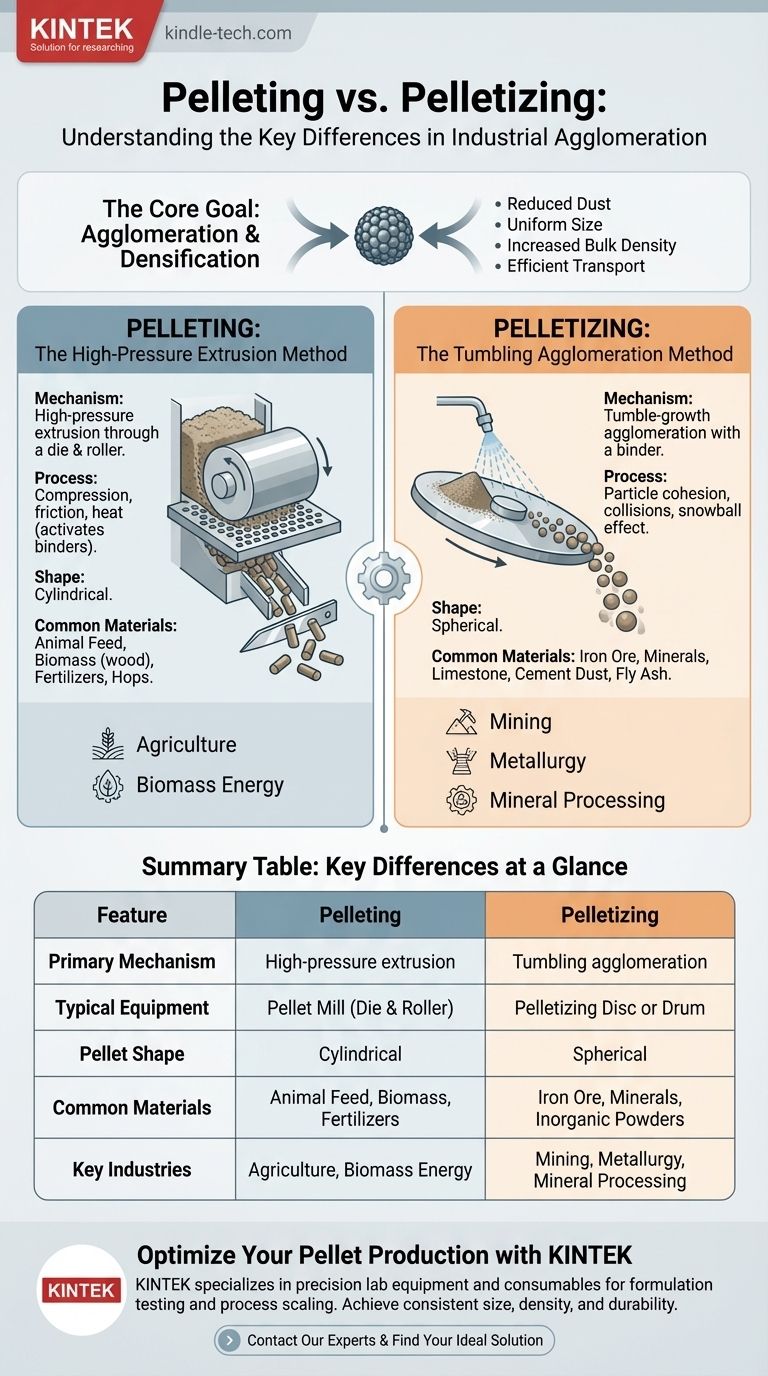
In industrial practice, the terms "pelleting" and "pelletizing" are frequently used to describe the same general outcome: converting fine powders or materials into larger, uniform granules called pellets. However, a technical distinction exists based on the mechanism used and the industry in which the term is applied. Pelleting typically involves high-pressure extrusion, while pelletizing often refers to a process of tumbling agglomeration.

The core difference lies in the method of formation. Pelleting is a high-pressure process that forces material through a die, common for organic materials like animal feed and biomass. Pelletizing is a lower-pressure process that tumbles fine particles with a liquid binder to form spheres, primarily used for minerals like iron ore.
What is the difference between pelleting and pelletizing? Understand the Core Agglomeration Methods

The Core Process: Agglomeration and Densification

Both pelleting and pelletizing are forms of agglomeration. The fundamental goal is to take a fine, dusty, or difficult-to-handle material and transform it into a dense, predictable, and free-flowing product.

### The Purpose of Creating Pellets

This process adds value by improving the material's properties. Key benefits include dramatically reduced dust, uniform size for consistent chemical reactions or dosing, increased bulk density for efficient transport and storage, and prevention of component segregation in a mixture.

Understanding "Pelleting": The Extrusion Method

Pelleting is best understood as a process of compression and extrusion. It creates dense, typically cylindrical pellets.

### The Mechanism: Die and Roller

In a standard pellet mill, loose material is fed into a chamber where heavy rollers press it against the inner surface of a perforated metal ring or plate, known as a die.

The immense pressure forces the material through the holes in the die. The combination of compression and friction generates significant heat, which can help activate natural binders within the material (like lignin in wood).

As the compressed material exits the die, it is cut by knives to a specified length, forming the final pellets.

### Common Industries and Materials

This high-pressure method is the standard for producing highly durable pellets from softer, often organic materials.

Common applications include animal feed, wood biomass fuel, fertilizers, and hops.

Understanding "Pelletizing": The Tumbling Method

Pelletizing is a process of tumble-growth agglomeration. It relies on particle cohesion rather than extreme force and typically produces spherical pellets.

### The Mechanism: Disc or Drum

This method uses a rotating disc or drum set at a precise angle. Fine raw material (like mineral concentrate) is continuously fed onto the disc.

A fine spray of a binding agent, often just water, is applied. As the disc rotates, the moistened particles tumble, collide, and stick together, gradually growing in size layer by layer, much like a snowball rolling downhill.

Once the pellets reach the desired size, they roll off the edge of the disc or out of the end of the drum.

### Common Industries and Materials

This "gentler" method is ideal for forming pellets from very fine, hard, inorganic powders.

The most prominent application is in the steel industry for pelletizing iron ore concentrate before it is fed into a blast furnace. Other uses include limestone, cement kiln dust, and fly ash.

Why the Terms Overlap

While technical experts in specific fields maintain the distinction, the terms often become blurred in general use.

### Colloquial vs. Technical Usage

In everyday conversation, "pelletizing" is often used as a catch-all verb for making any kind of pellet. The plastics industry, for example, uses "pelletizing" to describe cutting extruded polymer strands into pellets—a process mechanically closer to pelleting but using the other term.

### Focus on the Equipment

Often, the terminology simply follows the name of the machine. A pellet mill performs pelleting. A pelletizing disc performs pelletizing. This equipment-based distinction is a reliable way to differentiate the processes.

Making the Right Choice for Your Goal

To communicate with clarity, select your term based on the material and the underlying mechanical process.

  • If your primary focus is on animal feed, biomass, or organic fertilizers: The term "pelleting" is more precise, as it refers to the high-pressure die-and-roller extrusion process common in these fields.
  • If your primary focus is on mining, metallurgy, or mineral processing: "Pelletizing" is the correct choice to describe the tumble-growth agglomeration used for materials like iron ore.
  • If you are speaking in a general or mixed context: Using "pelletizing" as a broad verb is often acceptable, but be prepared to clarify the specific mechanical process (extrusion vs. tumbling) if precision matters.

Ultimately, understanding the fundamental difference between high-pressure extrusion and tumble-growth agglomeration is the key to mastering the subject.

Summary Table:

Feature Pelleting Pelletizing
Primary Mechanism High-pressure extrusion through a die Tumbling agglomeration with a binder
Typical Equipment Pellet Mill (Die & Roller) Pelletizing Disc or Drum
Pellet Shape Cylindrical Spherical
Common Materials Animal Feed, Biomass, Fertilizers Iron Ore, Minerals, Inorganic Powders
Key Industries Agriculture, Biomass Energy Mining, Metallurgy, Mineral Processing

Ready to Optimize Your Pellet Production Process?

Whether your project involves high-pressure pelleting for organic materials or tumble-growth pelletizing for minerals, selecting the right equipment is critical for efficiency and product quality.

KINTEK specializes in precision lab equipment and consumables for all your agglomeration needs. We provide the tools and expertise to help you:

  • Test and develop the perfect pellet formulation.
  • Scale your process from lab to production with confidence.
  • Achieve consistent size, density, and durability in your final product.

Let's discuss your specific application. Contact our experts today to find the ideal solution for your laboratory or pilot plant.

Visual Guide
What is the difference between pelleting and pelletizing? Understand the Core Agglomeration Methods Visual Guide

Related Products

People Also Ask

Related Products

Laboratory Single Horizontal Jar Mill

Laboratory Single Horizontal Jar Mill

KT-JM3000 is a mixing and grinding instrument for placing a ball milling tank with a volume of 3000ml or less. It adopts frequency conversion control to realize timing, constant speed, direction change, overload protection and other functions.

High Energy Planetary Ball Mill Machine for Laboratory Horizontal Tank Type

High Energy Planetary Ball Mill Machine for Laboratory Horizontal Tank Type

The KT-P2000H uses a unique Y-axis planetary trajectory, and utilizes the collision, friction and gravity between the sample and the grinding ball.

High Energy Planetary Ball Mill Milling Machine for Laboratory

High Energy Planetary Ball Mill Milling Machine for Laboratory

The biggest feature is that the high energy planetary ball mill can not only perform fast and effective grinding, but also has good crushing ability

High-Energy Omnidirectional Planetary Ball Mill Milling Machine for Laboratory

High-Energy Omnidirectional Planetary Ball Mill Milling Machine for Laboratory

The KT-P4000E is a new product derived from the vertical high-energy planetary ball mill with a 360° swivel function. Experience faster, uniform, and smaller sample output results with 4 ≤1000ml ball mill jars.

High-Energy Omnidirectional Planetary Ball Mill Machine for Laboratory

High-Energy Omnidirectional Planetary Ball Mill Machine for Laboratory

The KT-P2000E is a new product derived from the vertical high-energy planetary ball mill with a 360°rotation function. The product not only has the characteristics of the vertical high-energy ball mill, but also has a unique 360°rotation function for the planetary body.

High Energy Planetary Ball Mill Milling Machine for Laboratory

High Energy Planetary Ball Mill Milling Machine for Laboratory

Experience fast and effective sample processing with the F-P2000 high-energy planetary ball mill. This versatile equipment offers precise control and excellent grinding capabilities. Perfect for laboratories, it features multiple grinding bowls for simultaneous testing and high output. Achieve optimal results with its ergonomic design, compact structure, and advanced features. Ideal for a wide range of materials, it ensures consistent particle size reduction and low maintenance.

Laboratory Planetary Ball Mill Cabinet Planetary Ball Milling Machine

Laboratory Planetary Ball Mill Cabinet Planetary Ball Milling Machine

The vertical cabinet structure combined with ergonomic design enables users to obtain the best comfortable experience in standing operation. The maximum processing capacity is 2000ml, and the speed is 1200 revolutions per minute.

High Energy Planetary Ball Mill for Laboratory Horizontal Tank Type Milling Machine

High Energy Planetary Ball Mill for Laboratory Horizontal Tank Type Milling Machine

KT-P4000H uses the unique Y-axis planetary motion trajectory, and utilizes the collision, friction and gravity between the sample and the grinding ball to have a certain anti-sinking ability, which can obtain better grinding or mixing effects and further improve the sample output.

HFCVD Machine System Equipment for Drawing Die Nano-Diamond Coating

HFCVD Machine System Equipment for Drawing Die Nano-Diamond Coating

The nano-diamond composite coating drawing die uses cemented carbide (WC-Co) as the substrate, and uses the chemical vapor phase method ( CVD method for short ) to coat the conventional diamond and nano-diamond composite coating on the surface of the inner hole of the mold.

Laboratory Test Sieves and Sieving Machines

Laboratory Test Sieves and Sieving Machines

Precision lab test sieves & sieving machines for accurate particle analysis. Stainless steel, ISO-compliant, 20μm-125mm range. Request specs now!

Laboratory Sterilizer Lab Autoclave Vertical Pressure Steam Sterilizer for Liquid Crystal Display Automatic Type

Laboratory Sterilizer Lab Autoclave Vertical Pressure Steam Sterilizer for Liquid Crystal Display Automatic Type

Liquid crystal display automatic vertical sterilizer is a safe, reliable and automatic control sterilization equipment, which is composed of heating system, microcomputer control system and overheating and overvoltage protection system.

Laboratory Sterilizer Lab Autoclave Pulse Vacuum Lifting Sterilizer

Laboratory Sterilizer Lab Autoclave Pulse Vacuum Lifting Sterilizer

The pulse vacuum lifting sterilizer is a state-of-the-art equipment for efficient and precise sterilization. It uses pulsating vacuum technology, customizable cycles, and a user-friendly design for easy operation and safety.

Single Punch Tablet Press Machine and Mass Production Rotary Tablet Punching Machine for TDP

Single Punch Tablet Press Machine and Mass Production Rotary Tablet Punching Machine for TDP

Rotary tablet punching machine is an automatic rotating and continuous tableting machine. It is mainly used for tablet manufacturing in the pharmaceutical industry, and is also suitable for industrial sectors such as food, chemicals, batteries, electronics, ceramics, etc. to compress granular raw materials into tablets.

Single Punch Electric Tablet Press Machine Laboratory Powder Tablet Punching TDP Tablet Press

Single Punch Electric Tablet Press Machine Laboratory Powder Tablet Punching TDP Tablet Press

The single-punch electric tablet press is a laboratory-scale tablet press suitable for corporate laboratories in pharmaceutical, chemical, food, metallurgical and other industries.

Vacuum Dental Porcelain Sintering Furnace

Vacuum Dental Porcelain Sintering Furnace

Get precise and reliable results with KinTek's Vacuum Porcelain Furnace. Suitable for all porcelain powders, it features hyperbolic ceramic furnace function, voice prompt, and automatic temperature calibration.

Laboratory Vibratory Sieve Shaker Machine Slap Vibrating Sieve

Laboratory Vibratory Sieve Shaker Machine Slap Vibrating Sieve

KT-T200TAP is a slapping and oscillating sieving instrument for laboratory desktop use, with 300 rpm horizontal circular motion and 300 vertical slapping motions to simulate manual sieving to help sample particles pass through better.

Benchtop Laboratory Freeze Dryer for Lab Use

Benchtop Laboratory Freeze Dryer for Lab Use

Premium benchtop laboratory freeze dryer for lyophilization, preserving samples with ≤ -60°C cooling. Ideal for pharmaceuticals & research.

Benchtop Laboratory Vacuum Freeze Dryer

Benchtop Laboratory Vacuum Freeze Dryer

Benchtop laboratory freeze dryer for efficient lyophilization of biological, pharmaceutical, and food samples. Features intuitive touchscreen, high-performance refrigeration, and durable design. Preserve sample integrity—consult now!

Small Injection Molding Machine for Lab Use

Small Injection Molding Machine for Lab Use

The small injection molding machinehas fast and stable movements; good controllability and repeatability, super energy saving; the product can be automatically dropped and formed; the machine body is low, convenient for feeding, easy to maintain, and no height restrictions on the installation site.

Metallographic Specimen Mounting Machine for Laboratory Materials and Analysis

Metallographic Specimen Mounting Machine for Laboratory Materials and Analysis

Precision metallographic mounting machines for labs—automated, versatile, and efficient. Ideal for sample prep in research and quality control. Contact KINTEK today!


Leave Your Message