Knowledge What is the difference between pyrolysis and incomplete combustion? The Critical Role of Oxygen in Thermal Processes
Author avatar

Tech Team · Kintek Solution

Updated 6 days ago

What is the difference between pyrolysis and incomplete combustion? The Critical Role of Oxygen in Thermal Processes


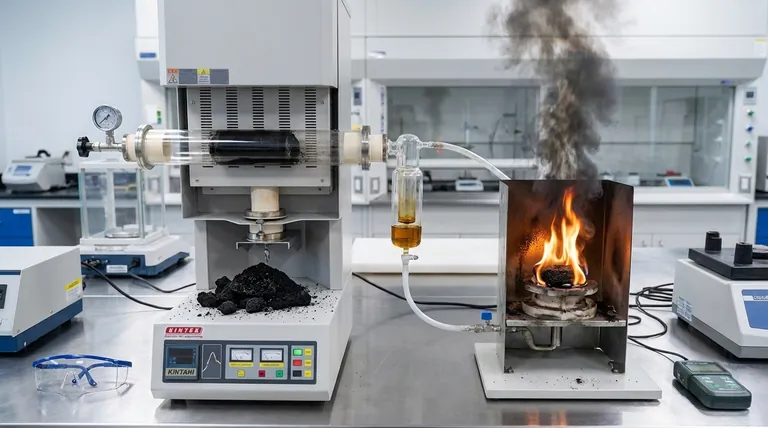
The fundamental difference between pyrolysis and incomplete combustion lies entirely in the presence and role of oxygen. Pyrolysis is the thermal decomposition of a material in the complete absence of oxygen, breaking it down with heat alone. Incomplete combustion is a chemical reaction—a type of burning—that occurs when there is an insufficient supply of oxygen.

While both processes involve high temperatures and carbon-based materials, they are fundamentally opposed in their chemistry and goals. Pyrolysis uses an oxygen-free environment to create valuable, energy-rich products, whereas incomplete combustion is an inefficient, oxygen-starved reaction that produces hazardous waste.
What is the difference between pyrolysis and incomplete combustion? The Critical Role of Oxygen in Thermal Processes

The Defining Factor: The Role of Oxygen

The presence or absence of oxygen dictates whether a material is chemically transformed or simply burned inefficiently. This single variable changes the energy balance, the reaction type, and all resulting products.

Pyrolysis: Thermal Decomposition Without Oxygen

Pyrolysis is a controlled process that uses external heat to break down complex organic materials. Because there is no oxygen, the material cannot actually burn or oxidize.

It is primarily an endothermic process, meaning it requires a constant input of energy to sustain the reaction.

The goal is not to release energy as heat, but to preserve the chemical energy from the original material in the new, simpler products it creates.

Incomplete Combustion: An Oxygen-Starved Reaction

Incomplete combustion is a true burning process where a material reacts with oxygen. However, the reaction is starved of a sufficient amount of oxygen.

This is an exothermic reaction, meaning it releases energy in the form of heat, but it does so very inefficiently compared to complete combustion.

Instead of fully oxidizing the fuel to carbon dioxide and water, the lack of oxygen leaves the reaction unfinished, creating undesirable byproducts.

Contrasting the Outputs and Their Value

The outputs of each process clearly reflect their underlying chemistry. One creates a suite of valuable resources, while the other produces waste and pollutants.

Products of Pyrolysis: Energy-Rich and Stable

By deconstructing material without burning it, pyrolysis creates a set of high-value, energy-dense products that can be stored, transported, and used later:

  • Bio-char: A stable, carbon-rich solid similar to charcoal.
  • Bio-oil: A dense, liquid mixture of organic compounds that can be refined into fuel.
  • Syngas: A mixture of flammable gases, primarily hydrogen and carbon monoxide.

Products of Incomplete Combustion: Wasteful and Hazardous

Because the fuel is not fully consumed, incomplete combustion generates low-value and often dangerous byproducts:

  • Soot (Black Carbon): Tiny, unburnt solid particles of carbon that we see as smoke.
  • Carbon Monoxide (CO): A toxic, colorless, and odorless gas.
  • Unburnt Hydrocarbons: Volatile organic compounds that contribute to smog.

Understanding the Applications and Goals

Pyrolysis is an intentional industrial tool, while incomplete combustion is almost always a sign of a system failure.

The Goal of Pyrolysis: Resource Creation

Engineers use pyrolysis intentionally to achieve a specific outcome. It is a cornerstone of waste-to-energy technologies and the advanced biofuels industry.

The objective is to convert low-value feedstock, like agricultural waste or plastics, into high-value chemical products and fuels.

The Problem of Incomplete Combustion: Process Failure

Incomplete combustion is rarely, if ever, a desired outcome. It signifies a problem in a system designed for efficient burning, such as a furnace, boiler, or internal combustion engine.

The appearance of soot or the detection of carbon monoxide indicates that the system is not receiving enough air, wasting fuel and creating a dangerous environment. The goal is always to fix the issue to achieve complete combustion.

How to Apply This to Your Goal

Your understanding of these processes depends entirely on what you are trying to achieve.

  • If your primary focus is creating valuable, storable energy products from raw materials: Pyrolysis is the correct industrial process, as it chemically transforms feedstock into stable fuels like bio-char and bio-oil.
  • If your primary focus is maximizing heat release from a fuel source: Your goal is complete combustion, and you must ensure a sufficient oxygen supply to prevent the inefficiency and hazardous byproducts of incomplete combustion.
  • If you are analyzing an inefficient burning process that produces soot and smoke: You are observing incomplete combustion, which indicates a problem with the air-to-fuel ratio that needs immediate correction.

Understanding the critical role of oxygen is the key to distinguishing these processes and harnessing thermal energy effectively.

Summary Table:

Feature Pyrolysis Incomplete Combustion
Oxygen Presence Complete absence Insufficient supply
Reaction Type Endothermic (requires heat) Exothermic (releases heat)
Primary Goal Create valuable products (bio-oil, syngas) An inefficient, problematic form of burning
Typical Products Bio-char, bio-oil, syngas Soot, carbon monoxide, unburnt hydrocarbons
Industrial Status Intentional, controlled process Sign of system failure or inefficiency

Need precise thermal processing for your lab or pilot plant?

Understanding the difference between pyrolysis and combustion is critical for safety, efficiency, and achieving your research and development goals. KINTEK specializes in high-quality lab equipment, including pyrolysis reactors and furnaces designed for controlled, oxygen-free environments.

Let our experts help you select the right equipment to transform your materials effectively and safely.

Contact KINTEK today to discuss your specific laboratory needs and how our solutions can drive your projects forward.

Visual Guide

What is the difference between pyrolysis and incomplete combustion? The Critical Role of Oxygen in Thermal Processes Visual Guide

Related Products

People Also Ask

Related Products

Vertical Laboratory Quartz Tube Furnace Tubular Furnace

Vertical Laboratory Quartz Tube Furnace Tubular Furnace

Elevate your experiments with our Vertical Tube Furnace. Versatile design allows for operation under various environments and heat treatment applications. Order now for precise results!

1400℃ Laboratory Quartz Tube Furnace with Alumina Tube Tubular Furnace

1400℃ Laboratory Quartz Tube Furnace with Alumina Tube Tubular Furnace

Looking for a tube furnace for high-temperature applications? Our 1400℃ Tube Furnace with Alumina Tube is perfect for research and industrial use.

Multi Zone Laboratory Quartz Tube Furnace Tubular Furnace

Multi Zone Laboratory Quartz Tube Furnace Tubular Furnace

Experience precise, efficient thermal testing with our Multi Zone Tube Furnace. Independent heating zones and temperature sensors allow for controlled high-temperature gradient heating fields. Order now for advanced thermal analysis!

1700℃ Laboratory Quartz Tube Furnace with Alumina Tube Tubular Furnace

1700℃ Laboratory Quartz Tube Furnace with Alumina Tube Tubular Furnace

Looking for a high-temperature tube furnace? Check out our 1700℃ Tube Furnace with Alumina Tube. Perfect for research and industrial applications up to 1700C.

1800℃ Muffle Oven Furnace for Laboratory

1800℃ Muffle Oven Furnace for Laboratory

KT-18 muffle furnace with Japan Al2O3 polycrystalline fibe and Silicon Molybdenum heating element, up to 1900℃, PID temperature control and 7" smart touch screen. Compact design, low heat loss, and high energy efficiency. Safety interlock system and versatile functions.

Laboratory Muffle Oven Furnace Bottom Lifting Muffle Furnace

Laboratory Muffle Oven Furnace Bottom Lifting Muffle Furnace

Efficiently produce batches with excellent temperature uniformity using our Bottom Lifting Furnace. Features two electric lifting stages and advanced temperature control up to 1600℃.

1700℃ Muffle Oven Furnace for Laboratory

1700℃ Muffle Oven Furnace for Laboratory

Get superior heat control with our 1700℃ Muffle Furnace. Equipped with intelligent temperature microprocessor, TFT touch screen controller & advanced insulation materials for precise heating up to 1700C. Order now!

High Temperature Muffle Oven Furnace for Laboratory Debinding and Pre Sintering

High Temperature Muffle Oven Furnace for Laboratory Debinding and Pre Sintering

KT-MD High temperature debinding and pre-sintering furnace for ceramic materials with various molding processes. Ideal for electronic components such as MLCC and NFC.

Laboratory Quartz Tube Furnace Tubular RTP Heating Furnace

Laboratory Quartz Tube Furnace Tubular RTP Heating Furnace

Get lightning-fast heating with our RTP Rapid Heating Tube Furnace. Designed for precise, high-speed heating and cooling with convenient sliding rail and TFT touch screen controller. Order now for ideal thermal processing!

Vacuum Heat Treat Sintering Brazing Furnace

Vacuum Heat Treat Sintering Brazing Furnace

A vacuum brazing furnace is a type of industrial furnace used for brazing, a metalworking process that joins two pieces of metal using a filler metal that melts at a lower temperature than the base metals. Vacuum brazing furnaces are typically used for high-quality applications where a strong, clean joint is required.

1400℃ Muffle Oven Furnace for Laboratory

1400℃ Muffle Oven Furnace for Laboratory

Get precise high-temperature control up to 1500℃ with KT-14M Muffle furnace. Equipped with a smart touch screen controller and advanced insulation materials.

1200℃ Controlled Atmosphere Furnace Nitrogen Inert Atmosphere Furnace

1200℃ Controlled Atmosphere Furnace Nitrogen Inert Atmosphere Furnace

Discover our KT-12A Pro Controlled atmosphere furnace - high precision, heavy duty vacuum chamber, versatile smart touch screen controller, and excellent temperature uniformity up to 1200C. Ideal for both laboratory and industrial application.

Rotary Tube Furnace Split Multi Heating Zone Rotating Tube Furnace

Rotary Tube Furnace Split Multi Heating Zone Rotating Tube Furnace

Multi zone rotary furnace for high-precision temperature control with 2-8 independent heating zones. Ideal for lithium ion battery electrode materials and high-temperature reactions. Can work under vacuum and controlled atmosphere.

Vacuum Heat Treat and Sintering Furnace with 9MPa Air Pressure

Vacuum Heat Treat and Sintering Furnace with 9MPa Air Pressure

The air pressure sintering furnace is a high-tech equipment commonly used for the sintering of advanced ceramic materials. It combines vacuum sintering and pressure sintering techniques to achieve high-density and high-strength ceramics.

Vacuum Heat Treat Furnace and Levitation Induction Melting Furnace

Vacuum Heat Treat Furnace and Levitation Induction Melting Furnace

Experience precise melting with our Vacuum Levitation Melting Furnace. Ideal for high melting point metals or alloys, with advanced technology for effective smelting. Order now for high-quality results.

Vacuum Heat Treat and Molybdenum Wire Sintering Furnace for Vacuum Sintering

Vacuum Heat Treat and Molybdenum Wire Sintering Furnace for Vacuum Sintering

A vacuum molybdenum wire sintering furnace is a vertical or bedroom structure, which is suitable for withdrawal, brazing, sintering and degassing of metal materials under high vacuum and high temperature conditions. It is also suitable for dehydroxylation treatment of quartz materials.

1400℃ Controlled Atmosphere Furnace with Nitrogen and Inert Atmosphere

1400℃ Controlled Atmosphere Furnace with Nitrogen and Inert Atmosphere

Achieve precise heat treatment with KT-14A controlled atmosphere furnace. Vacuum sealed with a smart controller, it's ideal for lab and industrial use up to 1400℃.

Vacuum Sealed Continuous Working Rotary Tube Furnace Rotating Tube Furnace

Vacuum Sealed Continuous Working Rotary Tube Furnace Rotating Tube Furnace

Experience efficient material processing with our vacuum-sealed rotary tube furnace. Perfect for experiments or industrial production, equipped with optional features for controlled feeding and optimized results. Order now.

600T Vacuum Induction Hot Press Furnace for Heat Treat and Sintering

600T Vacuum Induction Hot Press Furnace for Heat Treat and Sintering

Discover the 600T Vacuum Induction Hot Press Furnace, designed for high-temperature sintering experiments in vacuum or protected atmospheres. Its precise temperature and pressure control, adjustable working pressure, and advanced safety features make it ideal for nonmetal materials, carbon composites, ceramics, and metal powders.

Laboratory Vacuum Tilt Rotary Tube Furnace Rotating Tube Furnace

Laboratory Vacuum Tilt Rotary Tube Furnace Rotating Tube Furnace

Discover the versatility of Laboratory Rotary Furnace: Ideal for calcination, drying, sintering, and high-temperature reactions. Adjustable rotating and tilting functions for optimal heating. Suitable for vacuum and controlled atmosphere environments. Learn more now!


Leave Your Message