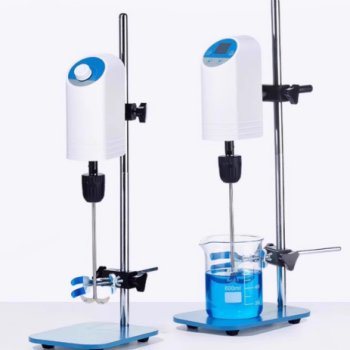
The primary function of a continuous stirring device during the 72-hour aging process is to generate constant mechanical shear force. This force maintains the cerium hydroxide precipitate in a highly uniform suspension within the aqueous solution, preventing the solids from settling or separating over this extended period.
Continuous stirring is not merely about mixing; it is a control mechanism for crystal development. By preventing excessive agglomeration, the process ensures the formation of a precursor with a stable structure and a narrow particle size distribution.
The Mechanics of the Aging Process
Maintaining Suspension Uniformity
The aging phase requires the precipitate to interact consistently with the solution. The stirring device prevents the heavier cerium hydroxide particles from settling at the bottom of the vessel.
By keeping the mixture in motion, the device ensures that every particle is exposed to identical chemical and thermal conditions. This homogeneity is critical for the consistency of the final support material.
Applying Mechanical Shear Force
The device introduces kinetic energy into the system in the form of mechanical shear. This physical force acts directly on the precipitate particles.
This shear force is necessary to counteract the natural tendency of particles to cluster together. It physically disrupts these interactions, keeping the particles distinct and suspended.
Impact on Material Properties
Preventing Excessive Agglomeration
One of the main risks during precipitation is the uncontrolled clumping of particles, known as agglomeration. If left unchecked, this results in large, irregular masses rather than fine, usable particles.
The continuous motion inhibits this by constantly separating particles before they can bond permanently. This results in a finer, more usable surface area for the eventual catalyst support.
Promoting Uniform Crystal Nuclei Growth
The 72-hour aging period is designed to allow crystal nuclei to mature. For this growth to be effective, it must be uniform across the entire batch.
Stirring ensures that nutrient transport to the crystal surfaces remains constant. This leads to crystals that grow at similar rates, resulting in a predictable and stable geometric structure.
Achieving Narrow Particle Size Distribution
The ultimate goal of using mechanical shear is to control the size of the particles. Uniform suspension leads to uniform growth conditions.
Consequently, the final precursor exhibits a narrow particle size distribution. This specific characteristic is often the differentiator between a high-performance catalyst support and a mediocre one.
The Consequence of Inadequate Agitation
The Risk of Structural Instability
If the stirring is interrupted or insufficient, the precursor structure may become unstable. Without shear force, the natural settling process creates density gradients within the solution.
This leads to uneven aging, where particles at the bottom mature differently than those at the top. The result is a mechanically weak support that may fail under operating conditions.
Loss of Precursor Quality
A lack of shear force directly correlates to a loss of control over the material's morphology. You risk producing a batch with a wide variance in particle sizes.
This inconsistency makes it difficult to predict how the final Cerium Oxide support will behave in catalytic applications.
Making the Right Choice for Your Goal
To ensure the highest quality Cerium Oxide supports, you must view the stirring parameters as critical process variables, not just background operations.
- If your primary focus is Structural Stability: Ensure the stirring speed provides sufficient shear to prevent any settling for the full 72 hours, guaranteeing a robust precursor framework.
- If your primary focus is Uniformity: Rely on constant mechanical agitation to maintain a narrow particle size distribution, eliminating outliers that could degrade catalytic performance.
Consistency in mechanical shear is the key to transforming a raw precipitate into a refined, high-performance support.
Summary Table:
| Process Feature | Functional Impact | Benefit to CeO2 Support |
|---|---|---|
| Mechanical Shear Force | Disrupts particle clustering | Prevents excessive agglomeration |
| Homogeneous Suspension | Eliminates density gradients | Ensures stable precursor structure |
| Constant Nutrient Transport | Equalizes growth conditions | Achieves narrow particle size distribution |
| Extended 72-Hour Aging | Mature crystal development | Enhanced structural integrity |
Elevate Your Materials Research with KINTEK Precision Solutions
Consistency is the foundation of high-performance catalyst supports. At KINTEK, we understand that the quality of your Cerium Oxide precursors depends on precise control over mechanical and thermal variables.
Whether you require high-performance magnetic or overhead stirrers, advanced high-temperature reactors, or specialized crushing and milling systems, KINTEK provides the laboratory equipment and consumables needed to ensure uniform results. Our portfolio also includes CVD/PECVD systems, PTFE products, and ultra-low temperature freezers to support your entire synthesis workflow from aging to storage.
Ready to achieve superior material uniformity and structural stability? Contact our technical experts today to find the perfect equipment tailored to your research requirements.
References
- Ga-Ram Hong, Hyun‐Seog Roh. The Effect of Precursor Concentration on the Crystallite Size of CeO2 to Enhance the Sulfur Resistance of Pt/CeO2 for Water Gas Shift. DOI: 10.3390/catal14020099
This article is also based on technical information from Kintek Solution Knowledge Base .
Related Products
- Laboratory Small Constant Temperature Heated Magnetic Stirrer Heater and Stirrer
- High Performance Laboratory Stirrers for Diverse Applications
- Custom PTFE Teflon Parts Manufacturer for Magnetic Stirring Bar
- Laboratory Vibratory Sieve Shaker Machine Slap Vibrating Sieve
People Also Ask
- What role does a magnetic stirrer with heating play in ZnO nanoparticle synthesis? Precision Control for Quality Results
- What role does a constant temperature heating magnetic stirrer play in MFC-HAp synthesis? Achieve Material Homogeneity
- What is the function of a laboratory magnetic stirrer in Ni–Cr–P electrodeposition? Optimize Ion Transport & Coating
- Why is a laboratory magnetic stirrer required for benzoic acid esters? Boost Reaction Speed & Yield with High RPM
- What role does a laboratory magnetic stirrer play in TiO2 and TiO2-Ag sol preparation? Master Chemical Kinetics