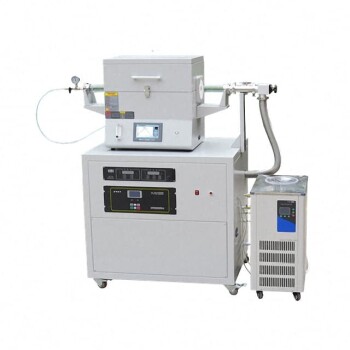
A controlled atmosphere tube furnace performs two critical functions simultaneously: it provides the thermal energy required to reshape metal films and creates a specific chemical environment to preserve material purity. By maintaining a precise high temperature, it drives the physical dewetting process, while a reducing atmosphere (such as a mixture of hydrogen and argon) prevents the chemical degradation of reactive metals.
The furnace creates the necessary thermodynamic conditions for synthesis: heat provides the kinetic energy for atoms to reorganize into islands, while the protective gas ensures that active metals remain pure enough to form uniform alloys rather than oxides.
The Role of Thermal Energy in Dewetting
Increasing Atomic Mobility
The primary physical driver in this process is heat. The tube furnace raises the temperature to a precise point where the metal atoms within the thin film gain significant surface mobility.
Breaking the Continuous Film
As the atoms move more freely, the thin film becomes thermodynamically unstable. The high thermal energy drives the continuous film to rupture and aggregate into discrete, isolated islands, a process known as dewetting.
Achieving Equilibrium
This aggregation is driven by the system's tendency to minimize surface energy. The furnace maintains the temperature stability required for the metal to reach this lower-energy state without uncontrolled melting or evaporation.
The Function of the Reducing Atmosphere
Preventing Oxidation
Standard air contains oxygen, which is detrimental to many alloying processes. The tube furnace utilizes a reducing atmosphere, commonly a mix like 10% Hydrogen (H2) and Argon (Ar), to actively scavenge oxygen and prevent it from reacting with the metal.
Protecting Active Metals
This protection is particularly critical when using active metals, such as nickel (Ni). Without a reducing atmosphere, nickel would rapidly oxidize at high temperatures, forming an insulating oxide layer rather than a conductive metal feature.
Ensuring Uniform Alloying
By keeping the metallic surfaces clean and oxide-free, the atmosphere facilitates true metallic bonding. This allows metals, such as Platinum (Pt) and Nickel (Ni), to interdiffuse effectively, resulting in the formation of a uniform, high-quality alloy.
Understanding the Operational Constraints
Balancing Gas Composition
While a protective atmosphere is essential, the composition must be carefully controlled. A mixture like 10% H2/Ar is specific; it provides enough hydrogen to reduce oxides without introducing safety risks associated with pure hydrogen or affecting the structural integrity of the furnace tube.
Thermal Precision
The "precise" nature of the high-temperature environment is non-negotiable. If the temperature fluctuates too much, the dewetting may be incomplete (leaving a semi-continuous film) or the alloying kinetics may be insufficient to create a homogenous material.
Making the Right Choice for Your Process
When configuring a tube furnace for dewetting and alloying, prioritize your parameters based on the specific material challenges:
- If your primary focus is Physical Morphology (Island Shape): Prioritize precise temperature control to fine-tune the surface mobility and the resulting size of the metal islands.
- If your primary focus is Chemical Purity (Alloy Quality): Ensure your reducing atmosphere (e.g., H2/Ar) is optimized to fully prevent oxidation of your most reactive metal component (like Nickel).
By synchronizing thermal energy with chemical protection, the tube furnace transforms unstable films into robust, uniform alloyed nanostructures.
Summary Table:
| Process Component | Primary Function | Key Benefit |
|---|---|---|
| Thermal Energy | Increases atomic mobility and surface energy minimization | Drives film rupture and aggregation into discrete islands |
| Reducing Atmosphere | Scavenges oxygen using gases like H2/Ar mixtures | Prevents oxidation of reactive metals (e.g., Ni) and ensures purity |
| Precise Temperature | Maintains thermodynamic stability | Ensures uniform alloy formation and consistent island morphology |
| H2/Ar Gas Mix | Active chemical reduction | Facilitates metallic bonding and interdiffusion of alloying elements |
Elevate Your Material Synthesis with KINTEK Precision
Unlock the full potential of your research with KINTEK’s advanced controlled atmosphere tube furnaces. Whether you are focused on the precise morphology of metal islands or the chemical purity of complex alloys, our high-temperature systems provide the thermal stability and gas-tight integrity required for sensitive dewetting and alloying processes.
Why Choose KINTEK?
- Precision Control: Industry-leading temperature accuracy for consistent thin-film transformation.
- Versatile Environments: Specialized for H2/Ar and other reducing atmospheres to prevent oxidation in active metals like Nickel.
- Comprehensive Lab Solutions: From tube and vacuum furnaces to crushing systems and PTFE consumables, we support your entire workflow.
Ready to achieve superior alloy quality? Contact our technical experts today to find the perfect furnace configuration for your laboratory.
References
- Lei Ji, Marco Altomare. A Dewetted‐Dealloyed Nanoporous Pt Co‐Catalyst Formed on TiO<sub>2</sub> Nanotube Arrays Leads to Strongly Enhanced Photocatalytic H<sub>2</sub> Production. DOI: 10.1002/asia.201901545
This article is also based on technical information from Kintek Solution Knowledge Base .
Related Products
- 1200℃ Controlled Atmosphere Furnace Nitrogen Inert Atmosphere Furnace
- 1700℃ Controlled Atmosphere Furnace Nitrogen Inert Atmosphere Furnace
- 1400℃ Controlled Atmosphere Furnace with Nitrogen and Inert Atmosphere
- Controlled Nitrogen Inert Hydrogen Atmosphere Furnace
- Mesh belt controlled atmosphere furnace
People Also Ask
- What is a controlled atmosphere furnace for heat treatment? Master Surface Chemistry and Metallurgy
- What is controlled atmosphere furnace? Precision Heating Without Oxidation for Superior Materials
- What is the role of the furnace atmosphere? Master Precise Metallurgical Control for Your Heat Treatment
- Why is a high-temperature furnace with a controlled atmosphere required for S@MMPC? Master Precision Synthesis
- Can you braze copper to brass without flux? Yes, but only under these specific conditions.