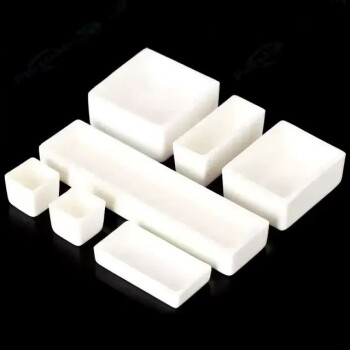
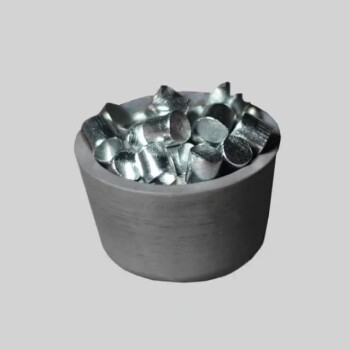
The primary function of a high-precision precursor crucible is to contain solid or liquid ruthenium complexes and strictly regulate their evaporation during the Chemical Vapor Deposition (CVD) process. By ensuring a near-linear mass loss over time, this component acts as a critical stabilizer, converting raw precursor material into a consistent vapor flux for the deposition chamber.
In ruthenium CVD, the quality of the final film is directly dictated by the stability of the precursor source. The high-precision crucible is the mechanism that ensures the vapor delivery remains constant, preventing fluctuations that would lead to uneven film thickness.
The Mechanics of Vapor Generation
Containing the Precursor Complex
The fundamental role of the crucible is to securely hold the ruthenium source material.
This material exists as either a solid or liquid complex prior to the deposition process. The crucible must contain this material effectively to prepare it for the evaporation stage.
Achieving Linear Mass Loss
The defining characteristic of a "high-precision" crucible is its ability to facilitate a near-linear mass loss over time.
Standard crucibles may allow evaporation rates to spike or drop as the material creates vapor. A high-precision crucible ensures that the rate at which the precursor evaporates remains steady from the beginning of the process to the end.
Interaction with Carrier Gas
The crucible does not operate in isolation; it functions under the influence of an inert carrier gas flow.
The geometry and design of the crucible are engineered to work in tandem with this gas flow. This interaction sweeps the evaporated material away from the source and toward the substrate in a controlled manner.
The Impact on Film Quality
Creating a Controllable Vapor Flux
The direct output of the crucible is a stable and controllable vapor flux.
Without the regulation provided by the crucible, the amount of ruthenium vapor entering the chamber would be unpredictable. This stability allows process engineers to calculate and predict the deposition rate accurately.
Ensuring Uniform Thickness
The ultimate goal of using a high-precision crucible is film uniformity.
If the vapor flux varies, the thickness of the deposited ruthenium layer will vary across the substrate. By locking in a stable evaporation rate, the crucible ensures the final film meets precise thickness specifications.
Critical Operational Considerations
The Sensitivity of Evaporation Rates
It is important to recognize that the "near-linear" performance is a delicate balance.
Any deviation in the crucible's performance or its interaction with the carrier gas can disrupt the mass loss rate. This disruption immediately translates to inconsistencies in the vapor flux.
The Dependency on Precursor State
The crucible must be compatible with the specific state of the ruthenium complex used (solid vs. liquid).
The mechanism for maintaining stable evaporation differs slightly between states, and the crucible must be selected or designed to accommodate the specific physical properties of the chosen precursor.
Making the Right Choice for Your Goal
To maximize the effectiveness of your ruthenium CVD process, consider the following regarding your crucible selection:
- If your primary focus is Film Homogeneity: Prioritize a crucible design that is explicitly rated for linear mass loss to prevent gradients in film thickness.
- If your primary focus is Process Stability: meaningfuly verify the compatibility between the crucible geometry and your specific inert carrier gas flow rates to ensure consistent vapor transport.
The high-precision crucible is not just a container; it is the primary throttle for quality control in the ruthenium deposition process.
Summary Table:
| Feature | Function in Ruthenium CVD | Impact on Process Quality |
|---|---|---|
| Precursor Containment | Holds solid/liquid ruthenium complexes | Prevents contamination and prepares material for evaporation |
| Linear Mass Loss | Maintains constant evaporation rate | Ensures predictable and repeatable deposition cycles |
| Gas Flow Interaction | Works with inert carrier gases | Facilitates efficient and controlled vapor transport to substrate |
| Flux Regulation | Controls the density of vapor entering chamber | Directly determines final film thickness and uniformity |
Elevate Your Thin Film Precision with KINTEK
Achieving the perfect ruthenium layer requires more than just chemistry; it requires the highest quality hardware. At KINTEK, we specialize in providing the high-precision laboratory equipment and consumables essential for advanced material research.
Whether you are refining CVD/PECVD processes, managing complex high-temperature furnace operations, or requiring specialized ceramics and crucibles designed for linear mass loss, our team is ready to support your lab's mission. From high-pressure reactors to precision milling and battery research tools, we deliver the reliability your research demands.
Ready to optimize your deposition uniformity? Contact our technical experts today to find the ideal crucible and equipment solutions for your specific application.
References
- Ruchi Gaur, Burak Atakan. Ruthenium complexes as precursors for chemical vapor-deposition (CVD). DOI: 10.1039/c4ra04701j
This article is also based on technical information from Kintek Solution Knowledge Base .
Related Products
- CVD Diamond Dressing Tools for Precision Applications
- High Purity Pure Graphite Crucible for Electron Beam Evaporation
- High Purity Pure Graphite Crucible for Evaporation
- Electron Beam Evaporation Coating Tungsten Crucible and Molybdenum Crucible for High Temperature Applications
- Arc-Shaped Alumina Ceramic Crucible High Temperature Resistant for Engineering Advanced Fine Ceramics
People Also Ask
- How do you identify a CVD diamond? The Definitive Guide to Lab-Grown Diamond Verification
- What is chemical vapor deposition of diamond? Grow High-Purity Diamonds Atom-by-Atom
- How do CVD diamonds grow? A Step-by-Step Guide to Lab-Grown Diamond Creation
- What are the raw materials for CVD diamonds? A seed, a gas, and the science of crystal growth.
- What is CVD diamond? The Ultimate Guide to Lab-Grown Diamonds and Their Uses