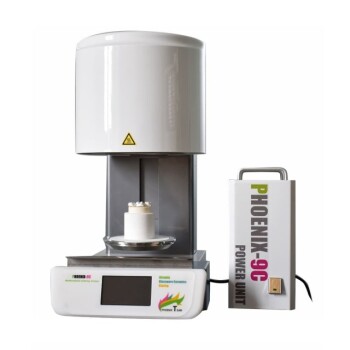
The high-temperature sintering furnace serves as the critical "skeleton-building" tool during the initial preparation of LLZA ceramic pellets. Specifically, it subjects pressed green bodies to conventional sintering at 1200°C. This process initiates solid-state reactions and bonds loose powder particles together, creating a cohesive, porous structure rather than a fully densified final product.
Core Takeaway This stage is not about achieving final density, but about establishing structural integrity. The furnace transforms fragile pressed powder into a robust "porous ceramic skeleton" capable of withstanding the extreme pressures of the subsequent Hot Isostatic Pressing (HIP) stage.
Creating the Structural Foundation
The role of the furnace in this specific workflow is to bridge the gap between raw powder and a pre-densified solid. It accomplishes this through three specific mechanisms.
Initiating Solid-State Reactions
The furnace provides a precisely controlled thermal environment, holding the material at 1200°C.
At this specific temperature, the chemical potential drives the initial solid-state reactions between the constituent elements (Li, Al, Zr, La, O). This ensures the material begins to form the correct crystallographic phases before full densification occurs.
Particle Bonding and Diffusion
The primary function at this stage is to encourage necking between powder particles.
Through surface diffusion and grain boundary diffusion, the individual powder granules begin to fuse at their contact points. This transforms a loose aggregate of particles into a unified, continuous network.
Developing Mechanical Strength
The output of this furnace run is a porous ceramic skeleton.
While the material remains porous, the bonding achieved at 1200°C provides sufficient mechanical strength (Vickers hardness and Young's modulus) to allow the pellet to be handled and processed further. Without this step, the green body would likely crumble under the mechanical stress of subsequent manufacturing steps.
Understanding the Trade-offs
When using a sintering furnace for this specific "pre-sintering" stage, balancing the thermal input is critical. You are balancing between structural stability and processability.
The Risk of Over-Sintering
If the furnace temperature exceeds 1200°C or the dwell time is too long, the material may densify too much too early.
Premature densification can close off the internal pore network. If the pores are sealed off before the Hot Isostatic Pressing (HIP) stage, the gas pressure from the HIP process cannot effectively densify the material further, leading to residual porosity and lower ionic conductivity in the final product.
The Risk of Under-Sintering
Conversely, if the temperature is too low, the solid-state bonding will be insufficient.
A weak skeleton lacks the mechanical integrity to survive the high pressures of the HIP chamber. This can result in the pellet cracking, deforming, or disintegrating during the final densification attempt.
Making the Right Choice for Your Goal
The function of the furnace is defined by your downstream processing requirements.
- If your primary focus is Preparing for HIP: Ensure the furnace profile creates a porous but strong skeleton at 1200°C, avoiding full densification to keep pores open for pressure treatment.
- If your primary focus is Phase Purity: Use the furnace to drive the solid-state reaction fully, ensuring the correct crystal structure is established before the material is subjected to isostatic pressure.
Ultimately, the furnace acts as the stabilizer, ensuring your material is strong enough to survive the rigorous densification that follows.
Summary Table:
| Process Mechanism | Temperature | Primary Outcome | Critical Requirement |
|---|---|---|---|
| Solid-State Reaction | 1200°C | Crystallographic phase formation | Precise thermal control |
| Particle Bonding | 1200°C | Necking & grain boundary diffusion | Unified continuous network |
| Strength Development | 1200°C | Robust porous ceramic skeleton | Balanced mechanical integrity |
Elevate Your Material Research with KINTEK Precision
Advanced solid-state electrolyte development like LLZA ceramic pellet preparation requires absolute thermal precision. At KINTEK, we specialize in the high-performance laboratory equipment essential for your breakthrough, including:
- High-Temperature Furnaces: Muffle, tube, and atmosphere furnaces optimized for 1200°C+ sintering.
- Advanced Pressing Systems: Hydraulic presses for green body formation and Hot Isostatic Presses (HIP) for final densification.
- Specialized Labware: High-purity ceramics and crucibles to prevent contamination during solid-state reactions.
Whether you are refining battery research or developing advanced ceramics, our team provides the technical expertise and comprehensive toolset you need to ensure structural integrity and phase purity.
Ready to optimize your sintering workflow? Contact KINTEK today for a customized solution.
Related Products
- High Temperature Muffle Oven Furnace for Laboratory Debinding and Pre Sintering
- Vacuum Heat Treat and Pressure Sintering Furnace for High Temperature Applications
- High Temperature Alumina (Al2O3) Furnace Tube for Engineering Advanced Fine Ceramics
- 2200 ℃ Tungsten Vacuum Heat Treat and Sintering Furnace
- 2200 ℃ Graphite Vacuum Heat Treat Furnace
People Also Ask
- Why is the annealing treatment in a high-temperature muffle furnace critical for the preparation of an Sb-SnO2 interlayer?
- What function does a high-temperature muffle furnace serve in Ti3AlC2 MAX phase synthesis? Master Molten Salt Diffusion
- What is the significance of integrating a high-temperature muffle furnace into an impact wear testing system?
- What is the primary function of high-temperature muffle or tube furnaces for ceramic coatings? Ensure Peak Durability
- What role does a calcination furnace play in preparing hollow core-shell particles? Achieve Perfect Nano-Structures