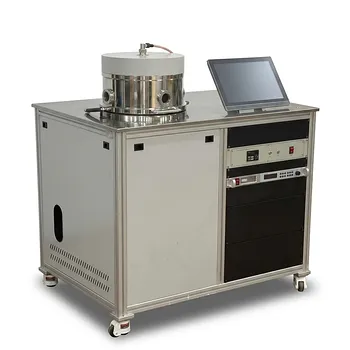
The horizontal tube furnace functions as the central reactor in Zinc Oxide (ZnO) nanorod synthesis. It provides the high-temperature environment required to vaporize source materials and facilitates the chemical reactions necessary for nanostructure growth. By managing precise thermal gradients and gas flow, the furnace ensures the transport of zinc vapor to substrates where it deposits and crystallizes into oriented nanorod arrays.
The horizontal tube furnace acts as a precision-controlled reactor that enables the evaporation, transport, and deposition of zinc precursors through stable temperature management and atmospheric control. This process is fundamental to determining the morphological consistency and crystalline quality of the resulting ZnO nanostructures.
The Role of Thermal Management in CVD
Vaporization of Source Materials
The furnace reaches high temperatures, typically ranging from 800°C to 950°C, to sublimate metallic zinc powder or facilitate the carbothermal reduction of ZnO. This thermal energy is the primary driver for converting solid precursors into the vapor phase.
Maintaining Reaction Stability
A stable thermal environment is a decisive factor in determining the growth rate and morphological uniformity of the nanorods. Precise temperature control provides the activation energy needed for high-quality crystallization, minimizing internal crystal defects.
Post-Growth Annealing
Beyond initial synthesis, the furnace can perform high-temperature air annealing (e.g., 550°C). This thermal energy induces atomic rearrangement, reducing lattice mismatch between the nanorods and the substrate to improve optical performance.
Managing Vapor Transport and Deposition
Creating Temperature Gradients
The horizontal design allows for distinct heating zones within the quartz tube. A high-temperature zone vaporizes the source, while a strategically placed lower-temperature zone downstream facilitates nucleation and anisotropic growth on the substrate.
Atmospheric and Gas Flow Control
The furnace housing supports a sealed environment where carrier gases, such as Argon and Oxygen, transport the zinc vapor. This stable gas flow field ensures the vapor reaches the substrate at the specific concentration and pressure needed for vertical alignment.
Driving Growth Mechanisms
The thermal energy within the furnace drives specific growth mechanisms such as Vapor-Liquid-Solid (VLS) or Vapor-Solid-Solid (VSS). These mechanisms are essential for achieving one-dimensional growth, resulting in nanowires or nanorods with high structural integrity.
Understanding the Trade-offs
Thermal Lag and Distribution
Large furnace volumes can suffer from uneven heat distribution, which may lead to inconsistent nanorod lengths across a single substrate. Users must carefully calibrate the "sweet spot" within the tube to ensure uniform results.
Precursor Buildup and Contamination
The horizontal orientation can lead to the accumulation of precursor materials on the quartz tube walls over time. Periodic cleaning and high-temperature bake-outs are required to prevent cross-contamination and maintain a pure growth environment.
Temperature Ramping Risks
Rapidly changing the temperature can cause thermal shock to the quartz tube or the silicon substrate. Gradual ramping is necessary to maintain the integrity of the equipment and the structural stability of the nanorods.
Optimizing Furnace Parameters for Your Goal
To achieve high-quality ZnO nanorods, you must balance temperature, gas flow, and substrate positioning.
- If your primary focus is crystalline quality: Prioritize precise temperature stability and utilize a post-growth annealing cycle at approximately 550°C to reduce lattice defects.
- If your primary focus is morphological control: Adjust the temperature gradient and the distance between the source material and the substrate to fine-tune the growth direction and nanorod density.
- If your primary focus is growth efficiency: Optimize the carrier gas flow rate to ensure maximum vapor transport while maintaining the required partial pressure of oxygen.
Mastering the thermal dynamics of the horizontal tube furnace is the most critical step in unlocking consistent, high-performance ZnO nanostructures.
Summary Table:
| Function | Key Parameter | Impact on ZnO Nanorods |
|---|---|---|
| Vaporization | 800°C - 950°C | Sublimates zinc precursors into the vapor phase |
| Transport | Carrier Gas Flow (Ar/O2) | Delivers zinc vapor to the substrate at stable pressures |
| Deposition | Temperature Gradient | Facilitates nucleation and drives vertical alignment |
| Annealing | Post-growth (550°C) | Reduces lattice defects and improves optical performance |
Elevate Your Nanotechnology Research with KINTEK
Achieving consistent, high-quality ZnO nanostructures requires absolute control over thermal dynamics. KINTEK specializes in precision laboratory equipment, providing a comprehensive range of horizontal tube furnaces, CVD, PECVD, and MPCVD systems designed to meet the rigorous demands of advanced material synthesis.
Beyond our industry-leading furnaces, KINTEK offers a full suite of laboratory solutions, including:
- High-temperature furnaces (muffle, vacuum, and atmosphere control)
- High-pressure reactors and autoclaves
- Crushing, milling, and sieving equipment for precursor preparation
- Essential consumables like PTFE products, ceramics, and high-purity crucibles
Ready to optimize your synthesis process? Contact our experts today to find the perfect equipment configuration for your lab and ensure repeatable, high-performance results every time.
References
- Dhruva Jindal. Fabrication & Test of Semiconductor Nanorods based Field Emitters for Applications in Advanced Sensors. DOI: 10.21275/sr23920153829
This article is also based on technical information from Kintek Solution Knowledge Base .
Related Products
- Customer Made Versatile CVD Tube Furnace Chemical Vapor Deposition Chamber System Equipment
- Multi Heating Zones CVD Tube Furnace Machine Chemical Vapor Deposition Chamber System Equipment
- Split Chamber CVD Tube Furnace with Vacuum Station Chemical Vapor Deposition System Equipment Machine
- Inclined Rotary Plasma Enhanced Chemical Vapor Deposition PECVD Equipment Tube Furnace Machine
- Controlled Nitrogen Inert Hydrogen Atmosphere Furnace
People Also Ask
- What is a CVD tube furnace? A Complete Guide to Thin-Film Deposition
- What is the function of a high-temperature CVD tube furnace in 3D graphene foam prep? Master 3D Nanomaterial Growth
- How does a CVD tube furnace inhibit the sintering of silver supports? Boost Membrane Durability and Performance
- What is the function of a tube furnace in CVD SiC synthesis? Achieving Ultra-Pure Silicon Carbide Powders
- What is the difference between hot wall CVD and cold wall CVD? Choose the Right System for Your Process