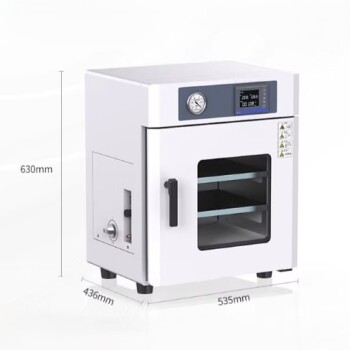
The laboratory constant temperature drying oven serves as a critical stabilization tool in the fabrication of Ag-TiO2 electrodes. It provides a strictly controlled thermal environment, specifically at 60 °C, to slowly evaporate ethanol solvent from the carbon foam substrate after it has been sprayed with the catalyst sol.
Core Takeaway This process is not merely about removing liquid; it is a structural fixation step. By controlling the evaporation rate of the solvent, the oven facilitates the stable attachment of nanoparticles onto the three-dimensional carbon framework, preventing the catalyst from detaching during use.
The Core Mechanism: Controlled Solvent Evaporation
Regulating the Evaporation Rate
The primary function of the oven is to manage the removal of the solvent, which is typically ethanol in this specific dispersion.
By maintaining a constant temperature of 60 °C, the oven ensures the ethanol evaporates slowly rather than flashing off instantly.
Creating a Uniform Attachment Layer
Rapid evaporation can cause surface irregularities, but controlled drying allows the Ag-TiO2 nanoparticles to settle properly.
This results in a stable and uniform attachment layer across the complex surface of the carbon foam framework.
Ensuring Structural Integrity and Loading Control
Facilitating Layer-by-Layer Build-up
Fabricating these electrodes often requires reaching a specific mass of catalyst loading.
The oven enables a cyclic workflow—spraying followed by drying—which allows you to precisely control the loading amount through repeated applications.
Preventing Catalyst Delamination
A major failure mode in electrode fabrication is the "falling off" or detachment of the active material.
The drying phase solidifies the bond between the Ag-TiO2 sol and the carbon foam, ensuring the catalyst remains fixed to the substrate during electrochemical operations.
Understanding the Trade-offs
The Risk of Temperature Fluctuation
While the primary goal is evaporation, the "constant" aspect of the temperature is vital.
If the temperature exceeds 60 °C significantly, the solvent may evaporate too violently, potentially disrupting the nanoparticle arrangement or degrading the carbon framework.
Incomplete Drying vs. Over-Drying
If the drying time is insufficient, residual ethanol can interfere with subsequent coating layers or the final electrochemical performance.
Conversely, excessive heat or duration (beyond what is needed for ethanol removal) generally yields diminishing returns and slows down the fabrication cycle.
Making the Right Choice for Your Goal
To maximize the quality of your Ag-TiO2 electrodes, consider how you manage the drying variables:
- If your primary focus is coating stability: Ensure the oven maintains a strict 60 °C to prevent rapid solvent boiling, which secures the nanoparticles to the foam.
- If your primary focus is precise catalyst loading: Utilize the oven for short, consistent drying intervals between multiple spray cycles to build up the active material gradually.
Effective electrode fabrication relies less on the application of heat, and more on the precision of the thermal control.
Summary Table:
| Parameter | Specification/Function | Impact on Ag-TiO2 Electrodes |
|---|---|---|
| Target Temperature | 60 °C (Constant) | Prevents rapid solvent boiling and surface irregularities. |
| Primary Solvent | Ethanol | Controlled removal facilitates uniform nanoparticle settling. |
| Substrate Type | 3D Carbon Foam | Ensures deep penetration and adherence to complex structures. |
| Process Goal | Structural Fixation | Prevents catalyst delamination and ensures loading precision. |
Elevate Your Electrode Fabrication with KINTEK Precision
Achieving the perfect Ag-TiO2 coating requires absolute thermal stability. KINTEK provides state-of-the-art laboratory constant temperature ovens and drying solutions specifically engineered for sensitive material synthesis.
Our extensive portfolio supports your entire research workflow, from high-temperature furnaces (muffle, vacuum, CVD) for catalyst sintering to crushing systems, hydraulic presses, and specialized electrolytic cells and electrodes for performance testing. Whether you are optimizing battery research or developing advanced photocatalysts, KINTEK delivers the reliability you need to prevent delamination and ensure precise loading.
Ready to enhance your lab's efficiency? Contact us today to find the perfect thermal or electrochemical solution!
References
- Shaozhu Fu, Shuangshi Dong. Visible-Light-Driven Photocatalytic Fuel Cell with an Ag-TiO2 Carbon Foam Anode for Simultaneous 4-Chlorophenol Degradation and Energy Recovery. DOI: 10.3390/chemengineering2020020
This article is also based on technical information from Kintek Solution Knowledge Base .
Related Products
- 23L Laboratory Vacuum Drying Oven
- Laboratory Scientific Electric Heating Blast Drying Oven
- 56L Vertical Laboratory Vacuum Drying Oven
- 1700℃ Muffle Oven Furnace for Laboratory
- 1400℃ Muffle Oven Furnace for Laboratory
People Also Ask
- Why is a laboratory vacuum drying oven recommended for rice straw residues? Protect Your Biomass Integrity
- What role does a laboratory vacuum drying oven play in the preparation of modified multi-walled carbon nanotubes?
- What is the importance of using a laboratory vacuum drying oven? Preserving Slow-Release Microcapsule Integrity
- Why is a Laboratory Vacuum Drying Oven recommended for PBAT microspheres? Protect Sensitive Polymer Integrity
- What role does a laboratory vacuum drying oven play in processing nanoparticle powder samples? Protect Sample Integrity