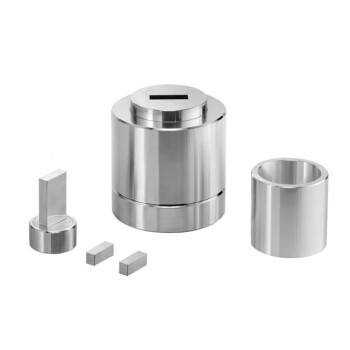
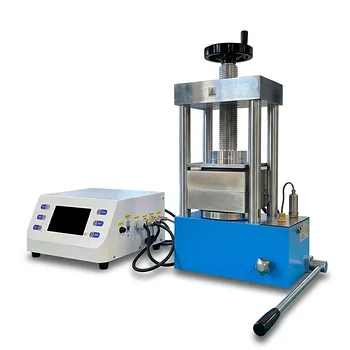
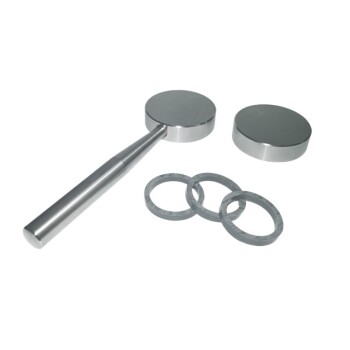
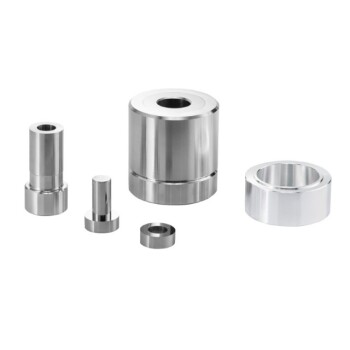
The primary function of a laboratory hydraulic press is mechanical densification. It applies significant compressive force—often reaching pressures like 490 MPa—to transform loose, ball-milled electrolyte powder into a solid, geometrically uniform pellet. This physical transformation is the critical first step in converting a synthesized powder into a testable sample.
The Core Takeaway The hydraulic press does not merely shape the sample; it fundamentally alters the material's microstructure by eliminating voids and forcing particles into intimate contact. This is essential for lowering grain boundary resistance, ensuring that subsequent tests measure the material’s true ionic conductivity rather than the resistance of air gaps.
The Science of Densification
Eliminating Porosity
Loose powders naturally contain a high volume of internal voids (pores). The hydraulic press applies immense pressure to collapse these voids, drastically increasing the packing density of the material. By reducing the distance between particles, the press creates a "green body" that mimics the bulk properties of a solid material.
Maximizing Particle Contact
Ionic conductivity depends on the ability of ions to hop from one particle to the next. If particles are barely touching, the path for ions is broken. The press forces particles into tight physical contact, maximizing the interfacial surface area available for ion transport.
Leveraging Material Properties
For certain materials, such as sulfide-based electrolytes which have a low elastic modulus, the press is particularly effective. The pressure causes the particles to deform plastically, merging them together to form a dense pellet without the need for additional heating.
Impact on Conductivity Measurement
Reducing Grain Boundary Resistance
The resistance found where two particles meet is known as grain boundary resistance. A loose sample has high grain boundary resistance, which acts as a bottleneck for ion flow. High-pressure compaction minimizes this impedance, preventing it from dominating the measurement results.
Enabling Accurate EIS Testing
Electrochemical Impedance Spectroscopy (EIS) is the standard method for testing conductivity. If a sample is porous, the EIS data will reflect the poor connectivity rather than the material's actual performance. A pressed, dense pellet ensures the EIS data accurately reflects the intrinsic ionic conductivity of the electrolyte.
Understanding the Limitations
Green Body vs. Sintered Density
While a hydraulic press creates a dense "green body," it is not always the final step for all materials. Hard oxide ceramics typically require high-temperature sintering after pressing to achieve full density and grain growth. Relying solely on cold pressing for these materials may still yield lower conductivity compared to sintered samples.
The Risk of Pressure Gradients
Applying pressure must be done with precision to ensure uniformity. If the pressure is not applied evenly, the pellet may have density gradients (some parts denser than others). This can lead to warping, cracking, or inconsistent conductivity readings across the sample surface.
Making the Right Choice for Your Goal
To ensure your conductivity data is valid, consider how the press supports your specific objective:
- If your primary focus is determining intrinsic conductivity: Apply high pressure (e.g., 490 MPa) to minimize porosity as much as possible, isolating the material's performance from geometric defects.
- If your primary focus is preparing hard ceramics (like LLZO): Use the press to form a uniform green body, but understand that this provides the geometric form for subsequent sintering, which completes the densification.
- If your primary focus is testing sulfide or halide electrolytes: Utilize the press as a "cold sintering" tool, as these materials can often achieve sufficient density for testing through pressure alone.
The laboratory hydraulic press acts as the critical bridge between raw synthesis and valid data, transforming loose potential into measurable performance.
Summary Table:
| Feature | Role in Electrolyte Pellet Preparation |
|---|---|
| Primary Function | Mechanical densification of ball-milled powders |
| Microstructure Change | Elimination of voids and reduction of grain boundary resistance |
| Mechanism | Applied pressure (up to 490+ MPa) for plastic deformation |
| Key Benefit | Ensures EIS data reflects intrinsic conductivity, not air gaps |
| Material Specifics | Cold-sintering for sulfides; green body formation for oxides |
Elevate Your Battery Research with KINTEK Precision
Precision in pellet preparation is the foundation of reliable solid-state battery data. KINTEK specializes in high-performance laboratory hydraulic presses (pellet, hot, and isostatic) designed to provide the uniform pressure necessary for eliminating grain boundary resistance in electrolyte research.
Beyond sample preparation, our comprehensive portfolio supports your entire workflow with:
- High-temperature furnaces for sintering oxide ceramics.
- Crushing and milling systems for optimal powder synthesis.
- Electrolytic cells, electrodes, and battery research tools for advanced electrochemical testing.
Don't let inconsistent density compromise your conductivity measurements. Contact KINTEK today to discover how our specialized equipment can bring accuracy and repeatability to your laboratory operations.
Related Products
- Automatic Laboratory Hydraulic Press for XRF & KBR Pellet Press
- Automatic Laboratory Hydraulic Pellet Press Machine for Lab Use
- Laboratory Hydraulic Pellet Press for XRF KBR FTIR Lab Applications
- Laboratory Manual Hydraulic Pellet Press for Lab Use
- kbr pellet press 2t
People Also Ask
- What is the significance of applying 200 MPa of pressure with a laboratory hydraulic pellet press for composite ceramics?
- What is the role of a laboratory hydraulic pellet press and stainless steel molds in the fabrication of RuO2/NbC anodes?
- What is the necessity of using a laboratory hydraulic pellet press in the preparation of biomass fuel pellets? Guide
- How does a laboratory hydraulic pellet press contribute to SiCw/2024 aluminum composite preforms? Optimize Densification
- What role does a laboratory hydraulic pellet press play in fly ash utilization? Enhancing Adsorption and Flow Control