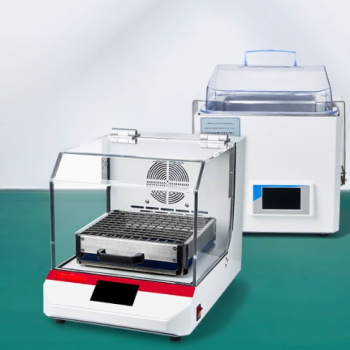
The primary function of a laboratory shaker in this context is to ensure continuous, uniform contact between the solid Fe-C@C nanoparticles and the dissolved Methylene Blue (MB). By providing consistent mechanical oscillation, typically at speeds like 80 rpm, the shaker prevents the nanoparticles from settling and drives the adsorption reaction toward completion.
The shaker acts as a catalyst for consistency, overcoming liquid diffusion barriers to ensure the material reaches thermodynamic equilibrium within 24 hours, thereby allowing for a precise calculation of maximum adsorption capacity.
The Mechanics of Effective Adsorption
Promoting Molecular Interaction
For adsorption to occur, the Methylene Blue molecules must physically reach the surface sites of the Fe-C@C nanoparticles.
A static solution allows particles to clump or settle, drastically reducing the active surface area. Continuous mechanical agitation forces the solid adsorbent to remain suspended, maximizing the probability of collision between the pollutant and the capture sites.
Overcoming Diffusion Resistance
Surrounding every solid particle in a liquid is a thin "film" of water that resists the movement of molecules.
The mechanical force generated by the shaker disrupts this boundary layer. By overcoming this water film diffusion resistance, the shaker facilitates the transfer of MB molecules from the bulk solution onto the surface and into the pores of the Fe-C@C.
Simulating Industrial Conditions
Laboratory data is most valuable when it predicts real-world performance.
Wastewater treatment facilities utilize dynamic flow and mixing rather than static soaking. Using a shaker simulates these hydrodynamic conditions, ensuring that the efficiency data collected is applicable to actual environmental engineering scenarios.
Ensuring Data Accuracy and Equilibrium
Reaching Thermodynamic Equilibrium
Accurate capacity measurements rely on the reaction reaching a point where no further adsorption occurs.
The shaker ensures the process runs uninterrupted for a sufficient duration, often 24 hours. This guarantees that the system reaches a stable state (equilibrium), preventing the underestimation of the material's total capacity.
Controlling the Kinetic Environment
To calculate how fast the Fe-C@C works (kinetics), the external conditions must remain constant.
A laboratory shaker provides a uniform kinetic environment. This eliminates variables caused by inconsistent manual mixing, ensuring that any changes in concentration are due to the material's properties, not experimental error.
Critical Considerations and Variables
The Role of Temperature Control
While mechanical agitation is the primary function, it is often paired with thermal regulation.
Using a constant-temperature shaker is vital for calculating thermodynamic parameters. If the temperature fluctuates during the shaking process, the adsorption capacity will shift, rendering the thermodynamic data unreliable.
Optimizing Agitation Speed
The speed of oscillation (e.g., 80 rpm) is not an arbitrary number.
It must be fast enough to ensure full suspension and overcome diffusion resistance, but consistent enough to allow for reproducible results. Deviating from the set speed mid-experiment will invalidate the kinetic data.
Ensuring Experimental Success
To get the most accurate data from your Fe-C@C evaluation, align your shaker settings with your specific analytical goals:
- If your primary focus is Determining Maximum Capacity: Ensure the shaker runs for the full 24-hour cycle to guarantee thermodynamic equilibrium is reached.
- If your primary focus is Kinetic Analysis: Prioritize a constant, specific rotation speed to standardize the diffusion forces acting on the nanoparticles.
- If your primary focus is Thermodynamic Parameters: Use a shaker with integrated temperature control to isolate the effect of heat on the adsorption process.
Consistent agitation is the baseline requirement for transforming raw observations into reproducible scientific evidence.
Summary Table:
| Function Category | Role in MB Adsorption Evaluation | Impact on Research Data |
|---|---|---|
| Mechanical Agitation | Keeps Fe-C@C nanoparticles in suspension | Maximizes active surface area & collisions |
| Diffusion Control | Breaks down the liquid boundary layer | Accelerates MB transport to adsorbent pores |
| Equilibrium Stability | Maintains continuous motion for 24+ hours | Ensures system reaches thermodynamic equilibrium |
| Kinetic Regulation | Provides constant oscillation speed (e.g., 80 rpm) | Eliminates variables for precise rate calculation |
| Thermal Regulation | Maintains precise temperature control | Enables accurate thermodynamic parameter analysis |
Elevate Your Research with Precision Lab Equipment
At KINTEK, we understand that accurate nanoparticle characterization requires absolute consistency. Our high-performance laboratory shakers and shakers with integrated temperature control provide the uniform kinetic environment necessary to reach thermodynamic equilibrium in your adsorption studies.
Beyond mixing solutions, KINTEK offers a comprehensive range of laboratory equipment including:
- Material Processing: High-temperature furnaces (Muffle, Vacuum, CVD), crushing & milling systems, and hydraulic presses.
- Advanced Synthesis: High-temperature high-pressure reactors, autoclaves, and electrolytic cells.
- Thermal Management: ULT freezers, cold traps, and freeze dryers.
- Sample Prep: Homogenizers, shakers, and essential ceramics or crucibles.
Ensure your data integrity with KINTEK’s industry-leading technology. Contact our technical specialists today to find the perfect equipment solution for your laboratory.
References
- Lixin Zhao, Chunyong Liang. Synthesis and Characterization of Flower-like Carbon-encapsulated Fe-C Nanoparticles for Application as Adsorbing Material. DOI: 10.3390/ma12050829
This article is also based on technical information from Kintek Solution Knowledge Base .
Related Products
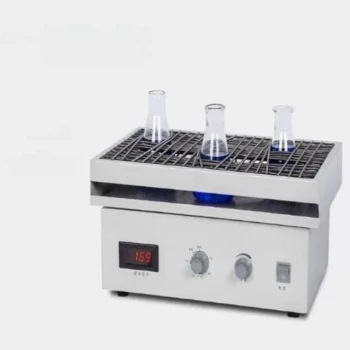
- Laboratory Multifunctional Small Speed-Adjustable Horizontal Mechanical Shaker for Lab
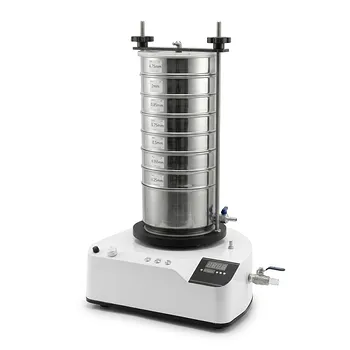
- Laboratory Vibratory Sieve Shaker Machine for Dry and Wet Three-Dimensional Sieving
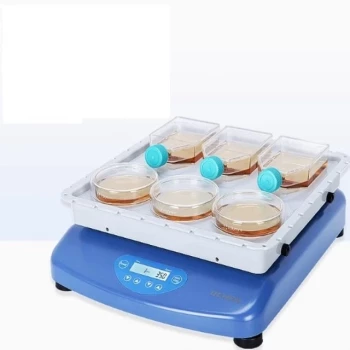
- Laboratory Oscillating Orbital Shaker
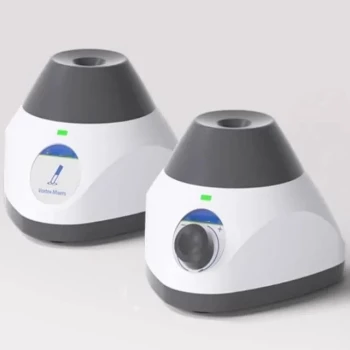
- Laboratory Vortex Mixer Orbital Shaker Multifunctional Rotation Oscillation Mixer
- Shaking Incubators for Diverse Laboratory Applications
People Also Ask
- How do static culture and shaking culture affect the morphology of BC? Optimize Lab Shaker Results
- What is the role of a laboratory shaker in silane sol preparation? Master Uniform Aramid Fabric Coating
- Why is a laboratory shaker required for continuous 24-hour catalyst treatment? Achieve Deep Uniform Impregnation
- How do laboratory shakers or stirrers influence the efficiency of hydrogen production during dark fermentation?
- What is the function of a laboratory shaker during the wet chemical synthesis of Pd/Fe3O4 nanocatalysts?