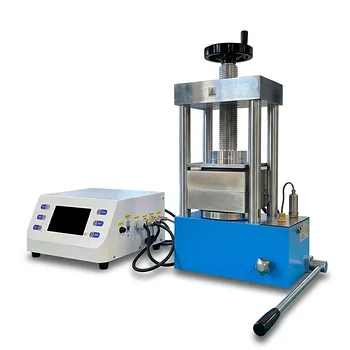
A laboratory uniaxial hydraulic press acts as the critical mechanical compaction tool in the synthesis of Wollastonite/Colemanite green pellets. It functions by applying a precise pressure of 2 MPa to compress ground mixed powders into uniform, cohesive units, typically measuring 10 mm in diameter and 1-2 mm in thickness.
The primary purpose of this mechanical compression is to eliminate void space and force particles into intimate contact. This physical proximity is the absolute prerequisite for atomic diffusion and phase transformation to occur efficiently during the subsequent high-temperature sintering process.
The Mechanics of Compaction
Precise Pressure Application
The press applies a specific load of 2 MPa vertically along a single axis (uniaxial). Unlike isostatic pressing, which applies pressure from all sides, uniaxial pressing focuses force in one direction to consolidate the loose powder into a specific shape. This specific pressure level is calibrated to bind the Wollastonite and Colemanite powders without inducing excessive stress or fracture.
Geometric Consistency
The press utilizes a die—typically 10 mm in diameter—to ensure every sample has identical dimensions. By controlling the amount of powder and pressure, the press yields pellets with a consistent thickness of 1-2 mm. This geometric uniformity is vital for ensuring that heat is distributed evenly across the sample during later thermal treatments.
The Role in Sintering Success
Maximizing Particle Contact
Before pressing, the ground powders exist as loose particles separated by air gaps. The hydraulic press mechanically forces these particles together, significantly increasing the packing density. This reduction in porosity is the first step in transforming a loose mixture into a solid ceramic body.
Enabling Atomic Diffusion
The ultimate goal of preparing these pellets is phase transformation during sintering. For this chemical reaction to happen, atoms must migrate across particle boundaries. The hydraulic press provides the physical foundation for this migration by ensuring the reactants are touching tightly. Without this initial compression, the diffusion distance would be too great, and the sintering process would likely fail.
Understanding the Trade-offs
The Risk of Under-Pressing
While the primary reference specifies 2 MPa, falling below this threshold is a common pitfall. Insufficient pressure results in a "green" (unfired) body that is structurally weak and difficult to handle. More importantly, low density leads to high porosity, which acts as a barrier to heat transfer and atomic diffusion, potentially leaving the reaction incomplete.
The Risk of Over-Pressing
Conversely, applying pressure significantly higher than the recommended 2 MPa can introduce defects. Excessive uniaxial pressure can cause density gradients, where the outside of the pellet is denser than the center. This can lead to lamination or capping, where the pellet cracks or separates into layers upon ejection from the die or during heating.
Making the Right Choice for Your Goal
To ensure the successful preparation of Wollastonite/Colemanite pellets, precise control of the hydraulic press is essential.
- If your primary focus is Phase Transformation: strictly adhere to the 2 MPa pressure setting to ensure adequate particle contact for atomic diffusion without sealing off necessary reaction pathways.
- If your primary focus is Sample Reproducibility: standardizing the 1-2 mm thickness is crucial to prevent thermal gradients that could warp thicker samples during sintering.
By maintaining precise pressure control, you ensure the green body has the structural integrity required to evolve into a high-quality sintered ceramic.
Summary Table:
| Parameter | Specification/Requirement | Role in Pellet Preparation |
|---|---|---|
| Applied Pressure | 2 MPa | Eliminates void space and enables atomic diffusion |
| Pellet Diameter | 10 mm | Ensures geometric consistency for uniform heat distribution |
| Pellet Thickness | 1 - 2 mm | Prevents thermal gradients during high-temperature sintering |
| Force Direction | Uniaxial (Single Axis) | Consolidates loose powder into cohesive ceramic green bodies |
| Key Outcome | High Packing Density | Prerequisite for phase transformation and sintering success |
Elevate Your Material Synthesis with KINTEK Precision
Achieving the perfect 2 MPa compaction for Wollastonite and Colemanite research requires equipment that offers both precision and reliability. KINTEK specializes in advanced laboratory solutions designed to meet the rigorous demands of material science.
Our extensive portfolio includes:
- Precision Hydraulic Presses: Manual, electric, and automated pellet presses for uniform green body preparation.
- High-Temperature Sintering: Muffle, tube, and vacuum furnaces to drive efficient phase transformation.
- Sample Preparation Tools: High-performance crushing, milling systems, and high-quality dies.
- Advanced Research Systems: High-pressure reactors, autoclaves, and specialized battery research tools.
Whether you are focusing on atomic diffusion or sample reproducibility, KINTEK provides the high-quality consumables and equipment—from PTFE products to ceramic crucibles—needed to ensure your sintering success.
Ready to optimize your pellet preparation workflow? Contact KINTEK today to discuss your laboratory needs!
References
- Ethem İlhan Şahin, Mehriban Emek. Wollastanit/PANI/Kolemanit Kompozitlerin Elektromanyetik Kalkanlama Etkinliği. DOI: 10.31590/ejosat.816145
This article is also based on technical information from Kintek Solution Knowledge Base .
Related Products
- Heated Hydraulic Press Machine with Integrated Manual Heated Plates for Lab Use
- Automatic Laboratory Hydraulic Press for XRF & KBR Pellet Press
- Laboratory Hydraulic Pellet Press for XRF KBR FTIR Lab Applications
- Laboratory Hydraulic Press Split Electric Lab Pellet Press
- 24T 30T 60T Heated Hydraulic Press Machine with Heated Plates for Laboratory Hot Press
People Also Ask
- Why is a heated laboratory hydraulic press necessary for composite laminates? Achieve Void-Free Structural Integrity
- What role does a heated hydraulic press play in Cold Sintering (CSP)? Enhancing LATP-Halide Densification
- What technical conditions does a heated hydraulic press provide for PEO batteries? Optimize Solid-State Interfaces
- Why is the heating function of a laboratory hydraulic press essential for MEA assembly in DEFC? Optimize Cell Bonding
- What are heated hydraulic presses used for? Molding Composites, Vulcanizing Rubber, and More