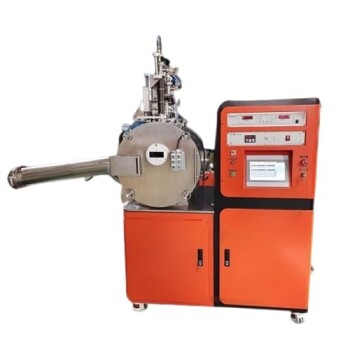
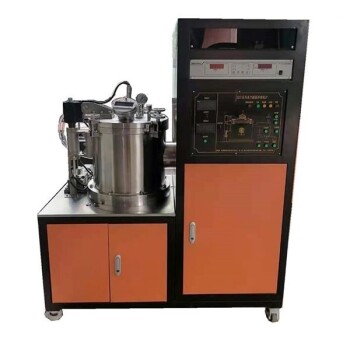
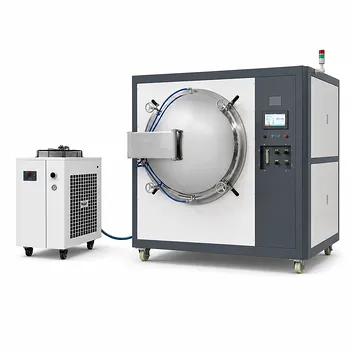
The primary function of a vacuum arc melting furnace in this context is to synthesize a macroscopically homogeneous master ingot from high-purity raw materials. By utilizing extremely high instantaneous temperatures within a vacuum or inert gas environment, the furnace repeatedly melts elements such as zirconium, copper, and aluminum to ensure they are perfectly fused. This process eliminates compositional segregation, creating the uniform chemical foundation necessary for the subsequent production of high-quality amorphous alloy ribbons.
The vacuum arc melting furnace serves as the critical homogenization tool in the initial compounding stage. It does not produce the ribbon itself; rather, it ensures the raw alloy possesses the absolute chemical uniformity required to achieve a disordered, amorphous structure during later processing.
The Critical Role of Homogeneity
Achieving Macroscopic Uniformity
In the early stages of preparation, raw materials must be combined into a single, uniform alloy. The vacuum arc melting furnace provides the intense energy required to fuse distinct metals.
This process ensures that the alloy components achieve a high degree of homogeneity on a macroscopic scale. Without this step, the material would suffer from compositional segregation, leading to inconsistent properties in the final product.
The Mechanism of High Instantaneous Temperature
To effectively mix high-purity metals like zirconium, copper, and aluminum, the furnace generates extremely high instantaneous temperatures.
This intense heat ensures that all constituent elements, regardless of their individual melting points, are brought to a liquid state and thoroughly mixed. Repeated melting cycles are often employed to guarantee this mixture is uniform throughout the entire ingot.
Protection from Environmental Contamination
The process operates within a vacuum or an inert gas protective environment.
This isolation is vital for maintaining the high purity of the raw materials during the melting phase. It prevents oxidation and other atmospheric reactions that could compromise the integrity of the alloy before it ever reaches the ribbon-forming stage.
Understanding the Process Trade-offs
The Distinction Between Mixing and Forming
It is critical to understand that the vacuum arc melting furnace is used for the preliminary preparation of the alloy ingot, not the final ribbon.
While this furnace ensures chemical uniformity, it does not provide the rapid cooling rates required to create the amorphous (glassy) structure. It creates the "master" material, which must be processed further.
The Necessity of Subsequent Steps
A perfectly homogenized ingot from a vacuum arc furnace is only the starting point. To actually create the amorphous ribbon, the material must often be remelted (e.g., in a vacuum induction furnace) and then subjected to melt-spinning.
Only the subsequent melt-spinning process delivers the ultra-high cooling rates (over $10^5$ K/s) necessary to freeze the atoms in a disordered state. Relying solely on the arc furnace would result in a crystalline, rather than amorphous, solid.
Making the Right Choice for Your Goal
To ensure the success of your amorphous alloy project, you must view the vacuum arc furnace as the foundation setter.
- If your primary focus is chemical consistency: Prioritize the vacuum arc melting process to eliminate segregation and ensure the master ingot is macroscopically homogeneous.
- If your primary focus is structural formation: Understand that the arc furnace only prepares the chemistry; you must rely on subsequent melt-spinning to achieve the actual amorphous atomic arrangement.
The quality of the final metallic glass ribbon is directly dependent on the purity and uniformity achieved during this initial vacuum arc melting stage.
Summary Table:
| Feature | Role in Amorphous Alloy Preparation |
|---|---|
| Primary Function | Synthesizing macroscopically homogeneous master ingots |
| Temperature Type | Extremely high instantaneous temperatures for rapid fusion |
| Environment | Vacuum or inert gas to prevent oxidation and contamination |
| Key Outcome | Elimination of compositional segregation in raw metals |
| Target Elements | High-purity Zirconium, Copper, Aluminum, and more |
| Next Process Step | Melt-spinning for rapid solidification into amorphous ribbons |
Elevate Your Materials Research with KINTEK Precision
Achieving the absolute chemical uniformity required for high-performance metallic glasses starts with the right equipment. KINTEK specializes in advanced laboratory solutions designed for the most demanding material synthesis. From our high-performance vacuum induction and arc melting furnaces to our precision crushing and milling systems, we provide the tools necessary to eliminate compositional segregation and ensure purity.
Whether you are developing amorphous alloys, advanced ceramics, or battery technologies, KINTEK offers a comprehensive range of:
- High-Temperature Furnaces: Muffle, tube, vacuum, and atmosphere-controlled systems.
- Processing Equipment: Hydraulic pellet presses, high-pressure reactors, and autoclaves.
- Lab Essentials: Specialized electrolytic cells, cooling solutions, and high-purity crucibles.
Ready to optimize your preliminary alloy preparation? Contact our technical experts today to discover how KINTEK’s specialized laboratory equipment can enhance your research outcomes and streamline your production workflow.
References
- Xin Xia, Yunlong Zi. Metallic glass-based triboelectric nanogenerators. DOI: 10.1038/s41467-023-36675-x
This article is also based on technical information from Kintek Solution Knowledge Base .
Related Products
- Non Consumable Vacuum Arc Induction Melting Furnace
- Vacuum Induction Melting Spinning System Arc Melting Furnace
- Vacuum Arc Induction Melting Furnace
- Lab-Scale Vacuum Induction Melting Furnace
- Vacuum Heat Treat Furnace and Levitation Induction Melting Furnace
People Also Ask
- What are the advantages of induction melting furnace? Achieve Purity, Efficiency, and Safety
- What is the use of induction melting furnace? Achieve Fast, Clean, and Precise Metal Melting
- What is the temperature range of the induction melting furnace? Find the Right Heat for Your Metals
- How do specialized industrial-grade small melting furnaces address challenges in precision jewelry casting? Expert Guide
- How do vacuum induction or arc melting furnaces facilitate the synthesis of U-Al-C MAX phases? Precision Heat & Purity