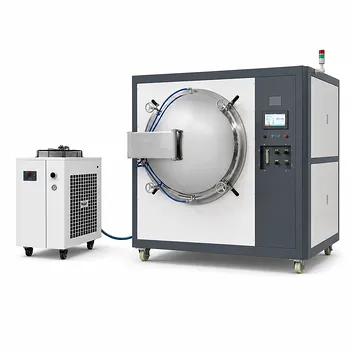
An industrial vacuum hot press furnace functions as a high-precision densification system designed to sinter ultra-high temperature ceramic composites by simultaneously applying thermal energy and mechanical force.
Specifically, it uses graphite rams to apply axial pressure to a powder and fiber mixture within a mold. This mechanical pressure dramatically increases the squeezing force at particle contact points, accelerates material flow, and promotes rapid densification, allowing for the creation of high-density composites at significantly lower temperatures than pressureless sintering methods require.
Core Takeaway While standard sintering relies on heat to bond particles over time, a vacuum hot press furnace forces densification through mechanical pressure in a protected environment. This overcomes the natural resistance of refractory materials to consolidate, ensuring maximum structural integrity and minimizing porosity.
The Mechanics of Densification
Increasing Contact Force
The primary function of the furnace is the application of axial pressure via graphite rams. This mechanical force acts directly on the powder and fiber mixture, physically squeezing particles together.
Accelerating Material Flow
By increasing the contact point squeezing force, the furnace forces the material to flow plastically. This fills the voids between particles and fibers much more efficiently than thermal diffusion alone.
Lowering Processing Temperatures
Because mechanical pressure aids the bonding process, the material does not need to reach the extreme temperatures required by pressureless sintering. This preserves the material properties that might degrade under excessive heat.
The Role of the Vacuum Environment
Preventing Oxidation
Ultra-high temperature ceramics are often sensitive to oxygen during the heating phase. The high-vacuum environment (often reaching low pressures like $10^{-3}$ Pa) removes oxygen from the chamber, preventing oxidative degradation of the composite matrix and fibers.
Removing Volatile Impurities
The vacuum actively extracts volatile gases and impurities from the spaces between powder particles. This results in cleaner particle surfaces, which facilitates stronger diffusion bonding and cleaner interfaces between the matrix and reinforcement.
Microstructural Control
Optimizing Phase Composition
Advanced furnaces integrate programmable temperature controls and hydraulic loading systems. This allows for precise regulation of heating and cooling rates, which is decisive in controlling phase transformations and ensuring the correct microstructural evolution.
Eliminating Residual Stress
Controlled cooling functions allow the material to release residual thermal stresses generated during the pressing cycle. This is essential for preventing cracking in brittle ceramic composites upon returning to room temperature.
Understanding the Trade-offs
Geometry Limitations
Because the pressure is applied axially (typically from top and bottom via rams), this method is generally limited to simple shapes like plates, disks, or blocks. Complex, net-shape components with undercuts are difficult or impossible to manufacture directly in a uniaxial hot press.
Throughput vs. Quality
Vacuum hot pressing is a batch process that is often slower and more expensive than continuous sintering methods. It is chosen when material performance and density are more critical than high-volume production speed.
Making the Right Choice for Your Project
The decision to utilize a vacuum hot press furnace depends on your specific performance requirements and component geometry.
- If your primary focus is Maximum Density: The vacuum hot press is the superior choice, as the mechanical pressure eliminates pores that pressureless sintering cannot close.
- If your primary focus is Material Purity: The vacuum environment is essential for preventing oxidation and removing volatiles in reactive or non-oxide ceramic composites.
- If your primary focus is Complex Geometry: You may need to consider alternative methods like Hot Isostatic Pressing (HIP) or pressureless sintering, as axial pressing limits shape complexity.
In summary, the vacuum hot press furnace is the critical enabler for converting loose ceramic powders into dense, high-performance structural composites without the defects associated with oxidation or incomplete bonding.
Summary Table:
| Feature | Vacuum Hot Press Function | Benefit to Ceramic Composites |
|---|---|---|
| Pressure Application | Axial mechanical force via graphite rams | Accelerates densification and fills voids at lower temperatures |
| Vacuum Environment | High-vacuum (up to 10⁻³ Pa) | Prevents oxidation and removes volatile impurities for cleaner bonds |
| Thermal Control | Precise programmable heating/cooling | Optimizes phase composition and eliminates residual thermal stress |
| Material Flow | Forced plastic flow at contact points | Achieves near-theoretical density compared to pressureless sintering |
Elevate Your Advanced Material Research with KINTEK
For researchers and manufacturers working with ultra-high temperature ceramics, precision and purity are non-negotiable. KINTEK specializes in high-performance laboratory equipment, including advanced vacuum hot press furnaces, muffle and tube furnaces, and isostatic presses designed to meet the rigorous demands of material science.
Our industrial furnace solutions provide the exact mechanical force and thermal stability required to produce high-density composites with minimal porosity. Beyond sintering, we offer a comprehensive range of crushing and milling systems, PTFE and ceramic consumables, and hydraulic pellet presses to support your entire workflow.
Ready to optimize your densification process? Contact KINTEK today to discuss how our specialized furnace technology can enhance your project's structural integrity and performance.
References
- Xinghong Zhang, PingAn Hu. Research Progress on Ultra-high Temperature Ceramic Composites. DOI: 10.15541/jim20230609
This article is also based on technical information from Kintek Solution Knowledge Base .
Related Products
- Vacuum Hot Press Furnace Heated Vacuum Press Machine Tube Furnace
- 600T Vacuum Induction Hot Press Furnace for Heat Treat and Sintering
- Vacuum Hot Press Furnace Machine Heated Vacuum Press
- Vacuum Hot Press Furnace Machine for Lamination and Heating
- Vacuum Heat Treat and Pressure Sintering Furnace for High Temperature Applications
People Also Ask
- What advantages does a vacuum hot press furnace provide for LSLBO ceramic electrolytes? Achieve 94% Relative Density
- What role does a Vacuum Hot Press (VHP) furnace play in the densification of austenitic stainless steel 316 composites?
- What are the advantages of using a vacuum hot pressing furnace? Superior Densification for 2024Al/Gr/SiC Composites
- What are the advantages of a vacuum hot press furnace for LTPO solid electrolytes? Boost Density and Conductivity
- What core processing conditions does a vacuum hot press furnace provide? Achieve High-Density Cu-SiC/Diamond Composites