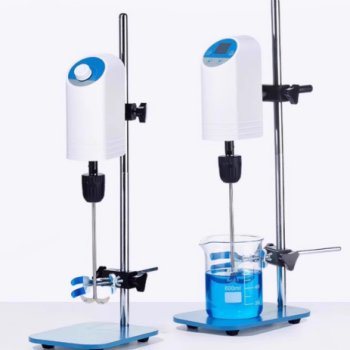
The function of combining these two methods is to create a synergistic dispersion system. This setup merges high-frequency vibrational cavitation with macroscopic mechanical shear forces to simultaneously shatter nano-scale agglomerates and maintain bulk suspension. This dual action ensures that graphene sheets and alumina powder are uniformly distributed throughout the ethanol/PEG matrix without clumping or settling.
The combination addresses two distinct physical challenges: ultrasonication provides the localized intensity to break particle clusters, while mechanical stirring provides the bulk flow necessary to prevent re-agglomeration and sedimentation.
The Mechanics of Dual-Mode Dispersion
To understand why this combination is necessary for graphene/alumina slurries, we must look at the specific role each component plays in the mixture.
Ultrasonic Cavitation: The "Breaker"
The ultrasonic disperser serves as the primary force for de-agglomeration.
It generates high-frequency vibrations that create microscopic bubbles within the solvent (ethanol/PEG solution). When these bubbles collapse—a process known as cavitation—they release intense localized energy.
This energy is sufficient to break the strong Van der Waals forces holding nano-scale alumina and graphene sheets together. Without this, these materials would remain as ineffective clusters rather than individual reinforcing agents.
Mechanical Shear: The "Sustainment"
While ultrasonication breaks particles apart, the mechanical stirrer manages the bulk fluid dynamics.
It applies constant mechanical shear forces to the entire volume of the slurry. This ensures that once the particles are separated by the ultrasonic waves, they are immediately moved away from each other.
This continuous motion is critical for preventing the dispersed nanomaterials from settling (precipitating) or drifting back together to re-form clumps.
Why the Combination is Critical
Using either method in isolation often leads to defects in the final ceramic composite.
Preventing Re-Agglomeration
Graphene has a natural tendency to restack, and nano-alumina tends to cluster.
The combined action ensures that as soon as the ultrasonic energy separates these materials, the mechanical stirrer distributes them into the matrix. This "break and disperse" cycle creates a homogeneity that neither tool could achieve alone.
Ensuring Uniform Matrix Distribution
For a ceramic composite to perform well, the reinforcement (graphene) must be everywhere, not just in pockets.
The mechanical stirring ensures the ethanol/PEG solution circulates the reinforcements throughout the entire mixing vessel. This leads to a slurry with uniform composition and viscosity, which is the foundation for a consistent final product.
Understanding the Constraints and Trade-offs
While powerful, this combined method requires careful management to avoid processing errors.
Solvent Volatility
Ultrasonic dispersion generates significant heat as a byproduct of cavitation.
Because the process uses ethanol—a volatile solvent—uncontrolled heat can lead to rapid evaporation. This changes the concentration of the slurry and the viscosity of the PEG solution, potentially altering the final ceramic properties.
Material Degradation
There is a balance between dispersion and destruction.
Excessive ultrasonic time or intensity can physically fracture the graphene sheets themselves, rather than just separating them. This reduces the aspect ratio of the graphene, diminishing its reinforcing capability in the final ceramic.
Making the Right Choice for Your Process
When designing your preparation protocol, tailor the balance of forces to your specific quality requirements.
- If your primary focus is preventing sedimentation: Prioritize continuous mechanical stirring throughout the entire process, even after the ultrasonic cycle is complete, to keep high-density particles suspended.
- If your primary focus is maximum particle separation: Increase the ultrasonic intensity but use pulsed cycles to manage heat build-up and prevent solvent evaporation.
Success lies in using the mechanical stirrer to maintain the suspension that the ultrasonic disperser creates.
Summary Table:
| Dispersion Method | Primary Mechanism | Key Function in Slurry Preparation |
|---|---|---|
| Ultrasonic Disperser | Acoustic Cavitation | Breaks nano-scale agglomerates and Van der Waals forces. |
| Mechanical Stirrer | Macro-scale Shear | Prevents sedimentation and maintains bulk suspension. |
| Combined System | Synergistic Dispersion | Ensures uniform distribution and prevents re-agglomeration. |
Elevate Your Material Research with KINTEK Precision
Achieving the perfect dispersion is critical for high-performance ceramic composites. KINTEK specializes in advanced laboratory equipment designed to meet the rigorous demands of nanomaterial processing. From high-intensity ultrasonic dispersers and mechanical stirring systems to our specialized high-temperature furnaces (vacuum, CVD, atmosphere) and crushing and milling systems, we provide the tools you need for consistent, scalable results.
Whether you are working on battery research, dental ceramics, or advanced aerospace composites, our portfolio of ball mills, hydraulic presses, and high-purity consumables ensures your lab operates at peak efficiency.
Ready to optimize your slurry preparation? Contact KINTEK today to consult with our experts and find the ideal equipment solution for your laboratory.
Related Products
- Advanced Engineering Fine Ceramics Alumina Ceramic Saggar for Fine Corundum
- High Quality Alumina Ceramic Screw for Engineering Advanced Fine Ceramics with High Temperature Resistance and Insulation
- Engineering Advanced Fine Ceramics Alumina Al2O3 Crucible With Lid Cylindrical Laboratory Crucible
- Alumina Al2O3 Ceramic Crucible Semicircle Boat with Lid for Engineering Advanced Fine Ceramics
- Engineering Advanced Fine Ceramics Alumina Crucibles (Al2O3) for Thermal Analysis TGA DTA
People Also Ask
- How is alumina ceramic made? A Guide to Manufacturing Methods and Material Properties
- Can ceramic withstand high temperatures? Discover the Superior Materials for Extreme Heat
- What are the useful applications of ceramics? Unlock High-Performance Solutions for Your Industry
- What industry uses ceramics? Discover the Critical Role of Advanced Ceramics in Modern Technology
- What is the specific heat of alumina? It's a range from 451 to 955 J/kg·K